




Why is the value of ‘g’ minimum at the equator?
Answer
 Verified
550.2k+ views
Hint: The formula for acceleration due to gravity, that is, ‘g’ is given by: $g=\dfrac{GM}{{{R}^{2}}}$. Here, we can see that the acceleration due to gravity is affected by three different entities. “G” is the universal gravitational constant which is a constant. “M” is the mass of the Earth and “R” is the radius of the Earth. We shall see what are the factors that change at the equator of the Earth, so that the value of ‘g’ gets minimized.
Complete step by step answer:
We know that, while solving problems or when talking in general, we assume the Earth to be a perfect sphere. Well, this assumption leads us to believe that ‘g’ is constant everywhere on Earth.
In reality, Earth is not a perfect sphere, but somewhat elliptical. This distortion on Earth causes the variation in gravitational acceleration at all places on Earth but the mass remains constant as it is independent of the shape. This could be understood as follows:
The Earth is bulged about its diameter, that is it is somewhat like the figure shown below:
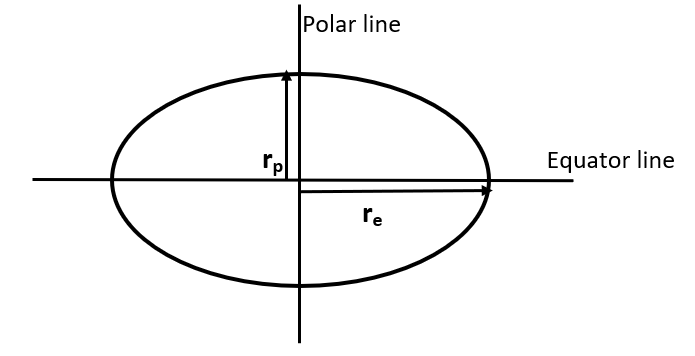
Here, we can see that the largest possible radius of Earth is equal to ‘${{r}_{e}}$’, that is, radius measured along the equator of Earth. This means that our expression for acceleration due to gravity is the least at the equator. Mathematically, this could be written as:
$\Rightarrow {{\left. \left( \dfrac{GM}{{{R}^{2}}} \right) \right|}_{\min }}=\left( \dfrac{GM}{{{r}_{e}}^{2}} \right)$
Hence, the value of ‘g’ minimum at the equator because the radius is maximum at the equator.
Note: Since the Earth is elliptical in shape, we see that its radius is minimum at the poles. Thus, we can say that poles are the places on Earth where maximum gravitational force is experienced whereas, all the places along the line of the equator experience minimum gravitational acceleration.
Complete step by step answer:
We know that, while solving problems or when talking in general, we assume the Earth to be a perfect sphere. Well, this assumption leads us to believe that ‘g’ is constant everywhere on Earth.
In reality, Earth is not a perfect sphere, but somewhat elliptical. This distortion on Earth causes the variation in gravitational acceleration at all places on Earth but the mass remains constant as it is independent of the shape. This could be understood as follows:
The Earth is bulged about its diameter, that is it is somewhat like the figure shown below:
Here, we can see that the largest possible radius of Earth is equal to ‘${{r}_{e}}$’, that is, radius measured along the equator of Earth. This means that our expression for acceleration due to gravity is the least at the equator. Mathematically, this could be written as:
$\Rightarrow {{\left. \left( \dfrac{GM}{{{R}^{2}}} \right) \right|}_{\min }}=\left( \dfrac{GM}{{{r}_{e}}^{2}} \right)$
Hence, the value of ‘g’ minimum at the equator because the radius is maximum at the equator.
Note: Since the Earth is elliptical in shape, we see that its radius is minimum at the poles. Thus, we can say that poles are the places on Earth where maximum gravitational force is experienced whereas, all the places along the line of the equator experience minimum gravitational acceleration.
Recently Updated Pages
Master Class 11 Social Science: Engaging Questions & Answers for Success

Master Class 11 English: Engaging Questions & Answers for Success
Master Class 11 Maths: Engaging Questions & Answers for Success
Master Class 11 Chemistry: Engaging Questions & Answers for Success
Master Class 11 Biology: Engaging Questions & Answers for Success
Master Class 11 Physics: Engaging Questions & Answers for Success
Trending doubts
One Metric ton is equal to kg A 10000 B 1000 C 100 class 11 physics CBSE
Difference Between Prokaryotic Cells and Eukaryotic Cells
Draw a diagram of a plant cell and label at least eight class 11 biology CBSE
Two of the body parts which do not appear in MRI are class 11 biology CBSE
Which gas is abundant in air class 11 chemistry CBSE
10 examples of friction in our daily life