




What is the value of $\cos {{60}^{0}}$?
(A) $1$
(B) $0$
(C) $2$
(D) $\dfrac{1}{2}$
Answer
 Verified
575.1k+ views
Hint: First we have to know about the formulae of general trigonometric angles.
From the basics of trigonometry we know that a right angle triangle contains an adjacent side and an opposite side and hypotenuse.
By using these sides we can write the general trigonometric angle formulae.
From the question given we have to know about the formulae of $\cos \theta $
$\cos \theta =\dfrac{adjacent\text{ side}}{hypotenuse}$
Complete step-by-step solution:
First of all to find the value of $\cos {{60}^{0}}$ we have to draw an equilateral triangle $ABC$
Let the length of each side of the equilateral triangle is “$a$”.
Now, draw a perpendicular line $AD$ to the base of the equilateral triangle $BC$
Figure of an equilateral triangle:
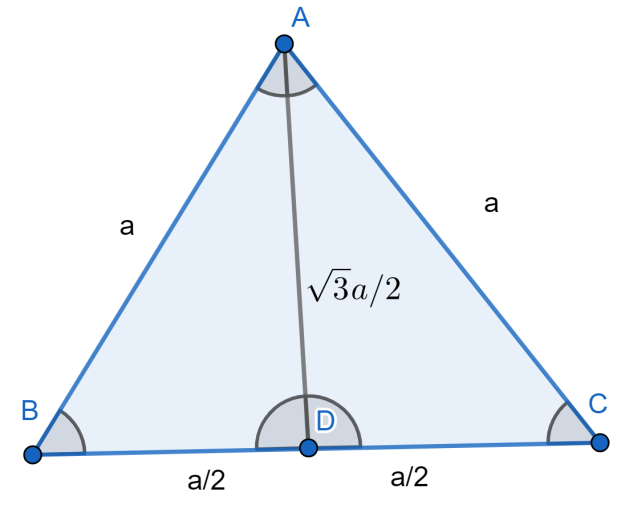
As it is an equilateral triangle and the perpendicular line $AD$ will bisect the base $BC$ at the midpoint. Therefore,
$BD=DC$
As we have been already assumed above that length of each side of the equilateral triangle is “$a$”
$BD+DC=a$
As $BD=DC$
$\begin{align}
& \Rightarrow \text{2BD=a} \\
& \Rightarrow \text{BD=}\dfrac{a}{2} \\
\end{align}$
Therefore,
$BD=DC\text{=}\dfrac{a}{2}$
Now, from the right angle triangle $\text{ADB}$,
$\angle \text{D=9}{{\text{0}}^{0}}$
By Pythagoras theorem,
$\begin{align}
& A{{B}^{2}}=A{{D}^{2}}+B{{D}^{2}} \\
& \Rightarrow {{a}^{2}}=A{{D}^{2}}+{{\left( \dfrac{a}{2} \right)}^{2}} \\
& \Rightarrow A{{D}^{2}}={{a}^{2}}-{{\left( \dfrac{a}{2} \right)}^{2}} \\
& \Rightarrow A{{D}^{2}}=\dfrac{3{{a}^{2}}}{4} \\
& \Rightarrow AD=\dfrac{\sqrt{3}a}{2} \\
\end{align}$
As we know from the basic concept, that the trigonometric formulae are given as
$\cos \theta =\dfrac{\text{adjacent side}}{hypotenuse}$
Here we have been asked to find out the angle of $\cos {{60}^{0}}$.
$\begin{align}
& \cos {{60}^{0}}=\dfrac{\text{adjacent side}}{hypotenuse} \\
& \Rightarrow \cos {{60}^{\circ }}=\dfrac{BD}{AB} \\
& \Rightarrow \cos {{60}^{\circ }}=\dfrac{\dfrac{a}{2}}{a} \\
& \Rightarrow \cos {{60}^{\circ }}=\dfrac{1}{2} \\
\end{align}$
Therefore, the value of $\cos {{60}^{0}}$ is $\dfrac{1}{2}$ .
Hence, option D is the correct option.
Note: While answering questions of this type we should be careful with the formulae and should be sure with the formulae and apply them at the right place. We should be aware of Pythagoras’ theorem which states that “In a right angle triangle, the square of the hypotenuse is equal to the sum of the squares of the other two (opposite and adjacent) sides”.
From the basics of trigonometry we know that a right angle triangle contains an adjacent side and an opposite side and hypotenuse.
By using these sides we can write the general trigonometric angle formulae.
From the question given we have to know about the formulae of $\cos \theta $
$\cos \theta =\dfrac{adjacent\text{ side}}{hypotenuse}$
Complete step-by-step solution:
First of all to find the value of $\cos {{60}^{0}}$ we have to draw an equilateral triangle $ABC$
Let the length of each side of the equilateral triangle is “$a$”.
Now, draw a perpendicular line $AD$ to the base of the equilateral triangle $BC$
Figure of an equilateral triangle:
As it is an equilateral triangle and the perpendicular line $AD$ will bisect the base $BC$ at the midpoint. Therefore,
$BD=DC$
As we have been already assumed above that length of each side of the equilateral triangle is “$a$”
$BD+DC=a$
As $BD=DC$
$\begin{align}
& \Rightarrow \text{2BD=a} \\
& \Rightarrow \text{BD=}\dfrac{a}{2} \\
\end{align}$
Therefore,
$BD=DC\text{=}\dfrac{a}{2}$
Now, from the right angle triangle $\text{ADB}$,
$\angle \text{D=9}{{\text{0}}^{0}}$
By Pythagoras theorem,
$\begin{align}
& A{{B}^{2}}=A{{D}^{2}}+B{{D}^{2}} \\
& \Rightarrow {{a}^{2}}=A{{D}^{2}}+{{\left( \dfrac{a}{2} \right)}^{2}} \\
& \Rightarrow A{{D}^{2}}={{a}^{2}}-{{\left( \dfrac{a}{2} \right)}^{2}} \\
& \Rightarrow A{{D}^{2}}=\dfrac{3{{a}^{2}}}{4} \\
& \Rightarrow AD=\dfrac{\sqrt{3}a}{2} \\
\end{align}$
As we know from the basic concept, that the trigonometric formulae are given as
$\cos \theta =\dfrac{\text{adjacent side}}{hypotenuse}$
Here we have been asked to find out the angle of $\cos {{60}^{0}}$.
$\begin{align}
& \cos {{60}^{0}}=\dfrac{\text{adjacent side}}{hypotenuse} \\
& \Rightarrow \cos {{60}^{\circ }}=\dfrac{BD}{AB} \\
& \Rightarrow \cos {{60}^{\circ }}=\dfrac{\dfrac{a}{2}}{a} \\
& \Rightarrow \cos {{60}^{\circ }}=\dfrac{1}{2} \\
\end{align}$
Therefore, the value of $\cos {{60}^{0}}$ is $\dfrac{1}{2}$ .
Hence, option D is the correct option.
Note: While answering questions of this type we should be careful with the formulae and should be sure with the formulae and apply them at the right place. We should be aware of Pythagoras’ theorem which states that “In a right angle triangle, the square of the hypotenuse is equal to the sum of the squares of the other two (opposite and adjacent) sides”.
Recently Updated Pages
Basicity of sulphurous acid and sulphuric acid are

Master Class 10 English: Engaging Questions & Answers for Success
Master Class 10 Social Science: Engaging Questions & Answers for Success
Master Class 10 Computer Science: Engaging Questions & Answers for Success
Class 10 Question and Answer - Your Ultimate Solutions Guide
Master Class 10 General Knowledge: Engaging Questions & Answers for Success
Trending doubts
Which country won the ICC Men's ODI World Cup in 2023?
In cricket, how many legal balls are there in a standard over?
Explain the Treaty of Vienna of 1815 class 10 social science CBSE
A boat goes 24 km upstream and 28 km downstream in class 10 maths CBSE
What does "powerplay" mean in limited-overs cricket?
What is the "Powerplay" in T20 cricket?