




Using integration, find the area of the triangle whose vertices are A(1, 3), B(2, 5) and C(3, 4).
Answer
 Verified
638.7k+ views
Hint: Geometrically, definite integration can be used to find the area under the given curve up to the x-axis. We will first find the equation of the sides AB, BC and AC of the triangle. The imaginary line through B, which divides the figure in two parts will be used as reference. The sum of the area under AB and BC will give the total area between the lines and the x-axis. We have to subtract the area below the triangular region to find the net area inside the triangle. This can be done by subtracting the area under line AC. The enclosing area is found using the formula-
$\mathop \smallint \nolimits_{{\text{x}} = {\text{a}}}^{{\text{x}} = {\text{b}}} {\text{f}}\left( {\text{x}} \right)d{\text{x}} = area$
Complete step-by-step answer:
Using the two point form, the equation of the straight line is-
${\text{y}} - {{\text{y}}_1} = \dfrac{{{{\text{y}}_2} - {{\text{y}}_1}}}{{{{\text{x}}_2} - {{\text{x}}_1}}}\left( {{\text{x}} - {{\text{x}}_1}} \right)$
For line AB,
${\text{y}} - 3 = \dfrac{{5 - 3}}{{2 - 1}}\left( {{\text{x}} - 1} \right)$
${\text{y}} - 3 = 2{\text{x}} - 2$
${\text{y}} = 2{\text{x}} + 1...\left( 1 \right)$
For line BC,
${\text{y}} - 5 = \dfrac{{4 - 5}}{{3 - 2}}\left( {{\text{x}} - 2} \right)$
${\text{y}} - 5 = - {\text{x}} + 2$
${\text{y}} = - {\text{x}} + 7...\left( 2 \right)$
For line CA,
$y - 4 = \dfrac{{3 - 4}}{{1 - 3}}\left( {x - 3} \right)$
$y - 4 = \dfrac{1}{2}x - \dfrac{3}{2}$
$y = \dfrac{1}{2}x + \dfrac{5}{2}...\left( 3 \right)$
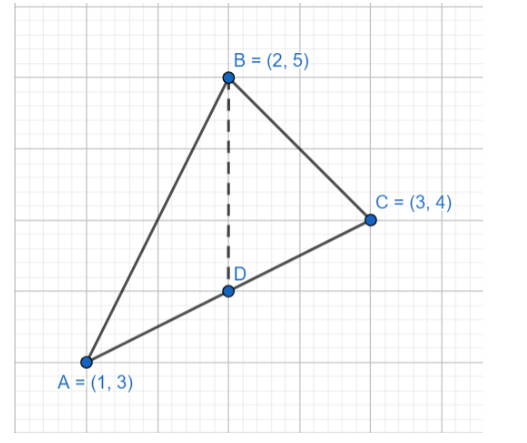
We will divide the triangle into two parts using the line x = 2, as shown in the figure. The first part inside the triangle can be calculated by finding the area under the line AB, and then subtracting the region below the triangle, which is the area under the line AD. Similarly, the second part is an area with a difference of area under lines BC and DC.
So, for the first portion-
Area I = area under AB - area under AD
$ = \mathop \smallint \nolimits_1^2 \left( {2{\text{x}} + 1} \right)d{\text{x}} - \mathop \smallint \nolimits_1^2 \left( {\dfrac{1}{2}{\text{x}} + \dfrac{5}{2}} \right)d{\text{x}}$
$ = \left( {{{\text{x}}^2} + {\text{x}}} \right)_1^2\; - \;\left( {\dfrac{{{{\text{x}}^2}}}{4} + \dfrac{5}{2}{\text{x}}} \right)_1^2$
$ = \left[ {4 + 2 - \left( {1 + 1} \right)} \right] - \left[ {\dfrac{4}{4} + \dfrac{{10}}{2} - \left( {\dfrac{1}{4} + \dfrac{5}{2}} \right)} \right]$
$ = 4 - \left[ {1 + 5 - \dfrac{{11}}{4}} \right]$
$ = - 2 + \dfrac{{11}}{4} = \dfrac{3}{4}$
For the second portion-
Area II = area under BC - area under DC
$ = \mathop \smallint \nolimits_2^3 \left( { - x + 7} \right)d{\text{x}} - \mathop \smallint \nolimits_2^3 \left( {\dfrac{1}{2}{\text{x}} + \dfrac{5}{2}} \right)d{\text{x}}$
$ = \left( { - \dfrac{{{{\text{x}}^2}}}{2} + 7{\text{x}}} \right)_2^3 - \left( {\dfrac{{{{\text{x}}^2}}}{4} + \dfrac{5}{2}{\text{x}}} \right)_2^3$
$ = \left[ { - \dfrac{9}{2} + 21 - \left( { - \dfrac{4}{2} + 14} \right)} \right] - \left[ {\dfrac{9}{4} + \dfrac{{15}}{2} - \left( {\dfrac{4}{4} + \dfrac{{10}}{2}} \right)} \right]$
$ = \left[ { - \dfrac{9}{2} + 21 + 2 - 14} \right] - \left[ {\dfrac{9}{4} + \dfrac{{15}}{2} - 1 - 5} \right]$
$ = \dfrac{9}{2} - \dfrac{{15}}{4} = \dfrac{3}{4}$
Area of the triangle is given by-
Area I + Area II =
$\dfrac{3}{4} + \dfrac{3}{4} = \dfrac{3}{2}\;sq\;units$
This is the required answer.
Note: In such types of questions, we may need to divide the figure into two or more regions as shown in the figure. Also, a diagram is necessary to solve the problem correctly. Alternatively, we can use y-axis as the reference and then find the area of the triangle. A common mistake is that sometimes the area under the graph comes out to be negative, and the students leave it as it is. To prevent this, they should use the modulus sign, because the area of any region cannot be negative.
$\mathop \smallint \nolimits_{{\text{x}} = {\text{a}}}^{{\text{x}} = {\text{b}}} {\text{f}}\left( {\text{x}} \right)d{\text{x}} = area$
Complete step-by-step answer:
Using the two point form, the equation of the straight line is-
${\text{y}} - {{\text{y}}_1} = \dfrac{{{{\text{y}}_2} - {{\text{y}}_1}}}{{{{\text{x}}_2} - {{\text{x}}_1}}}\left( {{\text{x}} - {{\text{x}}_1}} \right)$
For line AB,
${\text{y}} - 3 = \dfrac{{5 - 3}}{{2 - 1}}\left( {{\text{x}} - 1} \right)$
${\text{y}} - 3 = 2{\text{x}} - 2$
${\text{y}} = 2{\text{x}} + 1...\left( 1 \right)$
For line BC,
${\text{y}} - 5 = \dfrac{{4 - 5}}{{3 - 2}}\left( {{\text{x}} - 2} \right)$
${\text{y}} - 5 = - {\text{x}} + 2$
${\text{y}} = - {\text{x}} + 7...\left( 2 \right)$
For line CA,
$y - 4 = \dfrac{{3 - 4}}{{1 - 3}}\left( {x - 3} \right)$
$y - 4 = \dfrac{1}{2}x - \dfrac{3}{2}$
$y = \dfrac{1}{2}x + \dfrac{5}{2}...\left( 3 \right)$
We will divide the triangle into two parts using the line x = 2, as shown in the figure. The first part inside the triangle can be calculated by finding the area under the line AB, and then subtracting the region below the triangle, which is the area under the line AD. Similarly, the second part is an area with a difference of area under lines BC and DC.
So, for the first portion-
Area I = area under AB - area under AD
$ = \mathop \smallint \nolimits_1^2 \left( {2{\text{x}} + 1} \right)d{\text{x}} - \mathop \smallint \nolimits_1^2 \left( {\dfrac{1}{2}{\text{x}} + \dfrac{5}{2}} \right)d{\text{x}}$
$ = \left( {{{\text{x}}^2} + {\text{x}}} \right)_1^2\; - \;\left( {\dfrac{{{{\text{x}}^2}}}{4} + \dfrac{5}{2}{\text{x}}} \right)_1^2$
$ = \left[ {4 + 2 - \left( {1 + 1} \right)} \right] - \left[ {\dfrac{4}{4} + \dfrac{{10}}{2} - \left( {\dfrac{1}{4} + \dfrac{5}{2}} \right)} \right]$
$ = 4 - \left[ {1 + 5 - \dfrac{{11}}{4}} \right]$
$ = - 2 + \dfrac{{11}}{4} = \dfrac{3}{4}$
For the second portion-
Area II = area under BC - area under DC
$ = \mathop \smallint \nolimits_2^3 \left( { - x + 7} \right)d{\text{x}} - \mathop \smallint \nolimits_2^3 \left( {\dfrac{1}{2}{\text{x}} + \dfrac{5}{2}} \right)d{\text{x}}$
$ = \left( { - \dfrac{{{{\text{x}}^2}}}{2} + 7{\text{x}}} \right)_2^3 - \left( {\dfrac{{{{\text{x}}^2}}}{4} + \dfrac{5}{2}{\text{x}}} \right)_2^3$
$ = \left[ { - \dfrac{9}{2} + 21 - \left( { - \dfrac{4}{2} + 14} \right)} \right] - \left[ {\dfrac{9}{4} + \dfrac{{15}}{2} - \left( {\dfrac{4}{4} + \dfrac{{10}}{2}} \right)} \right]$
$ = \left[ { - \dfrac{9}{2} + 21 + 2 - 14} \right] - \left[ {\dfrac{9}{4} + \dfrac{{15}}{2} - 1 - 5} \right]$
$ = \dfrac{9}{2} - \dfrac{{15}}{4} = \dfrac{3}{4}$
Area of the triangle is given by-
Area I + Area II =
$\dfrac{3}{4} + \dfrac{3}{4} = \dfrac{3}{2}\;sq\;units$
This is the required answer.
Note: In such types of questions, we may need to divide the figure into two or more regions as shown in the figure. Also, a diagram is necessary to solve the problem correctly. Alternatively, we can use y-axis as the reference and then find the area of the triangle. A common mistake is that sometimes the area under the graph comes out to be negative, and the students leave it as it is. To prevent this, they should use the modulus sign, because the area of any region cannot be negative.
Recently Updated Pages
Master Class 12 Economics: Engaging Questions & Answers for Success

Master Class 12 English: Engaging Questions & Answers for Success
Master Class 12 Social Science: Engaging Questions & Answers for Success
Master Class 12 Maths: Engaging Questions & Answers for Success
Master Class 12 Physics: Engaging Questions & Answers for Success
Master Class 9 General Knowledge: Engaging Questions & Answers for Success
Trending doubts
Which are the Top 10 Largest Countries of the World?
Draw a labelled sketch of the human eye class 12 physics CBSE
Differentiate between homogeneous and heterogeneous class 12 chemistry CBSE
Why is the cell called the structural and functional class 12 biology CBSE
Draw ray diagrams each showing i myopic eye and ii class 12 physics CBSE
Which is the correct genotypic ratio of mendel dihybrid class 12 biology CBSE