




Using Huckel’s rule, prove that Naphthalene is aromatic.
Answer
 Verified
648.6k+ views
Hint: According to the Huckel’s rule of aromaticity, if a cyclic conjugated compound is planar and has (4n+2) π electrons, then the compound is said to be an aromatic compound. In an aromatic compound, all the π electrons are delocalized and this phenomenon is known as resonance. An aromatic compound is always more stable than an aliphatic counterpart.
Complete step by step answer:
In order to determine whether a compound is aromatic or not in terms of Huckel’s rule, let us look at the postulates of Huckel’s rule of aromaticity.
According to the Huckel’s rule of aromaticity, the basic criteria for a compound to be aromatic are:
(1) The molecule must be a cyclic molecule (the molecule must have a ring system).
(2) The molecule must possess (4n+2) number of π electrons (where n is zero or any positive integer number).
(3) The molecule must have a fully conjugated system (all the atoms in the ring must be $s{p^2}$ hybridized). All the π electrons must be fully delocalized in the ring system.
(4) The molecule must be planner at all costs (all the atoms in the ring system must be in the same plane).
If a cyclic compound follows the above criteria, then the molecule is said to be an aromatic molecule.
Now, naphthalene is the simplest bicyclic aromatic compound having the molecular formula ${C_{10}}{H_8}$. A naphthalene molecule consists of two benzene rings and they are fused together. The basic structure of a naphthalene molecule is given below:
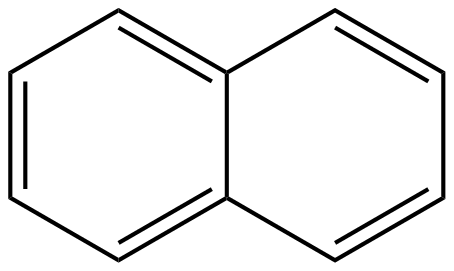
Now, let’s judge where all the postulates of Huckel’s rule apply to naphthalene or not.
-First of all, a naphthalene molecule is a cyclic molecule which means it has a ring system (a naphthalene molecule has two benzene rings fused together). Hence, it is following the first criteria.
-The molecule is having a total of 10 π electrons in the ring system. Hence, it is following the second criteria (4n+2 electrons, where n=2).
-All the π electrons are fully delocalized in the ring system of a naphthalene molecule. It is having a fully conjugated system with all the carbon atoms $s{p^2}$ hybridized. Hence, it is also following the third criteria.
-The naphthalene molecule is fully planner which means all the atoms are in the same plane. Thus, it is following the fourth criteria as well.
Thus, a naphthalene molecule is following all the essential criteria of Huckel’s rule. Hence, according to Huckel's rule of aromaticity, naphthalene is an aromatic compound.
Note: While applying the Huckel’s rule, the student has to remember that the value of n (in 4n+2 electrons) must be a positive integer. In order for a compound to be aromatic, all the criteria must be fulfilled. There are many cyclic compounds which have the required (4n+2) π electrons, but they are not fully conjugated. Many students consider them as aromatic compounds which is wrong.
Complete step by step answer:
In order to determine whether a compound is aromatic or not in terms of Huckel’s rule, let us look at the postulates of Huckel’s rule of aromaticity.
According to the Huckel’s rule of aromaticity, the basic criteria for a compound to be aromatic are:
(1) The molecule must be a cyclic molecule (the molecule must have a ring system).
(2) The molecule must possess (4n+2) number of π electrons (where n is zero or any positive integer number).
(3) The molecule must have a fully conjugated system (all the atoms in the ring must be $s{p^2}$ hybridized). All the π electrons must be fully delocalized in the ring system.
(4) The molecule must be planner at all costs (all the atoms in the ring system must be in the same plane).
If a cyclic compound follows the above criteria, then the molecule is said to be an aromatic molecule.
Now, naphthalene is the simplest bicyclic aromatic compound having the molecular formula ${C_{10}}{H_8}$. A naphthalene molecule consists of two benzene rings and they are fused together. The basic structure of a naphthalene molecule is given below:
Now, let’s judge where all the postulates of Huckel’s rule apply to naphthalene or not.
-First of all, a naphthalene molecule is a cyclic molecule which means it has a ring system (a naphthalene molecule has two benzene rings fused together). Hence, it is following the first criteria.
-The molecule is having a total of 10 π electrons in the ring system. Hence, it is following the second criteria (4n+2 electrons, where n=2).
-All the π electrons are fully delocalized in the ring system of a naphthalene molecule. It is having a fully conjugated system with all the carbon atoms $s{p^2}$ hybridized. Hence, it is also following the third criteria.
-The naphthalene molecule is fully planner which means all the atoms are in the same plane. Thus, it is following the fourth criteria as well.
Thus, a naphthalene molecule is following all the essential criteria of Huckel’s rule. Hence, according to Huckel's rule of aromaticity, naphthalene is an aromatic compound.
Note: While applying the Huckel’s rule, the student has to remember that the value of n (in 4n+2 electrons) must be a positive integer. In order for a compound to be aromatic, all the criteria must be fulfilled. There are many cyclic compounds which have the required (4n+2) π electrons, but they are not fully conjugated. Many students consider them as aromatic compounds which is wrong.
Recently Updated Pages
Which will be the least stable resonating structure class 11 chemistry CBSE

How many 5 digit telephone numbers can be construc-class-11-maths-CBSE
How do you find the angle of the resultant vector class 11 physics CBSE
Draw labelled diagram of the following i Gram seed class 11 biology CBSE
1 Quintal is equal to a 110 kg b 10 kg c 100kg d 1000 class 11 physics CBSE
What is the need and importance of classification class 11 biology CBSE
Trending doubts
One Metric ton is equal to kg A 10000 B 1000 C 100 class 11 physics CBSE
Find the value of the expression given below sin 30circ class 11 maths CBSE
Draw a diagram of nephron and explain its structur class 11 biology CBSE
10 examples of friction in our daily life
Proton was discovered by A Thomson B Rutherford C Chadwick class 11 chemistry CBSE
How many kilometers are there in 100 meters class 11 maths CBSE