




Using Cauchy’s mean value theorem, prove that $\dfrac{\sin \alpha -\sin \beta }{\cos \beta -\cos \alpha }=\cot \theta $ where $0<\alpha <\theta <\beta <\dfrac{\pi }{2}$.
Answer
 Verified
586.2k+ views
Hint: To solve this question, we should know the Cauchy theorem. Let us consider two functions $f\left( x \right)$and $g\left( x \right)$ which are continuous in the interval $\left[ a,b \right]$ and differentiable in the interval $\left( a,b \right)$ and $g\left( b \right)\ne g\left( a \right),g'\left( x \right)\ne 0\forall \left( a,b \right)$. We can write that there exist at least one value of $c$ which satisfies the equation $\dfrac{f\left( b \right)-f\left( a \right)}{g\left( b \right)-g\left( a \right)}=\dfrac{f'\left( c \right)}{g'\left( c \right)}$. In our question, by considering $f\left( x \right)=\sin x,g\left( x \right)=\cos x$ , $\left( a,b \right)=\left( \alpha ,\beta \right)$ and $c=\theta $, we get the answer.
Complete step by step answer:
We are asked to prove the equation $\dfrac{\sin \alpha -\sin \beta }{\cos \beta -\cos \alpha }=\cot \theta $ where $0<\alpha <\theta <\beta <\dfrac{\pi }{2}$. For this question, we should use Cauchy’s mean value theorem.
Let us consider two functions $f\left( x \right)$and $g\left( x \right)$ which are continuous in the interval $\left[ a,b \right]$ and differentiable in the interval $\left( a,b \right)$ and $g\left( b \right)\ne g\left( a \right),g'\left( x \right)\ne 0\forall \left( a,b \right)$. We can write that there exist at least one value of $c$ which satisfies the equation $\dfrac{f\left( b \right)-f\left( a \right)}{g\left( b \right)-g\left( a \right)}=\dfrac{f'\left( c \right)}{g'\left( c \right)}$.
This is the statement of Cauchy’s mean value theorem.
Let us consider $f\left( x \right)=\sin x$ and $g\left( x \right)=\cos x$. We know that $\sin x,\cos x$ are continuous and differentiable everywhere in the real domain. So, the assumed functions are continuous and differentiable in the range $\left( \alpha ,\beta \right)$. So, we can apply the Cauchy’s mean value theorem for the given range.
We can write that $f\left( x \right)=\sin x,g\left( x \right)=\cos x$, $\left( a,b \right)=\left( \alpha ,\beta \right)$ and $c=\theta $. We know that $\alpha \ne \beta \Rightarrow \cos \alpha \ne \cos \beta $ and $\sin \theta \ne 0$ in the given range.
By applying the mean value theorem, we get
$\begin{align}
& \dfrac{\sin \beta -\sin \alpha }{\cos \beta -\cos \alpha }=\dfrac{d{{\left( \sin x \right)}_{\theta }}}{d{{\left( \cos x \right)}_{\theta }}} \\
& \dfrac{\sin \beta -\sin \alpha }{\cos \beta -\cos \alpha }=\dfrac{\cos \theta }{-\sin \theta } \\
& \dfrac{\sin \beta -\sin \alpha }{\cos \beta -\cos \alpha }=-\cot \theta \\
\end{align}$
Multiplying by $-1$ on both sides, we get
\[\begin{align}
& -1\left( \dfrac{\sin \beta -\sin \alpha }{\cos \beta -\cos \alpha } \right)=-1\left( -\cot \theta \right) \\
& \dfrac{\sin \alpha -\sin \beta }{\cos \beta -\cos \alpha }=\cot \theta \\
\end{align}\]
$\therefore $Hence, we proved the required equation.
Note:
While solving questions using any of the mean value theorems, the initial conditions play a major role. Every condition of the theorem should be satisfied in order to apply the theorem or else we will end up getting the wrong results. The graphical representation of the Cauchy’s mean value theorem is
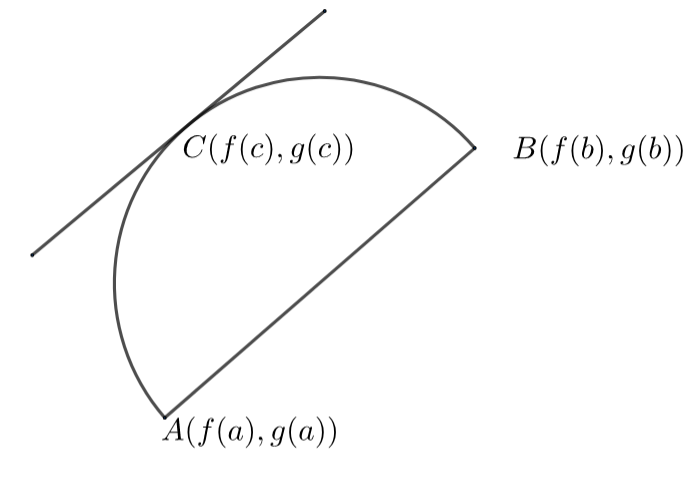
We can see that the slope of the line AB is equal to the slope of the tangent at C to the curve. The equality of slopes is what actually explained in the mean value theorem.
Complete step by step answer:
We are asked to prove the equation $\dfrac{\sin \alpha -\sin \beta }{\cos \beta -\cos \alpha }=\cot \theta $ where $0<\alpha <\theta <\beta <\dfrac{\pi }{2}$. For this question, we should use Cauchy’s mean value theorem.
Let us consider two functions $f\left( x \right)$and $g\left( x \right)$ which are continuous in the interval $\left[ a,b \right]$ and differentiable in the interval $\left( a,b \right)$ and $g\left( b \right)\ne g\left( a \right),g'\left( x \right)\ne 0\forall \left( a,b \right)$. We can write that there exist at least one value of $c$ which satisfies the equation $\dfrac{f\left( b \right)-f\left( a \right)}{g\left( b \right)-g\left( a \right)}=\dfrac{f'\left( c \right)}{g'\left( c \right)}$.
This is the statement of Cauchy’s mean value theorem.
Let us consider $f\left( x \right)=\sin x$ and $g\left( x \right)=\cos x$. We know that $\sin x,\cos x$ are continuous and differentiable everywhere in the real domain. So, the assumed functions are continuous and differentiable in the range $\left( \alpha ,\beta \right)$. So, we can apply the Cauchy’s mean value theorem for the given range.
We can write that $f\left( x \right)=\sin x,g\left( x \right)=\cos x$, $\left( a,b \right)=\left( \alpha ,\beta \right)$ and $c=\theta $. We know that $\alpha \ne \beta \Rightarrow \cos \alpha \ne \cos \beta $ and $\sin \theta \ne 0$ in the given range.
By applying the mean value theorem, we get
$\begin{align}
& \dfrac{\sin \beta -\sin \alpha }{\cos \beta -\cos \alpha }=\dfrac{d{{\left( \sin x \right)}_{\theta }}}{d{{\left( \cos x \right)}_{\theta }}} \\
& \dfrac{\sin \beta -\sin \alpha }{\cos \beta -\cos \alpha }=\dfrac{\cos \theta }{-\sin \theta } \\
& \dfrac{\sin \beta -\sin \alpha }{\cos \beta -\cos \alpha }=-\cot \theta \\
\end{align}$
Multiplying by $-1$ on both sides, we get
\[\begin{align}
& -1\left( \dfrac{\sin \beta -\sin \alpha }{\cos \beta -\cos \alpha } \right)=-1\left( -\cot \theta \right) \\
& \dfrac{\sin \alpha -\sin \beta }{\cos \beta -\cos \alpha }=\cot \theta \\
\end{align}\]
$\therefore $Hence, we proved the required equation.
Note:
While solving questions using any of the mean value theorems, the initial conditions play a major role. Every condition of the theorem should be satisfied in order to apply the theorem or else we will end up getting the wrong results. The graphical representation of the Cauchy’s mean value theorem is
We can see that the slope of the line AB is equal to the slope of the tangent at C to the curve. The equality of slopes is what actually explained in the mean value theorem.
Recently Updated Pages
Master Class 10 Computer Science: Engaging Questions & Answers for Success

Master Class 10 General Knowledge: Engaging Questions & Answers for Success
Master Class 10 English: Engaging Questions & Answers for Success
Master Class 10 Social Science: Engaging Questions & Answers for Success
Master Class 10 Maths: Engaging Questions & Answers for Success
Master Class 10 Science: Engaging Questions & Answers for Success
Trending doubts
What is the median of the first 10 natural numbers class 10 maths CBSE
Which women's tennis player has 24 Grand Slam singles titles?
Who is the Brand Ambassador of Incredible India?
Why is there a time difference of about 5 hours between class 10 social science CBSE
Write a letter to the principal requesting him to grant class 10 english CBSE
A moving boat is observed from the top of a 150 m high class 10 maths CBSE