




Use the graph paper for this question.
(Take 2cm=1 unit along both x and y axis)
Plot the point O(0, 0), A(-4, 4), B(-3, 0) and C(0, -3).
State the line of symmetry of this figure.
A. X-axis
B. Y-axis
C. Origin
D. Both x-axis and y-axis
Answer
 Verified
636.6k+ views
Hint: First, we will draw a graph, plot the x-axis and y-axis such that the scale of 2cm = 1 unit is maintained on both axes. The, we will mark the four points in the respective quadrants. A point has coordinates in the form (x,y). A line of symmetry is something which divides the given figure into equal parts. It is something that divides the area enclosed inside a figure equally. So, using this concept, we can find the right option.
Complete step-by-step answer:
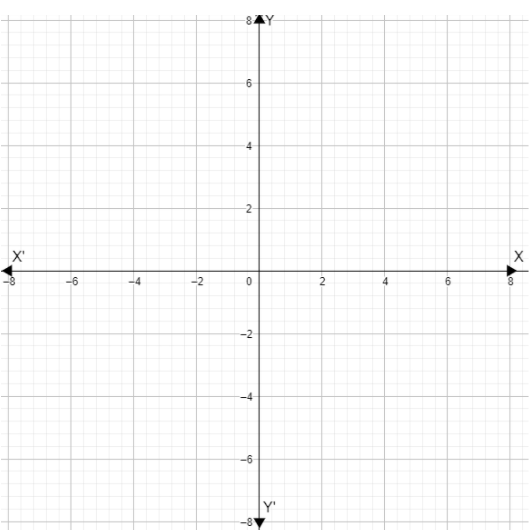
The figure in this question plays an important role in finding the solution. So, we will begin by plotting the graph. Since it is given that we have to take 2cm=1unit on both axes, we will plot and mark the details as shown below,
Now, we have to plot the points O(0, 0), A(-4, 4), B(-3, 0) and C(0, -3). We know that a point is represented using coordinates (x,y).
So, to plot O(0,0), we have to look for points on the graph which is x=0 and y=0. We know that this is the origin, so we will mark it.
Now taking A(-4,4), the x coordinate is -4 and y coordinate is 4. This will lie in the second quadrant.
Next we have B(-3,0). The x coordinate is -3 and y coordinate is 0, this means that this point would lie on the X-axis.
Last, we have C(0,-3). We have the x coordinate as 0 and the y coordinate as -3, so this indicated that the point would lie on the Y-axis.
Now, after plotting these points, the graph would look like below,
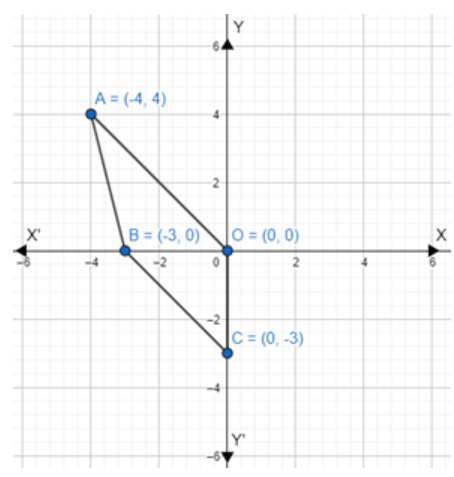
As mentioned in the question, we have to find the line of symmetry for the figure that is formed when the given points are plotted on a graph. Now, consider that the axes are mirrors, then try to think which axes would give the exact same image on the other side.
If we consider the x-axis, it is clear that it doesn’t divide the figure into two equal parts. Now considering the y-axis, we have a possibility of drawing the mirror image of the figure formed. So, let us draw the mirror image to make things clear.
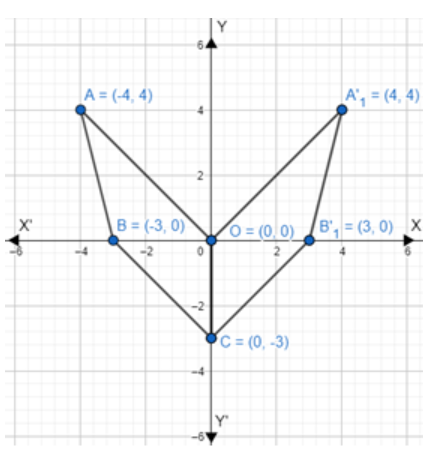
Hence, it is evident from the figure that the line of symmetry in this figure is y-axis.
Note: Whenever the scale is given in the question, we are supposed to use that. Here, the scale is given as 2cm = 1unit. And the most common mistake that the students make is that they may take 2 units as 1 cm, which is wrong. The students can also make an error if they don’t know how to find the line of symmetry for a figure, so for that the students must make sure that all the points are plotted correctly and after getting the image, they must consider all possible ways in which the figure can be symmetric. Some students may first check for symmetry along the x-axis, and if they get it symmetric, they assume it as the answer, but we have to also check for other possibilities, as sometimes the figure may also be symmetric along the y-axis.
Complete step-by-step answer:
The figure in this question plays an important role in finding the solution. So, we will begin by plotting the graph. Since it is given that we have to take 2cm=1unit on both axes, we will plot and mark the details as shown below,
Now, we have to plot the points O(0, 0), A(-4, 4), B(-3, 0) and C(0, -3). We know that a point is represented using coordinates (x,y).
So, to plot O(0,0), we have to look for points on the graph which is x=0 and y=0. We know that this is the origin, so we will mark it.
Now taking A(-4,4), the x coordinate is -4 and y coordinate is 4. This will lie in the second quadrant.
Next we have B(-3,0). The x coordinate is -3 and y coordinate is 0, this means that this point would lie on the X-axis.
Last, we have C(0,-3). We have the x coordinate as 0 and the y coordinate as -3, so this indicated that the point would lie on the Y-axis.
Now, after plotting these points, the graph would look like below,
As mentioned in the question, we have to find the line of symmetry for the figure that is formed when the given points are plotted on a graph. Now, consider that the axes are mirrors, then try to think which axes would give the exact same image on the other side.
If we consider the x-axis, it is clear that it doesn’t divide the figure into two equal parts. Now considering the y-axis, we have a possibility of drawing the mirror image of the figure formed. So, let us draw the mirror image to make things clear.
Hence, it is evident from the figure that the line of symmetry in this figure is y-axis.
Note: Whenever the scale is given in the question, we are supposed to use that. Here, the scale is given as 2cm = 1unit. And the most common mistake that the students make is that they may take 2 units as 1 cm, which is wrong. The students can also make an error if they don’t know how to find the line of symmetry for a figure, so for that the students must make sure that all the points are plotted correctly and after getting the image, they must consider all possible ways in which the figure can be symmetric. Some students may first check for symmetry along the x-axis, and if they get it symmetric, they assume it as the answer, but we have to also check for other possibilities, as sometimes the figure may also be symmetric along the y-axis.

Recently Updated Pages
Master Class 11 English: Engaging Questions & Answers for Success

Master Class 11 Social Science: Engaging Questions & Answers for Success
Master Class 11 Maths: Engaging Questions & Answers for Success
Master Class 11 Biology: Engaging Questions & Answers for Success
Master Class 11 Physics: Engaging Questions & Answers for Success
Master Class 11 Chemistry: Engaging Questions & Answers for Success
Trending doubts
How many millions make a billion class 6 maths CBSE
Give 10 examples for herbs , shrubs , climbers , creepers
Number of Prime between 1 to 100 is class 6 maths CBSE
Check whether the given numbers are divisible by 11 class 6 maths CBSE
What are the main physical divisions of India class 6 social science CBSE
What is the smallest onedigit number that is 0 or class 6 maths CBSE