




Unstriped smooth muscles are found in
(a) Thigh
(b) Eye muscles
(c) Iris
(d) Tongue
Answer
 Verified
564.6k+ views
Hint: Visceral organs in the body are lined by the muscles that have irregularly arranged actin and myosin fibres and myofibrils do not show dark and light bands. Visceral muscles are also known as smooth muscles found in the visceral organs.
Complete answer:
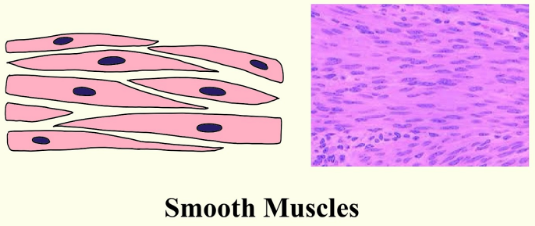
Visceral organs like blood vessels, Intestines, stomach, bronchi, kidneys, testis, and ovaries in the body are lined by unstriated and inventory muscles. They are called smooth muscles which are arranged in layers or sheets and it is a spindle-shaped (fusiform), uninucleated cell.
Iris and ciliary muscles of the eye are lined by the smooth muscle. Smooth muscles are also known as visceral muscles which present in the visceral organs. They are called smooth muscles because they do not contain striations like in striated muscles.
- Muscular tissue is mesodermal in origin that shows characteristics like excitability, conductivity, and contractility. They are divided into three types namely skeletal muscles, smooth muscles, and cardiac muscle.
- Striped voluntary muscles show attachment with the bone hence they are voluntary. They are long, cylindrical, and unbranched cells and also known as striated muscles.
- Unstriped, voluntary muscle that is located in the walls of visceral organs is called smooth muscle or visceral muscle.
- Due to the alternate arrangement of actin and myosin filaments, myofibrils do not show dark and light bands.
- They are called inventory muscles because they are not under conscious control.
- Smooth muscles can remain in a contracted state for prolonged periods without fatigue.
- Autonomic nervous system controls smooth muscle contractions.
so, the correct answer is 'Eye muscles'.
Note:
All the muscles are mesodermal in origin except the iris and ciliary body in the eye that are ectodermal in origin.
Skeletal muscles show fast contractions and undergo fatigue quickly and they are controlled by the somatic nervous system.
The specialized auto-rhythmic structure called the pacemaker produces impulses for contractions of cardiac muscle.
Complete answer:
Visceral organs like blood vessels, Intestines, stomach, bronchi, kidneys, testis, and ovaries in the body are lined by unstriated and inventory muscles. They are called smooth muscles which are arranged in layers or sheets and it is a spindle-shaped (fusiform), uninucleated cell.
Iris and ciliary muscles of the eye are lined by the smooth muscle. Smooth muscles are also known as visceral muscles which present in the visceral organs. They are called smooth muscles because they do not contain striations like in striated muscles.
- Muscular tissue is mesodermal in origin that shows characteristics like excitability, conductivity, and contractility. They are divided into three types namely skeletal muscles, smooth muscles, and cardiac muscle.
- Striped voluntary muscles show attachment with the bone hence they are voluntary. They are long, cylindrical, and unbranched cells and also known as striated muscles.
- Unstriped, voluntary muscle that is located in the walls of visceral organs is called smooth muscle or visceral muscle.
- Due to the alternate arrangement of actin and myosin filaments, myofibrils do not show dark and light bands.
- They are called inventory muscles because they are not under conscious control.
- Smooth muscles can remain in a contracted state for prolonged periods without fatigue.
- Autonomic nervous system controls smooth muscle contractions.
so, the correct answer is 'Eye muscles'.
Note:
All the muscles are mesodermal in origin except the iris and ciliary body in the eye that are ectodermal in origin.
Skeletal muscles show fast contractions and undergo fatigue quickly and they are controlled by the somatic nervous system.
The specialized auto-rhythmic structure called the pacemaker produces impulses for contractions of cardiac muscle.
Recently Updated Pages
Master Class 12 Economics: Engaging Questions & Answers for Success

Master Class 12 English: Engaging Questions & Answers for Success
Master Class 12 Social Science: Engaging Questions & Answers for Success
Master Class 12 Maths: Engaging Questions & Answers for Success
Master Class 12 Physics: Engaging Questions & Answers for Success
Master Class 9 General Knowledge: Engaging Questions & Answers for Success
Trending doubts
One Metric ton is equal to kg A 10000 B 1000 C 100 class 11 physics CBSE
Difference Between Prokaryotic Cells and Eukaryotic Cells
Two of the body parts which do not appear in MRI are class 11 biology CBSE
1 ton equals to A 100 kg B 1000 kg C 10 kg D 10000 class 11 physics CBSE
Draw a diagram of nephron and explain its structur class 11 biology CBSE
10 examples of friction in our daily life