




Typical growth curve in plants is
(a) Sigmoid
(b) Linear
(c) Stair steps shaped
(d) Parabolic
Answer
 Verified
569.4k+ views
Hint: Most of the living organisms follow a similar kind of growth pattern. The preparatory stage, exponential stage, and stationary stage. The graph formed will be ‘S’ shaped. It is used to observe the growth of culture bacteria.
Complete answer:
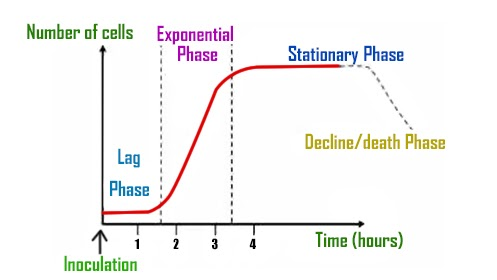
The graph of the growth curve in plants will be sigmoidal in shape. The growth curve is characterized by 4 different phases as mentioned below.
1. Lag phase: The biological systems experience an initial phase that exhibits a slow-growing process. This is called the 'lag phase.' During the lag phase, the cells will prepare themselves for cell division.
2. Log phase: The log phase is characterized by the actual cell division and it increases the number of cells. It is also called an exponential phase. Here the daughter cells begin to divide after the mitotic cell division. The number of live cells will be maximum in the log phase. Thus it can be observed that there will be a steep rise in the graph from the lag phase to the log phase.
3. Exponential phase: The cell growth gradually slows down due to the limited supply of nutrients (nutrients will be used up for the cell growth and hence the cells will become devoid of nutrients), giving rise to the 'stationary period.' During the stationary phase, the number of new cells formed will be equal to the number of cells that die.
4. Death phase: During the death phase, the cells will become senescent (old) and will eventually die. When we plot a graph for growth (number of bacteria) vs time, we get a sigmoidal curve or S-curve. This growth curve is characteristic of all cells, tissues, organs, and is representative of an organism that lives in a natural environment.
The below image represents the growth curve.
So, the correct answer is ‘Sigmoid’.
Note:
Plants react to the environment and phases of life in different ways and give rise to various types of structures. This is called plasticity. Example-The leaves of a young cotton plant vary from a mature cotton plant in shape. In addition, buttercup plant leaves growing in the air have a different shape than those growing in water. This process of generating different forms is called heterophylly.
Complete answer:
The graph of the growth curve in plants will be sigmoidal in shape. The growth curve is characterized by 4 different phases as mentioned below.
1. Lag phase: The biological systems experience an initial phase that exhibits a slow-growing process. This is called the 'lag phase.' During the lag phase, the cells will prepare themselves for cell division.
2. Log phase: The log phase is characterized by the actual cell division and it increases the number of cells. It is also called an exponential phase. Here the daughter cells begin to divide after the mitotic cell division. The number of live cells will be maximum in the log phase. Thus it can be observed that there will be a steep rise in the graph from the lag phase to the log phase.
3. Exponential phase: The cell growth gradually slows down due to the limited supply of nutrients (nutrients will be used up for the cell growth and hence the cells will become devoid of nutrients), giving rise to the 'stationary period.' During the stationary phase, the number of new cells formed will be equal to the number of cells that die.
4. Death phase: During the death phase, the cells will become senescent (old) and will eventually die. When we plot a graph for growth (number of bacteria) vs time, we get a sigmoidal curve or S-curve. This growth curve is characteristic of all cells, tissues, organs, and is representative of an organism that lives in a natural environment.
The below image represents the growth curve.
So, the correct answer is ‘Sigmoid’.
Note:
Plants react to the environment and phases of life in different ways and give rise to various types of structures. This is called plasticity. Example-The leaves of a young cotton plant vary from a mature cotton plant in shape. In addition, buttercup plant leaves growing in the air have a different shape than those growing in water. This process of generating different forms is called heterophylly.
Recently Updated Pages
Master Class 11 Social Science: Engaging Questions & Answers for Success

Master Class 11 English: Engaging Questions & Answers for Success
Master Class 11 Accountancy: Engaging Questions & Answers for Success
Master Class 11 Physics: Engaging Questions & Answers for Success
Master Class 11 Computer Science: Engaging Questions & Answers for Success
Master Class 11 Business Studies: Engaging Questions & Answers for Success
Trending doubts
Find the value of the expression given below sin 30circ class 11 maths CBSE
One Metric ton is equal to kg A 10000 B 1000 C 100 class 11 physics CBSE
Draw a diagram of nephron and explain its structur class 11 biology CBSE
10 examples of friction in our daily life
Proton was discovered by A Thomson B Rutherford C Chadwick class 11 chemistry CBSE
The teeth used for biting and cutting food are called class 11 biology CBSE