




What type of water is least dense?
Answer
 Verified
549.3k+ views
Hint: The density is the amount of mass present in specific volume of a substance. It depends upon the structural arrangement of the substance. The substance in which molecules and atoms are far apart from each other is said to be less dense.
\[\text{Density}=\dfrac{\text{Mass (g)}}{\text{Volume (c}{{\text{m}}^{3}})}\]
Complete answer:
Water is an essential part of our lives. It covers up to 70% of the earth’s surface. It exists in solid, liquid and gaseous phase within a low range of temperature and pressure.
Each water molecule is made up of two hydrogen atoms and one oxygen atom. These molecules of water are bonded to each other by hydrogen bonds in liquid state. Density is defined as the mass per unit volume of a substance. The density of water at room temperature is approximately $1\text{ g c}{{\text{m}}^{-3}}$. But the density of water changes with the change in temperature.
When water gradually cools, its mass remains constant but volume decreases. Since volume is inversely proportional to the density, thus density of water should increase with decrease in temperature. But when the temperature of water reaches $0{}^\circ \text{C}$, its density gets decreased.
At $0{}^\circ \text{C}$, water starts to freeze and forms ice. Ice has a rigid open lattice, web-like structure. The molecules in ice are arranged in a regular manner held by hydrogen bonds that form a crystalline lattice. These crystals have a number of vacant spaces that make ice less dense than water.
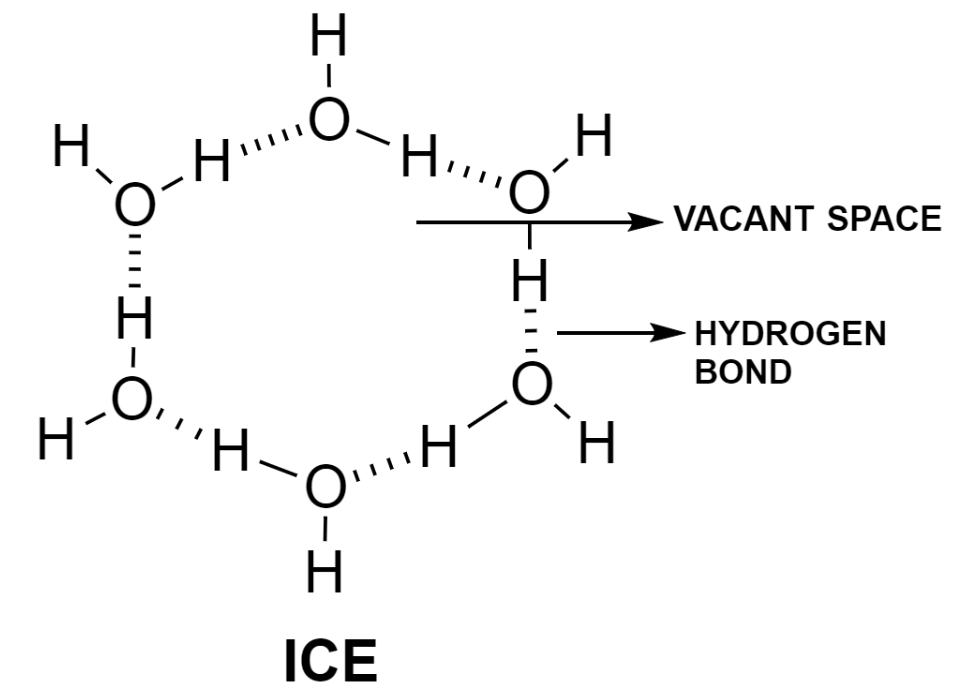
The density of water is maximum at $4{}^\circ \text{C}$ and it is equal to $1.0000\text{ g c}{{\text{m}}^{-3}}$ and after that density decreases and reaches a minimum value of $0.9168\text{ g c}{{\text{m}}^{-3}}$ at its freezing point $\left( 0{}^\circ \text{C} \right)$.
Hence, water at $0{}^\circ \text{C}$ (ice) is least dense.
Note:
The substance with lower value of density tends to float upon the substance with higher density. Since the density of water at$0{}^\circ \text{C}$ is less than the density of water at room temperature, this makes the water at $0{}^\circ \text{C}$, that is ice, float upon the liquid water. This is also why icebergs and ice cubes float on the surface of liquid water.
\[\text{Density}=\dfrac{\text{Mass (g)}}{\text{Volume (c}{{\text{m}}^{3}})}\]
Complete answer:
Water is an essential part of our lives. It covers up to 70% of the earth’s surface. It exists in solid, liquid and gaseous phase within a low range of temperature and pressure.
Each water molecule is made up of two hydrogen atoms and one oxygen atom. These molecules of water are bonded to each other by hydrogen bonds in liquid state. Density is defined as the mass per unit volume of a substance. The density of water at room temperature is approximately $1\text{ g c}{{\text{m}}^{-3}}$. But the density of water changes with the change in temperature.
When water gradually cools, its mass remains constant but volume decreases. Since volume is inversely proportional to the density, thus density of water should increase with decrease in temperature. But when the temperature of water reaches $0{}^\circ \text{C}$, its density gets decreased.
At $0{}^\circ \text{C}$, water starts to freeze and forms ice. Ice has a rigid open lattice, web-like structure. The molecules in ice are arranged in a regular manner held by hydrogen bonds that form a crystalline lattice. These crystals have a number of vacant spaces that make ice less dense than water.
The density of water is maximum at $4{}^\circ \text{C}$ and it is equal to $1.0000\text{ g c}{{\text{m}}^{-3}}$ and after that density decreases and reaches a minimum value of $0.9168\text{ g c}{{\text{m}}^{-3}}$ at its freezing point $\left( 0{}^\circ \text{C} \right)$.
Hence, water at $0{}^\circ \text{C}$ (ice) is least dense.
Note:
The substance with lower value of density tends to float upon the substance with higher density. Since the density of water at$0{}^\circ \text{C}$ is less than the density of water at room temperature, this makes the water at $0{}^\circ \text{C}$, that is ice, float upon the liquid water. This is also why icebergs and ice cubes float on the surface of liquid water.
Recently Updated Pages
Master Class 12 Business Studies: Engaging Questions & Answers for Success

Master Class 12 Biology: Engaging Questions & Answers for Success
Master Class 12 Chemistry: Engaging Questions & Answers for Success
Class 12 Question and Answer - Your Ultimate Solutions Guide
Master Class 11 Social Science: Engaging Questions & Answers for Success
Master Class 11 English: Engaging Questions & Answers for Success
Trending doubts
Explain the Treaty of Vienna of 1815 class 10 social science CBSE
Which Indian city is known as the "City of Victory"?
Which instrument is used to measure the Blood Pressure?
Who Won 36 Oscar Awards? Record Holder Revealed
What is the median of the first 10 natural numbers class 10 maths CBSE
Why is it 530 pm in india when it is 1200 afternoon class 10 social science CBSE