




Two trains start from P and Q respectively and travel towards each other at a speed of 50 km/hr and 40 km/hr respectively. By the time they meet the first train has travelled 100 km more than the second. The distance between P and Q is:
A. 500 km.
B. 630 km
C. 600 km
D. 900 km
Answer
 Verified
553.9k+ views
Hint: In this question, two trains are moving towards each other from two points P and Q. So, their speed will add up.To find the distance between the two starting points, first find the time when the two trains meet. After this calculate the distance travelled by each of the trains till the meeting time and then form the equation.
Complete step-by-step answer:
In the question, we have two trains starting from P and Q towards each other.
The speeds of two trains are given as 50 km/hr and 40 km/hr.
The diagram for the question is given below:
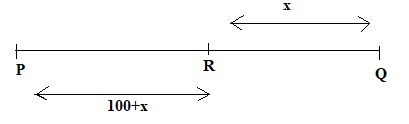
Here P and Q are the starting point and R is the meeting point.
Let the distance travelled by second train from Q to R be x km.
$\therefore $ Distance travelled by first train from P to R = x+100 km.
Now, we know that the time taken to meet at point R is calculated by:
${{\text{t}}_{{\text{meet}}}} = $ $\dfrac{{{\text{Distance between P and R}}}}{{{\text{speed of first train}}}} = \dfrac{{{\text{Distance between Q and R}}}}{{{\text{speed of second train}}}}$ .
Now, putting the values in above equation, we get:
$\dfrac{{{\text{x + 100}}}}{{50}} = \dfrac{{\text{x}}}{{40}}$
Multiplying both sides by 10, we get:
$
\dfrac{{{\text{x + 100}}}}{5} = \dfrac{{\text{x}}}{4} \\
\Rightarrow 4\left( {{\text{x + 100}}} \right) = 5{\text{x}} \\
\Rightarrow {\text{5x - 4x = 400}} \\
\Rightarrow {\text{x = 400}} \\
$
Therefore, distance travelled by second train = QR = x km = 400 km.
And distance travelled by first train = PR = x+ 100 km = (400+100) km = 500 km.
$\therefore $ Distance between P and Q = PR + QR = (500+400) km = 900 km.
So option D is correct.
Note: In this type of question, you should remember the formula for calculating time if speed and distance are known. Here we have found the time taken by two trains to reach the meeting point R and then equate then to form the equation. You can also use the formula ${{\text{t}}_{{\text{meet}}}} = \dfrac{{{\text{distance between P and Q}}}}{{{\text{sum of speed of two trains}}}}$ to calculate the meeting time.
Complete step-by-step answer:
In the question, we have two trains starting from P and Q towards each other.
The speeds of two trains are given as 50 km/hr and 40 km/hr.
The diagram for the question is given below:
Here P and Q are the starting point and R is the meeting point.
Let the distance travelled by second train from Q to R be x km.
$\therefore $ Distance travelled by first train from P to R = x+100 km.
Now, we know that the time taken to meet at point R is calculated by:
${{\text{t}}_{{\text{meet}}}} = $ $\dfrac{{{\text{Distance between P and R}}}}{{{\text{speed of first train}}}} = \dfrac{{{\text{Distance between Q and R}}}}{{{\text{speed of second train}}}}$ .
Now, putting the values in above equation, we get:
$\dfrac{{{\text{x + 100}}}}{{50}} = \dfrac{{\text{x}}}{{40}}$
Multiplying both sides by 10, we get:
$
\dfrac{{{\text{x + 100}}}}{5} = \dfrac{{\text{x}}}{4} \\
\Rightarrow 4\left( {{\text{x + 100}}} \right) = 5{\text{x}} \\
\Rightarrow {\text{5x - 4x = 400}} \\
\Rightarrow {\text{x = 400}} \\
$
Therefore, distance travelled by second train = QR = x km = 400 km.
And distance travelled by first train = PR = x+ 100 km = (400+100) km = 500 km.
$\therefore $ Distance between P and Q = PR + QR = (500+400) km = 900 km.
So option D is correct.
Note: In this type of question, you should remember the formula for calculating time if speed and distance are known. Here we have found the time taken by two trains to reach the meeting point R and then equate then to form the equation. You can also use the formula ${{\text{t}}_{{\text{meet}}}} = \dfrac{{{\text{distance between P and Q}}}}{{{\text{sum of speed of two trains}}}}$ to calculate the meeting time.
Recently Updated Pages
Master Class 11 English: Engaging Questions & Answers for Success

Master Class 11 Maths: Engaging Questions & Answers for Success
Class 11 Question and Answer - Your Ultimate Solutions Guide
Master Class 11 Biology: Engaging Questions & Answers for Success
Master Class 11 Physics: Engaging Questions & Answers for Success
Master Class 11 Accountancy: Engaging Questions & Answers for Success
Trending doubts
Explain the Treaty of Vienna of 1815 class 10 social science CBSE
Who Won 36 Oscar Awards? Record Holder Revealed
What is the median of the first 10 natural numbers class 10 maths CBSE
Why is it 530 pm in india when it is 1200 afternoon class 10 social science CBSE
Select the word that is correctly spelled a Twelveth class 10 english CBSE
Why is there a time difference of about 5 hours between class 10 social science CBSE