




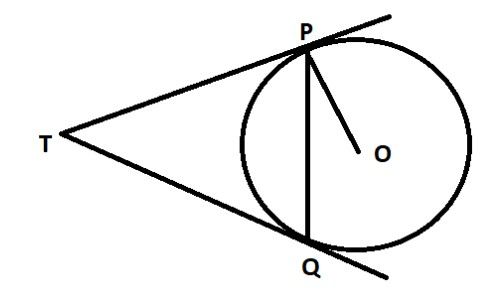
Two tangents TP and TQ are drawn to a circle with centre O from an external point T. Prove that $\angle PTQ = 2\angle OPQ$.
Answer
 Verified
559k+ views
Hint: Use the concept that length of tangents drawn from an external point to a circle are equal. So, TP = TQ, which are the tangents drawn from the external point T. Since, TP = TQ, so in triangle TPQ, angles TQP and TPQ will be equal due to the property that opposite angles to equal sides are equal.
Complete step-by-step answer:
Given in the question- A circle with centre O. Two tangents TP and TQ are drawn from external point T.
To prove: $\angle PTQ = 2\angle OPQ$.
Proof:
We know from the theorem that lengths of tangents drawn from an external point to a circle are equal. So, we can say that-
$
TP = TQ \\
\Rightarrow \angle TQP = \angle TPQ \to (1) \\
$ (Angles opposite to equal sides are equal)
Now, we know TP is tangent and OP is radius.
Therefore, $OP \bot TP$ by the theorem, tangent at any point of a circle is perpendicular to the radius through the point of contact.
So, $
\angle OPT = {90^ \circ } \\
\Rightarrow \angle OPQ + \angle TPQ = {90^ \circ } \\
\Rightarrow \angle TPQ = {90^ \circ } - \angle OPQ \to (2) \\
$
In $\vartriangle PTQ$
$\angle TPQ + \angle TQP + \angle PTQ = {180^ \circ }$ (Angle sum property of triangle)
$
\angle TPQ + \angle TPQ + \angle PTQ = {180^ \circ }(From(1):\angle TQP = \angle TPQ) \\
\Rightarrow 2\angle TPQ + \angle PTQ = {180^ \circ } \\
\Rightarrow 2({90^ \circ } - \angle OPQ) + \angle PTQ = {180^ \circ }(From(2)) \\
\Rightarrow 2({90^ \circ }) - 2\angle OPQ + \angle PTQ = {180^ \circ } \\
\Rightarrow {180^ \circ } - 2\angle OPQ + \angle PTQ = {180^ \circ } \\
\Rightarrow \angle PTQ = 2\angle OPQ \\
$
Hence Proved.
Note- Whenever such types of questions appear, then use the basic theorems of mathematics to solve the question. As mentioned in the solution, we have used the theorem that tangents drawn from an external point to a circle are equal and the theorem that the tangent at any point on a circle is perpendicular. Then in triangle PTQ, we have used the angle sum property and by using equation (1) and (2), we have proved the result.
Complete step-by-step answer:
Given in the question- A circle with centre O. Two tangents TP and TQ are drawn from external point T.
To prove: $\angle PTQ = 2\angle OPQ$.
Proof:
We know from the theorem that lengths of tangents drawn from an external point to a circle are equal. So, we can say that-
$
TP = TQ \\
\Rightarrow \angle TQP = \angle TPQ \to (1) \\
$ (Angles opposite to equal sides are equal)
Now, we know TP is tangent and OP is radius.
Therefore, $OP \bot TP$ by the theorem, tangent at any point of a circle is perpendicular to the radius through the point of contact.
So, $
\angle OPT = {90^ \circ } \\
\Rightarrow \angle OPQ + \angle TPQ = {90^ \circ } \\
\Rightarrow \angle TPQ = {90^ \circ } - \angle OPQ \to (2) \\
$
In $\vartriangle PTQ$
$\angle TPQ + \angle TQP + \angle PTQ = {180^ \circ }$ (Angle sum property of triangle)
$
\angle TPQ + \angle TPQ + \angle PTQ = {180^ \circ }(From(1):\angle TQP = \angle TPQ) \\
\Rightarrow 2\angle TPQ + \angle PTQ = {180^ \circ } \\
\Rightarrow 2({90^ \circ } - \angle OPQ) + \angle PTQ = {180^ \circ }(From(2)) \\
\Rightarrow 2({90^ \circ }) - 2\angle OPQ + \angle PTQ = {180^ \circ } \\
\Rightarrow {180^ \circ } - 2\angle OPQ + \angle PTQ = {180^ \circ } \\
\Rightarrow \angle PTQ = 2\angle OPQ \\
$
Hence Proved.
Note- Whenever such types of questions appear, then use the basic theorems of mathematics to solve the question. As mentioned in the solution, we have used the theorem that tangents drawn from an external point to a circle are equal and the theorem that the tangent at any point on a circle is perpendicular. Then in triangle PTQ, we have used the angle sum property and by using equation (1) and (2), we have proved the result.
Recently Updated Pages
Master Class 12 Economics: Engaging Questions & Answers for Success

Master Class 12 English: Engaging Questions & Answers for Success
Master Class 12 Social Science: Engaging Questions & Answers for Success
Master Class 12 Maths: Engaging Questions & Answers for Success
Master Class 12 Physics: Engaging Questions & Answers for Success
Master Class 9 General Knowledge: Engaging Questions & Answers for Success
Trending doubts
One Metric ton is equal to kg A 10000 B 1000 C 100 class 11 physics CBSE
Difference Between Prokaryotic Cells and Eukaryotic Cells
Two of the body parts which do not appear in MRI are class 11 biology CBSE
Find the value of the expression given below sin 30circ class 11 maths CBSE
1 ton equals to A 100 kg B 1000 kg C 10 kg D 10000 class 11 physics CBSE
Draw a diagram of nephron and explain its structur class 11 biology CBSE