




Two small balls having equal positive charge Q (coulomb) on each are suspended by two insulating strings of equal length L, from a hook fixed to a stand. If the whole set up is taking in a satellite then the angle $\theta $ between the two strings is: (in equilibrium).
$\left( A \right){0^0}$
$\left( B \right){90^0}$
$\left( C \right){180^0}$
$\left( D \right){0^0} < \theta < {180^0}$
Answer
 Verified
636.3k+ views
Hint: In this question use the concept that in a satellite the acceleration due to gravity becomes zero so the weight of the system becomes zero and use the concept that two like charges repel each other so use these properties to reach the solution of the question.
Complete Step-by-Step solution:
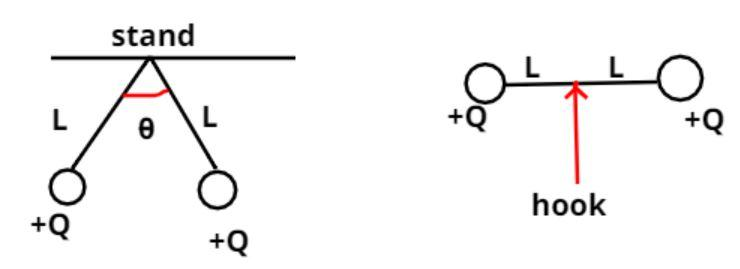
The pictorial representation of the above problem is shown above when we have on the earth surface the system represented as figure 1 having angle $\theta $ between two strings each of length L as shown in the figure.
But when we placed this system into the satellite the acceleration due to gravity becomes zero so the force acting on two small balls becomes zero as (F = ma) acceleration is zero so force is zero.
So the two balls fell zero weight in the satellite.
Now it is given that these two spherical balls have equal positive charge Q as shown in the figure so they both feel electrostatic force of repulsion as like force repel each other so the string becomes horizontal and the angle between these two strings becomes a straight angle, as shown in figure 2.
And we all know straight angle = ${180^0}$
Hence option (C) is the correct answer.
Note – If the charges on the balls are opposite to each other i.e. equal but opposite in sign so they feel electrostatic force of attraction as unlike charges attract each other so they overlap each other and the angle between the strings become zero degree.
Complete Step-by-Step solution:
The pictorial representation of the above problem is shown above when we have on the earth surface the system represented as figure 1 having angle $\theta $ between two strings each of length L as shown in the figure.
But when we placed this system into the satellite the acceleration due to gravity becomes zero so the force acting on two small balls becomes zero as (F = ma) acceleration is zero so force is zero.
So the two balls fell zero weight in the satellite.
Now it is given that these two spherical balls have equal positive charge Q as shown in the figure so they both feel electrostatic force of repulsion as like force repel each other so the string becomes horizontal and the angle between these two strings becomes a straight angle, as shown in figure 2.
And we all know straight angle = ${180^0}$
Hence option (C) is the correct answer.
Note – If the charges on the balls are opposite to each other i.e. equal but opposite in sign so they feel electrostatic force of attraction as unlike charges attract each other so they overlap each other and the angle between the strings become zero degree.
Recently Updated Pages
Master Class 12 Business Studies: Engaging Questions & Answers for Success

Master Class 12 Biology: Engaging Questions & Answers for Success
Master Class 12 Chemistry: Engaging Questions & Answers for Success
Class 12 Question and Answer - Your Ultimate Solutions Guide
Master Class 11 Social Science: Engaging Questions & Answers for Success
Master Class 11 English: Engaging Questions & Answers for Success
Trending doubts
What is the full form of NDA a National Democratic class 10 social science CBSE
Explain the Treaty of Vienna of 1815 class 10 social science CBSE
Who Won 36 Oscar Awards? Record Holder Revealed
Bharatiya Janata Party was founded in the year A 1979 class 10 social science CBSE
What is the median of the first 10 natural numbers class 10 maths CBSE
Why is it 530 pm in india when it is 1200 afternoon class 10 social science CBSE