




Two resistors when connected in series net resistance is \[5\,\Omega \]and when they are connected in parallel net resistance is \[1.2\,\Omega \]. What are these resistors?
\[A.\,1.2\,\Omega ,4\,\Omega \]
\[B.\,2\,\Omega ,3\,\Omega \]
\[C.\,0.6\,\Omega ,0.6\,\Omega \]
\[D.\,1\,\Omega ,0.3\,\Omega \]
Answer
 Verified
591k+ views
Hint: As, we are asked to find the values of the resistors, connected in both the parallel and series. We will use the series resistance and parallel resistance formula and substitute the value of one resistance in the form of other resistance to solve the equations.
Formula used:
\[\begin{align}
& {{R}_{s}}={{R}_{1}}+{{R}_{2}} \\
& {{R}_{P}}=\dfrac{{{R}_{1}}{{R}_{2}}}{{{R}_{1}}+{{R}_{2}}} \\
\end{align}\]
Complete answer:
From the data, we have the data as follows.
Two resistors, when connected in series net resistance, is \[5\,\Omega \]
Two resistors, when they are connected in parallel net resistance, is \[1.2\,\Omega \].
Let the resistors be \[{{R}_{1}},{{R}_{2}}\]
Consider the diagram representing the series and parallel connection of the resistors.
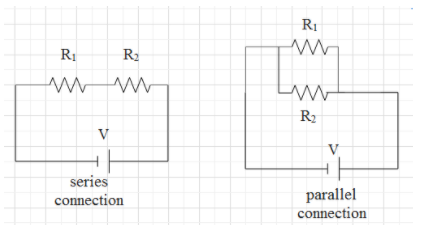
Firstly, we will compute the equivalent resistance of the resistors connected in series form.
So, the equivalent resistance is given as follows.
\[{{R}_{S}}={{R}_{1}}+{{R}_{2}}\]
Now substitute the value of the equivalent resistance given.
\[5={{R}_{1}}+{{R}_{2}}\]
Rearrange the terms in the above equation to represent the equation in terms of second the resistance.
So, we have,
\[{{R}_{2}}=5-{{R}_{1}}\] …… (1)
Now, we will compute the equivalent resistance of the resistors connected in parallel form.
So, the equivalent resistance is given as follows.
\[{{R}_{P}}=\dfrac{{{R}_{1}}{{R}_{2}}}{{{R}_{1}}+{{R}_{2}}}\]
Now substitute the value of the equivalent resistance given.
\[1.2=\dfrac{{{R}_{1}}{{R}_{2}}}{{{R}_{1}}+{{R}_{2}}}\]
Rearrange the terms in the above equation to represent the equation in terms of the resistance.
So, we have,
\[{{R}_{1}}{{R}_{2}}=1.2({{R}_{1}}+{{R}_{2}})\]
Substitute the equation (1) in the above equation.
\[{{R}_{1}}(5-{{R}_{1}})=1.2[{{R}_{1}}+(5-{{R}_{1}})]\]
Continue solving the above equation.
\[\begin{align}
& 5{{R}_{1}}-{{R}_{1}}^{2}=1.2{{R}_{1}}+6-1.2{{R}_{1}} \\
& \Rightarrow {{R}_{1}}^{2}-5{{R}_{1}}+6=0 \\
\end{align}\]
As the above equation is in the form of a quadratic equation, upon solving the above equation, the values of the first resistor obtained are as follows.
\[\begin{align}
& ({{R}_{1}}-2)({{R}_{1}}-3)=0 \\
& \Rightarrow {{R}_{1}}=2,3 \\
\end{align}\]
Substitute these values of the resistance in the equation (1) to obtain the values of the second resistor.
When,
\[\begin{align}
& {{R}_{1}}=2\Omega \\
& \Rightarrow {{R}_{2}}=3\Omega \\
\end{align}\]
When,
\[\begin{align}
& {{R}_{1}}=3\Omega \\
& \Rightarrow {{R}_{2}}=2\Omega \\
\end{align}\]
As, the values of the resistors are \[2\Omega \] and \[3\Omega \] .
Thus, option (B) is correct.
Note:
The formulae for calculating the equivalent resistance of the resistors connected in series and the parallel connection should be known to solve such problems.
Formula used:
\[\begin{align}
& {{R}_{s}}={{R}_{1}}+{{R}_{2}} \\
& {{R}_{P}}=\dfrac{{{R}_{1}}{{R}_{2}}}{{{R}_{1}}+{{R}_{2}}} \\
\end{align}\]
Complete answer:
From the data, we have the data as follows.
Two resistors, when connected in series net resistance, is \[5\,\Omega \]
Two resistors, when they are connected in parallel net resistance, is \[1.2\,\Omega \].
Let the resistors be \[{{R}_{1}},{{R}_{2}}\]
Consider the diagram representing the series and parallel connection of the resistors.
Firstly, we will compute the equivalent resistance of the resistors connected in series form.
So, the equivalent resistance is given as follows.
\[{{R}_{S}}={{R}_{1}}+{{R}_{2}}\]
Now substitute the value of the equivalent resistance given.
\[5={{R}_{1}}+{{R}_{2}}\]
Rearrange the terms in the above equation to represent the equation in terms of second the resistance.
So, we have,
\[{{R}_{2}}=5-{{R}_{1}}\] …… (1)
Now, we will compute the equivalent resistance of the resistors connected in parallel form.
So, the equivalent resistance is given as follows.
\[{{R}_{P}}=\dfrac{{{R}_{1}}{{R}_{2}}}{{{R}_{1}}+{{R}_{2}}}\]
Now substitute the value of the equivalent resistance given.
\[1.2=\dfrac{{{R}_{1}}{{R}_{2}}}{{{R}_{1}}+{{R}_{2}}}\]
Rearrange the terms in the above equation to represent the equation in terms of the resistance.
So, we have,
\[{{R}_{1}}{{R}_{2}}=1.2({{R}_{1}}+{{R}_{2}})\]
Substitute the equation (1) in the above equation.
\[{{R}_{1}}(5-{{R}_{1}})=1.2[{{R}_{1}}+(5-{{R}_{1}})]\]
Continue solving the above equation.
\[\begin{align}
& 5{{R}_{1}}-{{R}_{1}}^{2}=1.2{{R}_{1}}+6-1.2{{R}_{1}} \\
& \Rightarrow {{R}_{1}}^{2}-5{{R}_{1}}+6=0 \\
\end{align}\]
As the above equation is in the form of a quadratic equation, upon solving the above equation, the values of the first resistor obtained are as follows.
\[\begin{align}
& ({{R}_{1}}-2)({{R}_{1}}-3)=0 \\
& \Rightarrow {{R}_{1}}=2,3 \\
\end{align}\]
Substitute these values of the resistance in the equation (1) to obtain the values of the second resistor.
When,
\[\begin{align}
& {{R}_{1}}=2\Omega \\
& \Rightarrow {{R}_{2}}=3\Omega \\
\end{align}\]
When,
\[\begin{align}
& {{R}_{1}}=3\Omega \\
& \Rightarrow {{R}_{2}}=2\Omega \\
\end{align}\]
As, the values of the resistors are \[2\Omega \] and \[3\Omega \] .
Thus, option (B) is correct.
Note:
The formulae for calculating the equivalent resistance of the resistors connected in series and the parallel connection should be known to solve such problems.
Recently Updated Pages
Basicity of sulphurous acid and sulphuric acid are

Master Class 11 Business Studies: Engaging Questions & Answers for Success
Master Class 11 Computer Science: Engaging Questions & Answers for Success
Master Class 11 Economics: Engaging Questions & Answers for Success
Master Class 11 Social Science: Engaging Questions & Answers for Success
Master Class 11 English: Engaging Questions & Answers for Success
Trending doubts
The largest wind power cluster is located in the state class 11 social science CBSE
Explain zero factorial class 11 maths CBSE
Which among the following are examples of coming together class 11 social science CBSE
Draw a diagram of a plant cell and label at least eight class 11 biology CBSE
Why was the Vernacular Press Act passed by British class 11 social science CBSE
10 examples of friction in our daily life