




Two poles of equal height stand on either side of the roadway which is 30m wide. At a point in the roadway between the pillars, the elevations of tops of the pillars are \[{{30}^{\circ }}\] and \[{{60}^{\circ }}\]. Find the heights of the pillars and the position of the point.
Answer
 Verified
576.6k+ views
Hint: Draw a diagram of the given situation. Assume the height of each pillar as ‘h’. Assume a point in between the two pillars whose distance from pillar 1 and pillar 2 are \[{{x}_{1}}\] and \[{{x}_{2}}\] respectively. From two right-angle triangles and use, \[\tan \theta \] = (perpendicular / base) to form two expressions, one each in terms of \[{{x}_{1}}\] and \[{{x}_{2}}\] and equate it with 30 to get the value of h. Substitute this value of h in the expressions of \[{{x}_{1}}\] and \[{{x}_{2}}\] to determine their values.
Complete step-by-step solution:
Let us draw a diagram of the given situation.
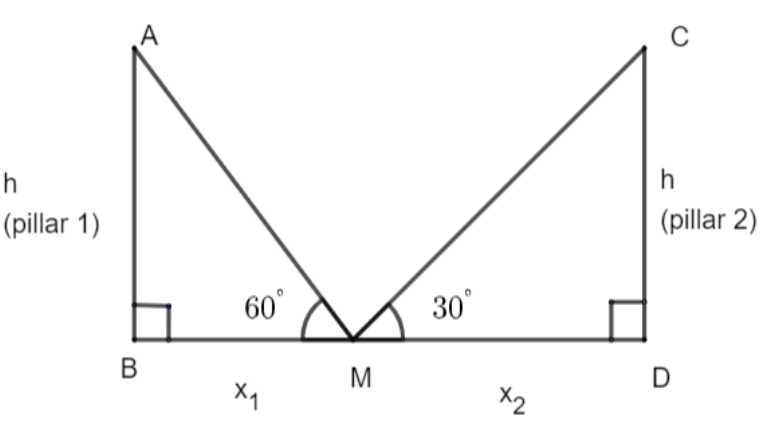
In the above figure, we have assumed AB and CD as pillar 1 and pillar 2 respectively. We have assumed their height as ‘h’. The angle of elevation of pillar 1 and pillar 2 are \[{{60}^{\circ }}\] and \[{{30}^{\circ }}\] respectively. We have assumed a point M whose distance from the foot of pillar 1 and pillar 2 are \[{{x}_{1}}\] and \[{{x}_{2}}\] respectively. Here, we have to determine the value of h.
Now, in right angle triangle CDM, we have,
CD = h
DM = \[{{x}_{2}}\]
\[\angle CMD={{30}^{\circ }}\]
Using, \[\tan \theta \] = (perpendicular / base), where \[\theta \] is the angle of elevation, we get,
\[\begin{align}
& \Rightarrow \tan {{30}^{\circ }}=\dfrac{CD}{DM} \\
& \Rightarrow \tan {{30}^{\circ }}=\dfrac{h}{{{x}_{2}}} \\
\end{align}\]
\[\Rightarrow {{x}_{2}}=\dfrac{h}{\tan {{30}^{\circ }}}\] - (1)
Now, in right angle triangle ABM, we have,
AB = h
BM = \[{{x}_{1}}\]
\[\angle AMB={{60}^{\circ }}\]
Using, \[\tan \theta \] = (perpendicular / base), we get,
\[\begin{align}
& \Rightarrow \tan {{60}^{\circ }}=\dfrac{AB}{BM} \\
& \Rightarrow \tan {{60}^{\circ }}=\dfrac{h}{{{x}_{1}}} \\
\end{align}\]
\[\Rightarrow {{x}_{1}}=\dfrac{h}{\tan {{60}^{\circ }}}\] - (2)
Here, in the above question we have been given that the distance between the two pillars is 30m.
\[\begin{align}
& \Rightarrow BD=30 \\
& \Rightarrow BM+DM=30 \\
\end{align}\]
Therefore, substituting the values of \[{{x}_{1}}\] and \[{{x}_{2}}\] from equations (1) and (2), we get,
\[\begin{align}
& \Rightarrow BM+DM={{x}_{1}}+{{x}_{2}}=\dfrac{h}{\tan {{30}^{\circ }}}+\dfrac{h}{\tan {{60}^{\circ }}}=30 \\
& \Rightarrow h\left[ \dfrac{1}{\tan {{30}^{\circ }}}+\dfrac{1}{\tan {{60}^{\circ }}} \right]=30 \\
\end{align}\]
Substituting, \[\tan {{30}^{\circ }}=\dfrac{1}{\sqrt{3}}\] and \[\tan {{60}^{\circ }}=\sqrt{3}\], we get,
\[\begin{align}
& \Rightarrow h\left[ \dfrac{1}{\dfrac{1}{\sqrt{3}}}+\dfrac{1}{\sqrt{3}} \right]=30 \\
& \Rightarrow h\times \left( \sqrt{3}+\dfrac{1}{\sqrt{3}} \right)=30 \\
& \Rightarrow h\times \left( \dfrac{4}{\sqrt{3}} \right)=30 \\
& \Rightarrow h=\dfrac{30\sqrt{3}}{4} \\
& \Rightarrow h=\dfrac{15\sqrt{3}}{2}m \\
\end{align}\]
Therefore, the height of the tower is \[\dfrac{15\sqrt{3}}{2}m\].
Now, substituting the value of equation (1), we get,
\[\begin{align}
& \Rightarrow {{x}_{2}}=\dfrac{15\sqrt{3}}{2\times \dfrac{1}{\sqrt{3}}} \\
& \Rightarrow {{x}_{2}}=\dfrac{15\times 3}{2} \\
& \Rightarrow {{x}_{2}}=22.5m \\
& \Rightarrow {{x}_{1}}=30-{{x}_{2}} \\
& \Rightarrow {{x}_{1}}=30-22.5=7.5m \\
\end{align}\]
Note: One may note that we have found the value of \[{{x}_{1}}\] by subtracting the value of \[{{x}_{2}}\] from 30. We can also find the value of \[{{x}_{1}}\] by substituting the obtained value of h in equation (2). This will not alter our answer. Always try to draw the diagram of the given situation as it will help you to understand the situation better. You can see that we have used the expression for \[\tan \theta \] and not
\[\sin \theta \] or \[\cos \theta \] in the solution. This is because we have been provided the information regarding perpendicular and base and not hypotenuse in the right angle triangle.
Complete step-by-step solution:
Let us draw a diagram of the given situation.
In the above figure, we have assumed AB and CD as pillar 1 and pillar 2 respectively. We have assumed their height as ‘h’. The angle of elevation of pillar 1 and pillar 2 are \[{{60}^{\circ }}\] and \[{{30}^{\circ }}\] respectively. We have assumed a point M whose distance from the foot of pillar 1 and pillar 2 are \[{{x}_{1}}\] and \[{{x}_{2}}\] respectively. Here, we have to determine the value of h.
Now, in right angle triangle CDM, we have,
CD = h
DM = \[{{x}_{2}}\]
\[\angle CMD={{30}^{\circ }}\]
Using, \[\tan \theta \] = (perpendicular / base), where \[\theta \] is the angle of elevation, we get,
\[\begin{align}
& \Rightarrow \tan {{30}^{\circ }}=\dfrac{CD}{DM} \\
& \Rightarrow \tan {{30}^{\circ }}=\dfrac{h}{{{x}_{2}}} \\
\end{align}\]
\[\Rightarrow {{x}_{2}}=\dfrac{h}{\tan {{30}^{\circ }}}\] - (1)
Now, in right angle triangle ABM, we have,
AB = h
BM = \[{{x}_{1}}\]
\[\angle AMB={{60}^{\circ }}\]
Using, \[\tan \theta \] = (perpendicular / base), we get,
\[\begin{align}
& \Rightarrow \tan {{60}^{\circ }}=\dfrac{AB}{BM} \\
& \Rightarrow \tan {{60}^{\circ }}=\dfrac{h}{{{x}_{1}}} \\
\end{align}\]
\[\Rightarrow {{x}_{1}}=\dfrac{h}{\tan {{60}^{\circ }}}\] - (2)
Here, in the above question we have been given that the distance between the two pillars is 30m.
\[\begin{align}
& \Rightarrow BD=30 \\
& \Rightarrow BM+DM=30 \\
\end{align}\]
Therefore, substituting the values of \[{{x}_{1}}\] and \[{{x}_{2}}\] from equations (1) and (2), we get,
\[\begin{align}
& \Rightarrow BM+DM={{x}_{1}}+{{x}_{2}}=\dfrac{h}{\tan {{30}^{\circ }}}+\dfrac{h}{\tan {{60}^{\circ }}}=30 \\
& \Rightarrow h\left[ \dfrac{1}{\tan {{30}^{\circ }}}+\dfrac{1}{\tan {{60}^{\circ }}} \right]=30 \\
\end{align}\]
Substituting, \[\tan {{30}^{\circ }}=\dfrac{1}{\sqrt{3}}\] and \[\tan {{60}^{\circ }}=\sqrt{3}\], we get,
\[\begin{align}
& \Rightarrow h\left[ \dfrac{1}{\dfrac{1}{\sqrt{3}}}+\dfrac{1}{\sqrt{3}} \right]=30 \\
& \Rightarrow h\times \left( \sqrt{3}+\dfrac{1}{\sqrt{3}} \right)=30 \\
& \Rightarrow h\times \left( \dfrac{4}{\sqrt{3}} \right)=30 \\
& \Rightarrow h=\dfrac{30\sqrt{3}}{4} \\
& \Rightarrow h=\dfrac{15\sqrt{3}}{2}m \\
\end{align}\]
Therefore, the height of the tower is \[\dfrac{15\sqrt{3}}{2}m\].
Now, substituting the value of equation (1), we get,
\[\begin{align}
& \Rightarrow {{x}_{2}}=\dfrac{15\sqrt{3}}{2\times \dfrac{1}{\sqrt{3}}} \\
& \Rightarrow {{x}_{2}}=\dfrac{15\times 3}{2} \\
& \Rightarrow {{x}_{2}}=22.5m \\
& \Rightarrow {{x}_{1}}=30-{{x}_{2}} \\
& \Rightarrow {{x}_{1}}=30-22.5=7.5m \\
\end{align}\]
Note: One may note that we have found the value of \[{{x}_{1}}\] by subtracting the value of \[{{x}_{2}}\] from 30. We can also find the value of \[{{x}_{1}}\] by substituting the obtained value of h in equation (2). This will not alter our answer. Always try to draw the diagram of the given situation as it will help you to understand the situation better. You can see that we have used the expression for \[\tan \theta \] and not
\[\sin \theta \] or \[\cos \theta \] in the solution. This is because we have been provided the information regarding perpendicular and base and not hypotenuse in the right angle triangle.
Recently Updated Pages
Master Class 10 Computer Science: Engaging Questions & Answers for Success

Master Class 10 General Knowledge: Engaging Questions & Answers for Success
Master Class 10 English: Engaging Questions & Answers for Success
Master Class 10 Social Science: Engaging Questions & Answers for Success
Master Class 10 Maths: Engaging Questions & Answers for Success
Master Class 10 Science: Engaging Questions & Answers for Success
Trending doubts
What is the median of the first 10 natural numbers class 10 maths CBSE
Which women's tennis player has 24 Grand Slam singles titles?
Who is the Brand Ambassador of Incredible India?
Why is there a time difference of about 5 hours between class 10 social science CBSE
Write a letter to the principal requesting him to grant class 10 english CBSE
State and prove converse of BPT Basic Proportionality class 10 maths CBSE