




Two poles of equal height are standing opposite to each other on either side of a road which is 100m wide. From a point between them on the road, angles of elevation of their tops are \[{{30}^{\circ }}\] and \[{{60}^{\circ }}\]. The height of each pole in meter is: -
(a) \[25\sqrt{3}\]
(b) \[20\sqrt{3}\]
(c) \[28\sqrt{3}\]
(d) \[30\sqrt{3}\]
Answer
 Verified
599.7k+ views
Hint: Draw a diagram of the given situation. Assume the height of each pillar as ‘h’. Assume a point in between the two pillars whose distance from pillar 1 and pillar 2 are \[{{x}_{1}}\] and \[{{x}_{2}}\] respectively. Form two right angle triangles and use, \[\tan \theta \] = (perpendicular / base), where \[\theta \] is the angle of elevation, to form expressions in terms of \[{{x}_{1}}\] and \[{{x}_{2}}\] and equate their with 100 to determine the value of h.
Complete step by step answer:
Let us draw a diagram of the given situation.
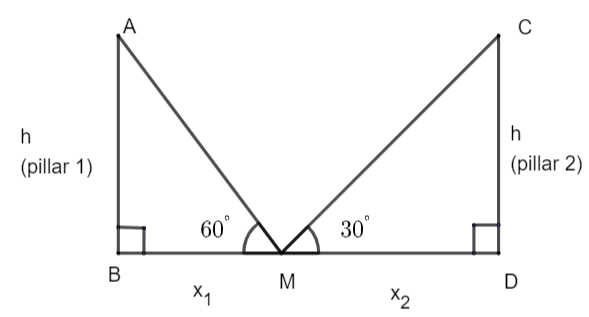
In the above figure, we have assumed AB and CD as pillar 1 and pillar 2 respectively. We have assumed their height as ‘h’. The angle of elevation of pillar 1 and pillar 2 are \[{{60}^{\circ }}\] and \[{{30}^{\circ }}\] respectively. We have assumed a point M whose distance from foot of pillar 1 and pillar 2 are \[{{x}_{1}}\] and \[{{x}_{2}}\] respectively. Here, we have to determine the value of h.
Now, in right angle triangle CDM, we have,
CD = h
DM = \[{{x}_{2}}\]
\[\angle CMD={{30}^{\circ }}\]
Using, \[\tan \theta \] = (perpendicular / base), where \[\theta \] is the angle of elevation, we get,
\[\begin{align}
& \Rightarrow \tan {{30}^{\circ }}=\dfrac{CD}{DM} \\
& \Rightarrow \tan {{30}^{\circ }}=\dfrac{h}{{{x}_{2}}} \\
\end{align}\]
\[\Rightarrow {{x}_{2}}=\dfrac{h}{\tan {{30}^{\circ }}}\] - (1)
Now, in right angle triangle ABM, we have,
AB = h
BM = \[{{x}_{1}}\]
\[\angle AMB={{60}^{\circ }}\]
Using, \[\tan \theta \] = (perpendicular / base), we get,
\[\begin{align}
& \Rightarrow \tan {{60}^{\circ }}=\dfrac{AB}{BM} \\
& \Rightarrow \tan {{60}^{\circ }}=\dfrac{h}{{{x}_{1}}} \\
\end{align}\]
\[\Rightarrow {{x}_{1}}=\dfrac{h}{\tan {{60}^{\circ }}}\] - (2)
Here, in the above question we have been given that the distance between the two pillars is 100m.
\[\Rightarrow \] BD = 100
\[\begin{align}
& \Rightarrow BM+DM=100 \\
& \Rightarrow {{x}_{1}}+{{x}_{2}}=100 \\
\end{align}\]
Substituting the values of \[{{x}_{1}}\] and \[{{x}_{2}}\] from equations (1) and (2), we get,
\[\begin{align}
& \Rightarrow \dfrac{h}{\tan {{30}^{\circ }}}+\dfrac{h}{\tan {{60}^{\circ }}}=100 \\
& \Rightarrow h\left[ \dfrac{1}{\tan {{30}^{\circ }}}+\dfrac{1}{\tan {{60}^{\circ }}} \right]=100 \\
\end{align}\]
Substituting, \[\tan {{30}^{\circ }}=\dfrac{1}{\sqrt{3}}\] and \[\tan {{60}^{\circ }}=\sqrt{3}\], we get,
\[\begin{align}
& \Rightarrow h\left[ \dfrac{1}{\dfrac{1}{\sqrt{3}}}+\dfrac{1}{\sqrt{3}} \right]=100 \\
& \Rightarrow h\left[ \sqrt{3}+\dfrac{1}{\sqrt{3}} \right]=100 \\
\end{align}\]
\[\begin{align}
& \Rightarrow h\times \left( \dfrac{4}{\sqrt{3}} \right)=100 \\
& \Rightarrow h=\dfrac{100\times \sqrt{3}}{4} \\
& \Rightarrow h=25\sqrt{3}m \\
\end{align}\]
So, the correct answer is “Option a”.
Note: One may note that we must draw the diagram so that we can visualize and understand the situation more clearly and easily. As you can see that we have used the trigonometric function \[\tan \theta \] and not \[\sin \theta \] or \[\cos \theta \] in the two right angle triangles. This is because we have been provided with the information regarding base and perpendicular but not the hypotenuse of the triangle.
Complete step by step answer:
Let us draw a diagram of the given situation.
In the above figure, we have assumed AB and CD as pillar 1 and pillar 2 respectively. We have assumed their height as ‘h’. The angle of elevation of pillar 1 and pillar 2 are \[{{60}^{\circ }}\] and \[{{30}^{\circ }}\] respectively. We have assumed a point M whose distance from foot of pillar 1 and pillar 2 are \[{{x}_{1}}\] and \[{{x}_{2}}\] respectively. Here, we have to determine the value of h.
Now, in right angle triangle CDM, we have,
CD = h
DM = \[{{x}_{2}}\]
\[\angle CMD={{30}^{\circ }}\]
Using, \[\tan \theta \] = (perpendicular / base), where \[\theta \] is the angle of elevation, we get,
\[\begin{align}
& \Rightarrow \tan {{30}^{\circ }}=\dfrac{CD}{DM} \\
& \Rightarrow \tan {{30}^{\circ }}=\dfrac{h}{{{x}_{2}}} \\
\end{align}\]
\[\Rightarrow {{x}_{2}}=\dfrac{h}{\tan {{30}^{\circ }}}\] - (1)
Now, in right angle triangle ABM, we have,
AB = h
BM = \[{{x}_{1}}\]
\[\angle AMB={{60}^{\circ }}\]
Using, \[\tan \theta \] = (perpendicular / base), we get,
\[\begin{align}
& \Rightarrow \tan {{60}^{\circ }}=\dfrac{AB}{BM} \\
& \Rightarrow \tan {{60}^{\circ }}=\dfrac{h}{{{x}_{1}}} \\
\end{align}\]
\[\Rightarrow {{x}_{1}}=\dfrac{h}{\tan {{60}^{\circ }}}\] - (2)
Here, in the above question we have been given that the distance between the two pillars is 100m.
\[\Rightarrow \] BD = 100
\[\begin{align}
& \Rightarrow BM+DM=100 \\
& \Rightarrow {{x}_{1}}+{{x}_{2}}=100 \\
\end{align}\]
Substituting the values of \[{{x}_{1}}\] and \[{{x}_{2}}\] from equations (1) and (2), we get,
\[\begin{align}
& \Rightarrow \dfrac{h}{\tan {{30}^{\circ }}}+\dfrac{h}{\tan {{60}^{\circ }}}=100 \\
& \Rightarrow h\left[ \dfrac{1}{\tan {{30}^{\circ }}}+\dfrac{1}{\tan {{60}^{\circ }}} \right]=100 \\
\end{align}\]
Substituting, \[\tan {{30}^{\circ }}=\dfrac{1}{\sqrt{3}}\] and \[\tan {{60}^{\circ }}=\sqrt{3}\], we get,
\[\begin{align}
& \Rightarrow h\left[ \dfrac{1}{\dfrac{1}{\sqrt{3}}}+\dfrac{1}{\sqrt{3}} \right]=100 \\
& \Rightarrow h\left[ \sqrt{3}+\dfrac{1}{\sqrt{3}} \right]=100 \\
\end{align}\]
\[\begin{align}
& \Rightarrow h\times \left( \dfrac{4}{\sqrt{3}} \right)=100 \\
& \Rightarrow h=\dfrac{100\times \sqrt{3}}{4} \\
& \Rightarrow h=25\sqrt{3}m \\
\end{align}\]
So, the correct answer is “Option a”.
Note: One may note that we must draw the diagram so that we can visualize and understand the situation more clearly and easily. As you can see that we have used the trigonometric function \[\tan \theta \] and not \[\sin \theta \] or \[\cos \theta \] in the two right angle triangles. This is because we have been provided with the information regarding base and perpendicular but not the hypotenuse of the triangle.
Recently Updated Pages
Master Class 10 Computer Science: Engaging Questions & Answers for Success

Master Class 10 General Knowledge: Engaging Questions & Answers for Success
Master Class 10 English: Engaging Questions & Answers for Success
Master Class 10 Social Science: Engaging Questions & Answers for Success
Master Class 10 Maths: Engaging Questions & Answers for Success
Master Class 10 Science: Engaging Questions & Answers for Success
Trending doubts
Explain the Treaty of Vienna of 1815 class 10 social science CBSE
Who Won 36 Oscar Awards? Record Holder Revealed
What is the median of the first 10 natural numbers class 10 maths CBSE
Why is it 530 pm in india when it is 1200 afternoon class 10 social science CBSE
Select the word that is correctly spelled a Twelveth class 10 english CBSE
Why is there a time difference of about 5 hours between class 10 social science CBSE