




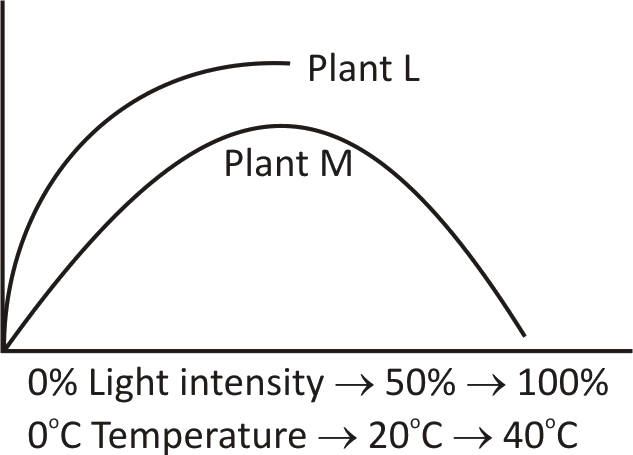
When two plants L and M were exposed to different light intensities and temperatures, they showed changes in their rates of photosynthesis, which have been represented in the following graph.
The graph indicates that.
A- Plant L is a $C_{3}$ plant for which the light subtraction point is 100% of full sunlight.
B- Plant M is a $C_{4}$ plant for which the optimum temperature is around 20°C
C- Plant M is a $C_{3}$ plant which is more affected by higher temperature and higher light intensity as compared to plant L.
D- Plant L is a plant and can not function at light intensities above the saturation point.
Answer
 Verified
606.3k+ views
Hint: Rate of photosynthesis is greater in intense light than diffuse light . But a higher light intensity the process of photooxidation occurs and photosynthesis apparatus may get destroyed.
Complete answer:
When a plant can achieve maximum rate of photosynthesis at light intensity that is known as light saturation point. In $C_{3}$ sun plants its value is 50-70% of full sunlight and in $C_{4}$ sun plants it is up to 20% of full sunlight. The rate of photosynthesis starts to decline beyond the saturation point. When the rate of photosynthesis is maximum is 100C−250C for $C_{3}$ plants and 30−450C for $C_{4}$ plants is called optimum temperature. So from the given statement , it is clear that in the given graph, plant L is a C $C_{4}$ plant and plant M is a $C_{3}$ plant. So, the option c is the correct answer that plant M is a $C_{3}$ plant which is more affected at higher temperature and higher light intensity as compared to plant L.
Additional information:
Factors affecting photosynthesis:
1.Light quality and wavelength: maximum photosynthesis takes place in red light than in blue light.
2.Light intensity: rate of photosynthesis is greater in intense light than diffuse light
3.Temperature: Optimum temperature for photosynthesis is 20-35°C
4.Water : The rate of photosynthesis reduces due to lack of water
5.Inhibitors: All the chemicals are used as herbicides which mostly block electron transport system
6.Minerals:For the structure of chlorophyll and enzymes magnesium and nitrogen are essential.
Note: Compensation point is very low in $C_{4}$ plants while in $C_{3}$ plants it is very high. $C_{3}$ plants are common in dicots and monocots both while $C_{4}$ plants are very rare in dicots. Enzymes of the Calvin cycle are found in all green plants. Enzymes of the calvin cycle are found in all green cells. In $C_{4}$ plants enzymes of the calvin cycle are absent in mesophyll cells while present in a bundle of sheath.
Complete answer:
When a plant can achieve maximum rate of photosynthesis at light intensity that is known as light saturation point. In $C_{3}$ sun plants its value is 50-70% of full sunlight and in $C_{4}$ sun plants it is up to 20% of full sunlight. The rate of photosynthesis starts to decline beyond the saturation point. When the rate of photosynthesis is maximum is 100C−250C for $C_{3}$ plants and 30−450C for $C_{4}$ plants is called optimum temperature. So from the given statement , it is clear that in the given graph, plant L is a C $C_{4}$ plant and plant M is a $C_{3}$ plant. So, the option c is the correct answer that plant M is a $C_{3}$ plant which is more affected at higher temperature and higher light intensity as compared to plant L.
Additional information:
Factors affecting photosynthesis:
1.Light quality and wavelength: maximum photosynthesis takes place in red light than in blue light.
2.Light intensity: rate of photosynthesis is greater in intense light than diffuse light
3.Temperature: Optimum temperature for photosynthesis is 20-35°C
4.Water : The rate of photosynthesis reduces due to lack of water
5.Inhibitors: All the chemicals are used as herbicides which mostly block electron transport system
6.Minerals:For the structure of chlorophyll and enzymes magnesium and nitrogen are essential.
Note: Compensation point is very low in $C_{4}$ plants while in $C_{3}$ plants it is very high. $C_{3}$ plants are common in dicots and monocots both while $C_{4}$ plants are very rare in dicots. Enzymes of the Calvin cycle are found in all green plants. Enzymes of the calvin cycle are found in all green cells. In $C_{4}$ plants enzymes of the calvin cycle are absent in mesophyll cells while present in a bundle of sheath.
Recently Updated Pages
Master Class 12 Economics: Engaging Questions & Answers for Success

Master Class 12 English: Engaging Questions & Answers for Success
Master Class 12 Social Science: Engaging Questions & Answers for Success
Master Class 12 Maths: Engaging Questions & Answers for Success
Master Class 12 Physics: Engaging Questions & Answers for Success
Master Class 11 Social Science: Engaging Questions & Answers for Success
Trending doubts
One Metric ton is equal to kg A 10000 B 1000 C 100 class 11 physics CBSE
Difference Between Prokaryotic Cells and Eukaryotic Cells
Find the value of the expression given below sin 30circ class 11 maths CBSE
Two of the body parts which do not appear in MRI are class 11 biology CBSE
1 ton equals to A 100 kg B 1000 kg C 10 kg D 10000 class 11 physics CBSE
Draw a diagram of nephron and explain its structur class 11 biology CBSE