



Two persons, A of mass 60kg and B of mass 40kg, are standing on a platform of mass 50kg. The platform is supported on wheels on a horizontal frictionless surface and is initially at rest. Consider the following situations.
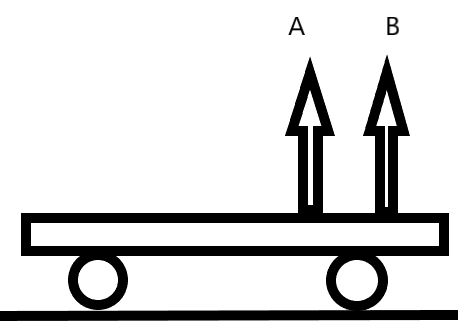
(i)Both A and B jump from the platform simultaneously and in the same horizontal direction.
(ii)A jumps first in a horizontal direction and after a few seconds B also jumps in the same direction.
In the both situations above, just after the jump, the person (A or B) moves away from the platform with a speed 3\[\text{m}{{\text{s}}^{-1}}\] relative to the [platform and along the horizontal. Final speed of the platform in situation (ii), i.e., just after B jumped will be nearly –
\[\begin{align}
& \text{A) 7}\text{.5m}{{\text{s}}^{-1}} \\
& \text{B) 5}\text{.5m}{{\text{s}}^{-1}} \\
& \text{C) 4}\text{.5m}{{\text{s}}^{-1}} \\
& \text{D) 2}\text{.5m}{{\text{s}}^{-1}} \\
\end{align}\]
Answer
 Verified
586.2k+ views
Hint: We have to consider the given situations in which A and B jumps from the platform and compare together to get the sufficient information to compute the final speed attained by the platform. We can use conservation of momentum to easily get the answer.
Complete answer:
We are given two persons standing on a platform supported by wheels placed on a frictionless horizontal floor. The whole system is supposed to be at rest initially as per the figure.
Now, persons A and B jump horizontally on the platform at the same instant. We know that the platform tends to move along the horizontal direction only. Since, the people are jumping vertically, there is no chance for net force on the platform and there will be no velocity along the direction of the centre of mass. The acceleration will be also zero.
\[\begin{align}
& {{m}_{hor}}v={{m}_{total}}({{v}_{0}}-v) \\
& \text{given,} \\
& {{\text{m}}_{a}}=60kg \\
& {{m}_{b}}=40kg \\
& {{m}_{total}}=100kg \\
& {{m}_{hor}}=50kg \\
& {{v}_{0}}=3m{{s}^{-1}} \\
& \Rightarrow 50v=300-100v \\
& \Rightarrow v=2m{{s}^{-1}} \\
\end{align}\]
The speed of the platform will be 2\[\text{m}{{\text{s}}^{-1}}\] in the initial situation.
Now, we know that person B jumps after a few seconds and then moves away with a speed of 3\[\text{m}{{\text{s}}^{-1}}\]. We can find the velocity of the cart after the A jumps as –
\[\begin{align}
& {{m}_{b+c}}u={{m}_{a}}(3-u) \\
& {{m}_{b+c}}=90kg \\
& \Rightarrow 90u=60(3-u) \\
& \Rightarrow 90u=180-60u \\
& \Rightarrow u=1.2m{{s}^{-1}} \\
\end{align}\]
Now, we can find the final speed of the platform after the person B jumps as –
\[\begin{align}
& {{m}_{b+c}}u={{m}_{c}}{{v}_{f}}-{{m}_{b}}(3-{{v}_{f}}) \\
& u=1.2m{{s}^{-1}} \\
& \Rightarrow 90\times 1.2=50{{v}_{f}}-40(3-{{v}_{f}}) \\
& \Rightarrow 108=50{{v}_{f}}-120+40{{v}_{f}} \\
& \Rightarrow 228=90{{v}_{f}} \\
& \Rightarrow {{v}_{f}}=2.53m{{s}^{-1}} \\
\end{align}\]
So, the final speed of the platform is \[2.53m{{s}^{-1}}\].
So, the correct answer is “Option D”.
Note:
The concept of conservation of linear momentum was used in the entire question to solve it. The speed of the platform is varied by the momentum imparted by the masses on jumping and moving away. The velocity of center of mass is also an important concept.
Complete answer:
We are given two persons standing on a platform supported by wheels placed on a frictionless horizontal floor. The whole system is supposed to be at rest initially as per the figure.
Now, persons A and B jump horizontally on the platform at the same instant. We know that the platform tends to move along the horizontal direction only. Since, the people are jumping vertically, there is no chance for net force on the platform and there will be no velocity along the direction of the centre of mass. The acceleration will be also zero.
\[\begin{align}
& {{m}_{hor}}v={{m}_{total}}({{v}_{0}}-v) \\
& \text{given,} \\
& {{\text{m}}_{a}}=60kg \\
& {{m}_{b}}=40kg \\
& {{m}_{total}}=100kg \\
& {{m}_{hor}}=50kg \\
& {{v}_{0}}=3m{{s}^{-1}} \\
& \Rightarrow 50v=300-100v \\
& \Rightarrow v=2m{{s}^{-1}} \\
\end{align}\]
The speed of the platform will be 2\[\text{m}{{\text{s}}^{-1}}\] in the initial situation.
Now, we know that person B jumps after a few seconds and then moves away with a speed of 3\[\text{m}{{\text{s}}^{-1}}\]. We can find the velocity of the cart after the A jumps as –
\[\begin{align}
& {{m}_{b+c}}u={{m}_{a}}(3-u) \\
& {{m}_{b+c}}=90kg \\
& \Rightarrow 90u=60(3-u) \\
& \Rightarrow 90u=180-60u \\
& \Rightarrow u=1.2m{{s}^{-1}} \\
\end{align}\]
Now, we can find the final speed of the platform after the person B jumps as –
\[\begin{align}
& {{m}_{b+c}}u={{m}_{c}}{{v}_{f}}-{{m}_{b}}(3-{{v}_{f}}) \\
& u=1.2m{{s}^{-1}} \\
& \Rightarrow 90\times 1.2=50{{v}_{f}}-40(3-{{v}_{f}}) \\
& \Rightarrow 108=50{{v}_{f}}-120+40{{v}_{f}} \\
& \Rightarrow 228=90{{v}_{f}} \\
& \Rightarrow {{v}_{f}}=2.53m{{s}^{-1}} \\
\end{align}\]
So, the final speed of the platform is \[2.53m{{s}^{-1}}\].
So, the correct answer is “Option D”.
Note:
The concept of conservation of linear momentum was used in the entire question to solve it. The speed of the platform is varied by the momentum imparted by the masses on jumping and moving away. The velocity of center of mass is also an important concept.
Recently Updated Pages
Master Class 11 Business Studies: Engaging Questions & Answers for Success

Master Class 11 Computer Science: Engaging Questions & Answers for Success
Master Class 11 Economics: Engaging Questions & Answers for Success
Master Class 11 Social Science: Engaging Questions & Answers for Success
Master Class 11 English: Engaging Questions & Answers for Success
Master Class 11 Chemistry: Engaging Questions & Answers for Success
Trending doubts
Draw a diagram of nephron and explain its structur class 11 biology CBSE
Explain zero factorial class 11 maths CBSE
Chemical formula of Bleaching powder is A Ca2OCl2 B class 11 chemistry CBSE
Name the part of the brain responsible for the precision class 11 biology CBSE
The growth of tendril in pea plants is due to AEffect class 11 biology CBSE
One Metric ton is equal to kg A 10000 B 1000 C 100 class 11 physics CBSE