




Two people standing on the same side of a tower in straight line with it, measures the angles of elevation of the height of tower as \[{{25}^{\circ }}\] and \[{{50}^{\circ }}\] respectively. If the height of the tower is 70m, find the distance between the two people.
Answer
 Verified
626.1k+ views
Hint: Draw a diagram of the given conditions and assume the height of the tower as ‘h’. Assume \[{{x}_{1}}\] and \[{{x}_{2}}\] as the distance of person 1 and person 2 respectively from the foot of the tower. Form two right-angle triangles and use \[\tan \theta \] = (perpendicular / base) to form expressions in terms of \[{{x}_{1}}\] and \[{{x}_{2}}\], where ‘\[\theta \]’ is the angle of elevation. Take the difference of \[{{x}_{1}}\] and \[{{x}_{2}}\] and substitute the given values of \[\theta \] and ‘h’ to get the answer.
Complete step by step answer:
Let us draw a rough diagram of the given situation: -
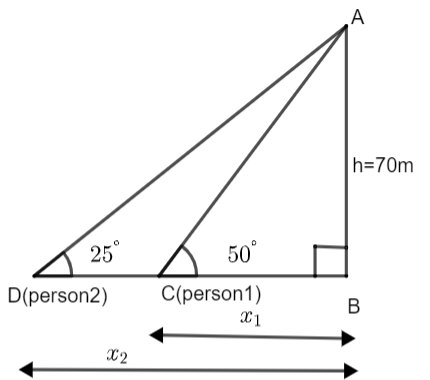
In the above figure, we have assumed that AB is the tower of height ‘h’. A is the top of the tower and B is its foot. Here, person 1 is assumed to be standing at point C at a distance of \[{{x}_{1}}\] from point B. Person 2 is assumed to be at point D at a distance of \[{{x}_{2}}\] from point B. The angle of elevation of the top of the tower for person 1 and person 2 are \[{{50}^{\circ }}\] and \[{{25}^{\circ }}\] respectively.
Now, in the right angle triangle ABC, we have,
AB = h
BC = \[{{x}_{1}}\]
\[\angle ACB={{50}^{\circ }}\]
Using, \[\tan \theta \] = (perpendicular / base), where \[\theta \] is the angle of elevation, we get,
\[\begin{align}
& \Rightarrow \tan {{50}^{\circ }}=\dfrac{AB}{BC} \\
& \Rightarrow \tan {{50}^{\circ }}=\dfrac{h}{{{x}_{1}}} \\
\end{align}\]
\[\Rightarrow {{x}_{1}}=\dfrac{h}{\tan {{50}^{\circ }}}\] - (1)
Now, in right angle triangle ABD, we have,
AB = h
BD = \[{{x}_{2}}\]
\[\angle ADB={{25}^{\circ }}\]
Using, \[\tan \theta \] = (perpendicular / base), we get,
\[\Rightarrow \tan {{25}^{\circ }}=\dfrac{h}{{{x}_{2}}}=\dfrac{AB}{BD}\]
\[\Rightarrow {{x}_{2}}=\dfrac{h}{\tan {{25}^{\circ }}}\] - (2)
Now, we can clearly see that the total distance between the two people is \[CD=BD-BC={{x}_{2}}-{{x}_{1}}\]. So, subtracting equations (2) and (1), we get,
\[\begin{align}
& \Rightarrow {{x}_{2}}-{{x}_{1}}=\dfrac{h}{\tan {{25}^{\circ }}}-\dfrac{h}{\tan {{50}^{\circ }}} \\
& \Rightarrow {{x}_{2}}-{{x}_{1}}=h\left[ \dfrac{1}{\tan {{25}^{\circ }}}-\dfrac{1}{\tan {{50}^{\circ }}} \right] \\
\end{align}\]
Using the conversion, \[\tan \theta =\dfrac{\sin \theta }{\cos \theta }\], we get,
\[\Rightarrow {{x}_{2}}-{{x}_{1}}=h\left[ \dfrac{\cos {{25}^{\circ }}}{\sin {{25}^{\circ }}}-\dfrac{\cos {{50}^{\circ }}}{\sin {{50}^{\circ }}} \right]\]
Substituting h = 70, we get,
\[\Rightarrow {{x}_{2}}-{{x}_{1}}=70\times \left[ \dfrac{\sin {{25}^{\circ }}\cos {{25}^{\circ }}-\cos {{50}^{\circ }}\sin {{50}^{\circ }}}{\sin {{25}^{\circ }}\sin {{50}^{\circ }}} \right]\]
Using the identity, \[\sin A\cos B-\cos A\sin B=\sin \left( A-B \right)\], we get,
\[\begin{align}
& \Rightarrow {{x}_{2}}-{{x}_{2}}=70\times \left[ \dfrac{\sin \left( {{50}^{\circ }}-{{25}^{\circ }} \right)}{\sin {{25}^{\circ }}\sin {{50}^{\circ }}} \right] \\
& \Rightarrow {{x}_{2}}-{{x}_{2}}=70\times \dfrac{\sin {{25}^{\circ }}}{\sin {{25}^{\circ }}\sin {{50}^{\circ }}} \\
\end{align}\]
Cancelling the common factor, we get,
\[\Rightarrow {{x}_{2}}-{{x}_{2}}=\dfrac{70}{\sin {{50}^{\circ }}}\]
Hence, the distance between two people is \[\dfrac{70}{\sin {{50}^{\circ }}}\].
Note:
One may note that we have obtained the answer in terms of the sine of the angle \[{{50}^{\circ }}\]. This is because we cannot substitute the value of \[\sin {{50}^{\circ }}\] in the expression without using a sine table. So, the expression cannot be simplified any further. You must draw a diagram according to the given question so that all the conditions can be easily visualized. Also, note that we have used \[\tan \theta \] and not \[\sin \theta \] or \[\cos \theta \] while solving the question because we have been provided information regarding base and perpendicular but not the hypotenuse.
Complete step by step answer:
Let us draw a rough diagram of the given situation: -
In the above figure, we have assumed that AB is the tower of height ‘h’. A is the top of the tower and B is its foot. Here, person 1 is assumed to be standing at point C at a distance of \[{{x}_{1}}\] from point B. Person 2 is assumed to be at point D at a distance of \[{{x}_{2}}\] from point B. The angle of elevation of the top of the tower for person 1 and person 2 are \[{{50}^{\circ }}\] and \[{{25}^{\circ }}\] respectively.
Now, in the right angle triangle ABC, we have,
AB = h
BC = \[{{x}_{1}}\]
\[\angle ACB={{50}^{\circ }}\]
Using, \[\tan \theta \] = (perpendicular / base), where \[\theta \] is the angle of elevation, we get,
\[\begin{align}
& \Rightarrow \tan {{50}^{\circ }}=\dfrac{AB}{BC} \\
& \Rightarrow \tan {{50}^{\circ }}=\dfrac{h}{{{x}_{1}}} \\
\end{align}\]
\[\Rightarrow {{x}_{1}}=\dfrac{h}{\tan {{50}^{\circ }}}\] - (1)
Now, in right angle triangle ABD, we have,
AB = h
BD = \[{{x}_{2}}\]
\[\angle ADB={{25}^{\circ }}\]
Using, \[\tan \theta \] = (perpendicular / base), we get,
\[\Rightarrow \tan {{25}^{\circ }}=\dfrac{h}{{{x}_{2}}}=\dfrac{AB}{BD}\]
\[\Rightarrow {{x}_{2}}=\dfrac{h}{\tan {{25}^{\circ }}}\] - (2)
Now, we can clearly see that the total distance between the two people is \[CD=BD-BC={{x}_{2}}-{{x}_{1}}\]. So, subtracting equations (2) and (1), we get,
\[\begin{align}
& \Rightarrow {{x}_{2}}-{{x}_{1}}=\dfrac{h}{\tan {{25}^{\circ }}}-\dfrac{h}{\tan {{50}^{\circ }}} \\
& \Rightarrow {{x}_{2}}-{{x}_{1}}=h\left[ \dfrac{1}{\tan {{25}^{\circ }}}-\dfrac{1}{\tan {{50}^{\circ }}} \right] \\
\end{align}\]
Using the conversion, \[\tan \theta =\dfrac{\sin \theta }{\cos \theta }\], we get,
\[\Rightarrow {{x}_{2}}-{{x}_{1}}=h\left[ \dfrac{\cos {{25}^{\circ }}}{\sin {{25}^{\circ }}}-\dfrac{\cos {{50}^{\circ }}}{\sin {{50}^{\circ }}} \right]\]
Substituting h = 70, we get,
\[\Rightarrow {{x}_{2}}-{{x}_{1}}=70\times \left[ \dfrac{\sin {{25}^{\circ }}\cos {{25}^{\circ }}-\cos {{50}^{\circ }}\sin {{50}^{\circ }}}{\sin {{25}^{\circ }}\sin {{50}^{\circ }}} \right]\]
Using the identity, \[\sin A\cos B-\cos A\sin B=\sin \left( A-B \right)\], we get,
\[\begin{align}
& \Rightarrow {{x}_{2}}-{{x}_{2}}=70\times \left[ \dfrac{\sin \left( {{50}^{\circ }}-{{25}^{\circ }} \right)}{\sin {{25}^{\circ }}\sin {{50}^{\circ }}} \right] \\
& \Rightarrow {{x}_{2}}-{{x}_{2}}=70\times \dfrac{\sin {{25}^{\circ }}}{\sin {{25}^{\circ }}\sin {{50}^{\circ }}} \\
\end{align}\]
Cancelling the common factor, we get,
\[\Rightarrow {{x}_{2}}-{{x}_{2}}=\dfrac{70}{\sin {{50}^{\circ }}}\]
Hence, the distance between two people is \[\dfrac{70}{\sin {{50}^{\circ }}}\].
Note:
One may note that we have obtained the answer in terms of the sine of the angle \[{{50}^{\circ }}\]. This is because we cannot substitute the value of \[\sin {{50}^{\circ }}\] in the expression without using a sine table. So, the expression cannot be simplified any further. You must draw a diagram according to the given question so that all the conditions can be easily visualized. Also, note that we have used \[\tan \theta \] and not \[\sin \theta \] or \[\cos \theta \] while solving the question because we have been provided information regarding base and perpendicular but not the hypotenuse.
Recently Updated Pages
Differentiate between voluntary action and reflex class 10 biology CBSE

The uses of bleaching powder are A It is used bleaching class 10 chemistry CBSE
Fill in the blanks with abstract nouns of the words class 10 english CBSE
How many threedigit numbers are there class 10 maths CBSE
What is a reflex arc class 10 biology CBSE
Construct a square whose diagonal is 6cm Measure the class 10 maths CBSE
Trending doubts
Explain the Treaty of Vienna of 1815 class 10 social science CBSE
The slogan Jai Hind was given by A Lal Bahadur Shastri class 10 social science CBSE
10 examples of evaporation in daily life with explanations
What is the full form of POSCO class 10 social science CBSE
Identify the feminine form of noun nephew a shenephew class 10 english CBSE
CSIR full form?