




Two particles start moving from the same position on a circle of radius $20cm$ with speed $40\pi m{{s}^{-1}}$ and $36\pi m{{s}^{-1}}$ respectively in the same direction. Calculate the time after which the particles will meet again.
Answer
 Verified
589.8k+ views
Hint: The relative velocity of the particle should be found out first. Then the distance of the circumference covered with this relative velocity should be found out. Calculate the time taken from this by rearranging the equation. These all may help you to solve this question.
Complete answer:
It is mentioned in the question that the two particles start from the same position. The radius of this circular path will be given as,
$r=20cm$
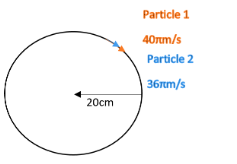
The speed of the travel will be given as,
$\begin{align}
& {{s}_{1}}=40\pi m{{s}^{-1}} \\
& {{s}_{2}}=36\pi m{{s}^{-1}} \\
\end{align}$
From this the relative velocity of the first particle with respect to the slow particle will be written as,
$\begin{align}
& {{v}_{r}}=\left( 40\pi -36\pi \right)m{{s}^{-1}} \\
& \Rightarrow {{v}_{r}}=4\pi m{{s}^{-1}} \\
\end{align}$
The relative velocity will be the ratio of the distance of the circular path taken to the time taken for the travel.
${{v}_{r}}=\dfrac{c}{T}$
Where $c$ be the circumference of the circular path traversed and $T$ will be the time at which the particle will meet again.
The circumference of the distance covered with this relative velocity will be given as,
$c=2\pi R$
Substituting this in the equation will give,
$4\pi =\dfrac{2\pi R}{T}$
Rearranging this equation will give,
$T=\dfrac{2\pi R}{4\pi }=\dfrac{R}{2}$
Substituting the value of the radius in it will give,
$T=\dfrac{20\times {{10}^{-2}}}{2}=10\times {{10}^{-2}}=\dfrac{1}{10}s$
Therefore after $\dfrac{1}{10}s$ the particles will meet again.
Note:
The relative velocity is defined as the difference in the velocity of the body with respect to another body in any other frame of reference. Maybe the other object will be in rest or in a moving frame. It is the vector difference between the velocities of two bodies. In one dimension, if the objects are moving in a parallel direction, then the relative velocity will be the sum of both the velocities. If they are antiparallel then their difference in velocity will be the relative velocity.
Complete answer:
It is mentioned in the question that the two particles start from the same position. The radius of this circular path will be given as,
$r=20cm$
The speed of the travel will be given as,
$\begin{align}
& {{s}_{1}}=40\pi m{{s}^{-1}} \\
& {{s}_{2}}=36\pi m{{s}^{-1}} \\
\end{align}$
From this the relative velocity of the first particle with respect to the slow particle will be written as,
$\begin{align}
& {{v}_{r}}=\left( 40\pi -36\pi \right)m{{s}^{-1}} \\
& \Rightarrow {{v}_{r}}=4\pi m{{s}^{-1}} \\
\end{align}$
The relative velocity will be the ratio of the distance of the circular path taken to the time taken for the travel.
${{v}_{r}}=\dfrac{c}{T}$
Where $c$ be the circumference of the circular path traversed and $T$ will be the time at which the particle will meet again.
The circumference of the distance covered with this relative velocity will be given as,
$c=2\pi R$
Substituting this in the equation will give,
$4\pi =\dfrac{2\pi R}{T}$
Rearranging this equation will give,
$T=\dfrac{2\pi R}{4\pi }=\dfrac{R}{2}$
Substituting the value of the radius in it will give,
$T=\dfrac{20\times {{10}^{-2}}}{2}=10\times {{10}^{-2}}=\dfrac{1}{10}s$
Therefore after $\dfrac{1}{10}s$ the particles will meet again.
Note:
The relative velocity is defined as the difference in the velocity of the body with respect to another body in any other frame of reference. Maybe the other object will be in rest or in a moving frame. It is the vector difference between the velocities of two bodies. In one dimension, if the objects are moving in a parallel direction, then the relative velocity will be the sum of both the velocities. If they are antiparallel then their difference in velocity will be the relative velocity.
Recently Updated Pages
Basicity of sulphurous acid and sulphuric acid are

Master Class 11 Business Studies: Engaging Questions & Answers for Success
Master Class 11 Computer Science: Engaging Questions & Answers for Success
Master Class 11 Economics: Engaging Questions & Answers for Success
Master Class 11 Social Science: Engaging Questions & Answers for Success
Master Class 11 English: Engaging Questions & Answers for Success
Trending doubts
One Metric ton is equal to kg A 10000 B 1000 C 100 class 11 physics CBSE
The largest wind power cluster is located in the state class 11 social science CBSE
Explain zero factorial class 11 maths CBSE
State and prove Bernoullis theorem class 11 physics CBSE
What steps did the French revolutionaries take to create class 11 social science CBSE
Which among the following are examples of coming together class 11 social science CBSE