




Two particles, each of mass m and speed v, travel in opposite directions along parallel lines separated by a distance d. Show that the vector angular momentum of the two particle systems is the same whatever be the point about which the angular momentum is taken.
Answer
 Verified
633k+ views
Hint – To get this problem solved we will find the angular momentum about all the possible points and if we get them same then our problem is solved.
Formula Used – Angular momentum = mass x speed x distance between particle and axis about which it is being calculated.
Complete step-by-step answer:
We know that angular momentum can be written as mvr.
We will draw a figure and illustrate from the figure to solve this problem.
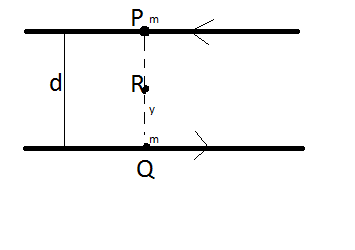
Let two particles be at points P and Q at a given time, as seen in the figure below.
Take point R, which is at a distance from point Q, i.e.
QR = y
PR = d−y
Angular momentum about the point P can be calculated as:
Lp = mv x 0 + mv × d = mvd ......(i)
Angular momentum about the point Q can be calculated as:
L q= mv x d + mv x 0 = mvd....(ii)
Angular momentum about the point R can be calculated as:
Lr = mv x (d−y) + mv x y = mvd ....(iii)
Comparing equations (i), (ii), and (iii), we get:
LP=LQ=LR......(iv)
We assume from equation (iv) that the angular momentum of the device does not depend on the point at which it is taken.
We can easily see that the vector angular momentum of the two particle systems is the same, regardless of the point at which the angular momentum is obtained.
Note – To solve this problem, we measured the angular momentum of all points and found that all points are the same, such that we can assume that the angular vector momentum of the two particle systems is the same, regardless of the point from which the angular momentum is taken.
Formula Used – Angular momentum = mass x speed x distance between particle and axis about which it is being calculated.
Complete step-by-step answer:
We know that angular momentum can be written as mvr.
We will draw a figure and illustrate from the figure to solve this problem.
Let two particles be at points P and Q at a given time, as seen in the figure below.
Take point R, which is at a distance from point Q, i.e.
QR = y
PR = d−y
Angular momentum about the point P can be calculated as:
Lp = mv x 0 + mv × d = mvd ......(i)
Angular momentum about the point Q can be calculated as:
L q= mv x d + mv x 0 = mvd....(ii)
Angular momentum about the point R can be calculated as:
Lr = mv x (d−y) + mv x y = mvd ....(iii)
Comparing equations (i), (ii), and (iii), we get:
LP=LQ=LR......(iv)
We assume from equation (iv) that the angular momentum of the device does not depend on the point at which it is taken.
We can easily see that the vector angular momentum of the two particle systems is the same, regardless of the point at which the angular momentum is obtained.
Note – To solve this problem, we measured the angular momentum of all points and found that all points are the same, such that we can assume that the angular vector momentum of the two particle systems is the same, regardless of the point from which the angular momentum is taken.
Recently Updated Pages
Master Class 11 Social Science: Engaging Questions & Answers for Success

Master Class 11 English: Engaging Questions & Answers for Success
Master Class 11 Maths: Engaging Questions & Answers for Success
Master Class 11 Chemistry: Engaging Questions & Answers for Success
Master Class 11 Biology: Engaging Questions & Answers for Success
Master Class 11 Physics: Engaging Questions & Answers for Success
Trending doubts
One Metric ton is equal to kg A 10000 B 1000 C 100 class 11 physics CBSE
Difference Between Prokaryotic Cells and Eukaryotic Cells
How many of the following diseases can be studied with class 11 biology CBSE
Draw a diagram of a plant cell and label at least eight class 11 biology CBSE
Two of the body parts which do not appear in MRI are class 11 biology CBSE
10 examples of friction in our daily life