




Two parabolas ${{y}^{2}}=4x$ and ${{x}^{2}}=4y$ intersect at a point P other than the origin, such that
(a) their tangents at P make Complementary angle with x-axis.
(b) they touch each other at P.
(c) they intersect at right angles at P.
(d) None of these.
Answer
 Verified
605.1k+ views
Hint: We start solving the problem by finding the point of intersection of the parabolas other than the origin. We then find the slope of the tangents for both the parabolas at the point P using the fact that the slope of the tangent for a conic is defined as $\dfrac{dy}{dx}$. We then check whether the parabolas touch each other using the fact that they will have a common tangent at that point. We then check whether the parabolas are perpendicular to each other by using the fact that they will have a perpendicular tangent at that point. We then find the angles made by each tangent with x-axis and add both of them to check whether they are satisfying the property of complementary angles to get the correct answer(s).
Complete step by step answer:
According to the problem, we are given that two parabolas ${{y}^{2}}=4x$ and ${{x}^{2}}=4y$ intersect at a point P other than the origin. We need to check properties of tangents at P and check which is the correct one from the given options.
Let us find the intersection point P of the parabolas ${{y}^{2}}=4x$ and ${{x}^{2}}=4y$.
Let us substitute $y=2\sqrt{x}$ in ${{x}^{2}}=4y$.
$\Rightarrow {{x}^{2}}=4\left( 2\sqrt{x} \right)$.
$\Rightarrow {{\left( \sqrt{x} \right)}^{4}}=8\sqrt{x}$.
$\Rightarrow {{\left( \sqrt{x} \right)}^{4}}-8\sqrt{x}=0$.
$\Rightarrow \sqrt{x}\left( {{\left( \sqrt{x} \right)}^{3}}-8 \right)=0$.
$\Rightarrow {{\left( \sqrt{x} \right)}^{3}}-8=0$, as $x=0$ in $\sqrt{x}=0$ which gives us the intersection point as origin.
$\Rightarrow {{\left( \sqrt{x} \right)}^{3}}=8$.
$\Rightarrow \sqrt{x}=2$.
$\Rightarrow x=4$. Let us substitute this value in ${{x}^{2}}=4y$.
So, we get $4y={{4}^{2}}\Leftrightarrow y=4$.
So, the intersection point P is $\left( 4,4 \right)$.
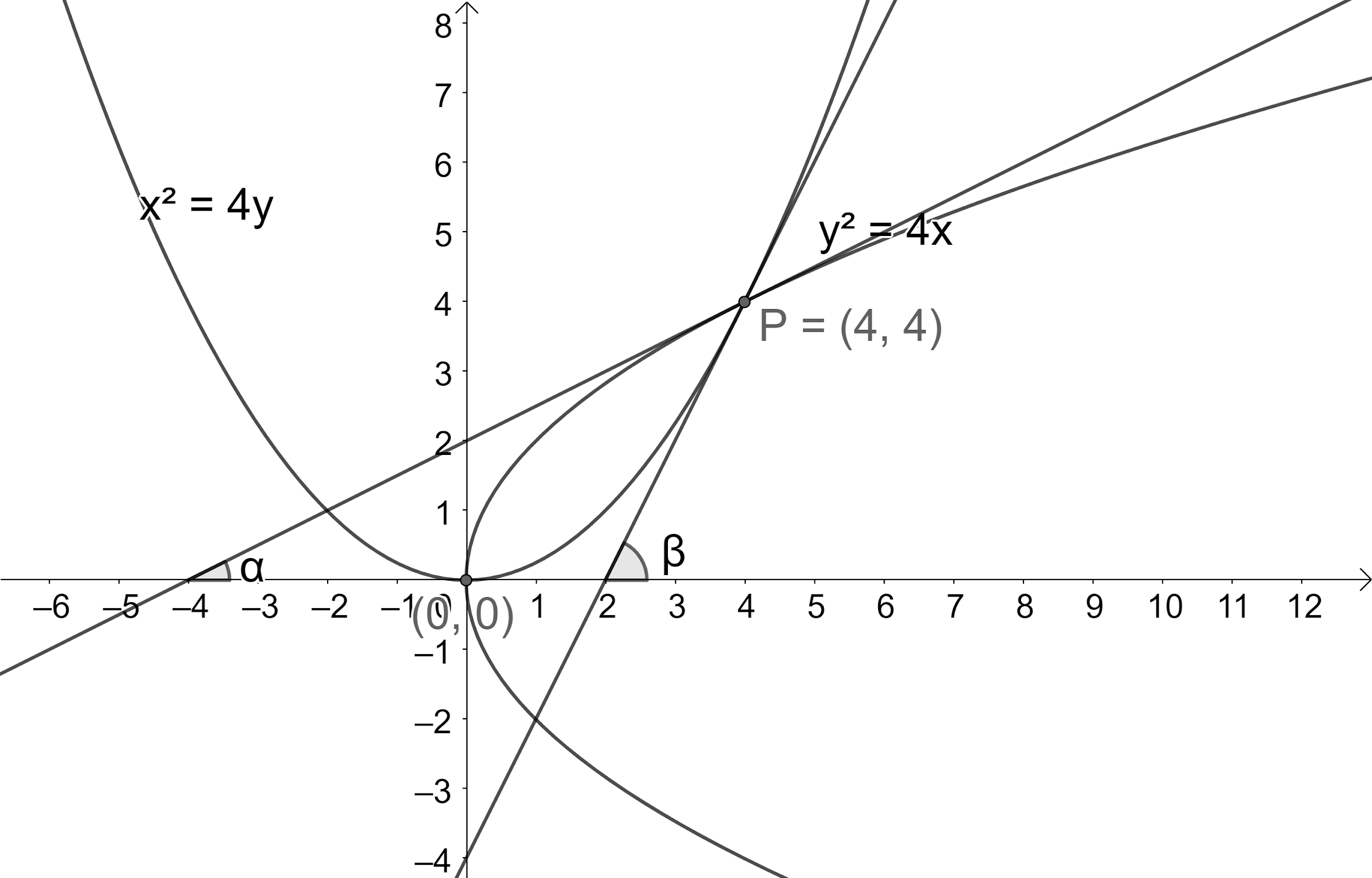
Let us find the slope of the tangent to parabola ${{y}^{2}}=4x$ at point $P\left( 4,4 \right)$.
We know that the slope of the tangent at any point for a conic is defined as $\dfrac{dy}{dx}$ at that point.
Let us differentiate ${{y}^{2}}=4x$ w.r.t x on both sides.
So, we get $\dfrac{d}{dx}\left( {{y}^{2}} \right)=\dfrac{d}{dx}\left( 4x \right)$.
$\Rightarrow 2y\dfrac{dy}{dx}=4$.
$\Rightarrow \dfrac{dy}{dx}=\dfrac{4}{2y}$.
$\Rightarrow \dfrac{dy}{dx}=\dfrac{2}{y}$.
$\Rightarrow slope={{\left. \dfrac{dy}{dx} \right|}_{P\left( 4,4 \right)}}=\dfrac{2}{4}=\dfrac{1}{2}$ ---(1).
Now, let us find the slope of the tangent to parabola ${{x}^{2}}=4y$ at point $P\left( 4,4 \right)$.
Let us differentiate ${{x}^{2}}=4y$ w.r.t x on both sides.
So, we get $\dfrac{d}{dx}\left( {{x}^{2}} \right)=\dfrac{d}{dx}\left( 4y \right)$.
$\Rightarrow 2x=4\dfrac{dy}{dx}$.
$\Rightarrow \dfrac{dy}{dx}=\dfrac{2x}{4}$.
$\Rightarrow \dfrac{dy}{dx}=\dfrac{x}{2}$.
$\Rightarrow slope={{\left. \dfrac{dy}{dx} \right|}_{P\left( 4,4 \right)}}=\dfrac{2\left( 4 \right)}{4}=2$ ---(2).
We know that if the two parabolas touch each other at a point, then they will have a common tangent at that point. This means that the slope of both the tangents should be equal.
From equation (1) and (2), we can see that the slopes are equal which means that the parabolas are not touching each other at point P.
We know that if the two parabolas are perpendicular to each other at a point, then they will have a perpendicular tangent at that point. This means that the product of slopes of both the tangents should be equal to ‘–1’.
Let us multiply the slopes obtained in equation (1) and (2). So, we get $\dfrac{1}{2}\times 2=1$. Which is not equal to –1. So, the parabolas are not perpendicular to each other at point P.
Now, let us find the angles made by each tangent with x-axis.
We know that the slope of any line is equal to the tangent of the angle made by a line with x-axis.
Let us assume the angles made by these two tangents with x-axis be $\alpha $ and $\beta $.
So, we have $\tan \alpha =\dfrac{1}{2}\Leftrightarrow \alpha ={{\tan }^{-1}}\left( \dfrac{1}{2} \right)$ ---(3).
And $\tan \beta =2\Leftrightarrow \beta ={{\tan }^{-1}}\left( 2 \right)$ ---(4).
Let us add the angles $\alpha $ and $\beta $.
We have $\alpha +\beta ={{\tan }^{-1}}\left( \dfrac{1}{2} \right)+{{\tan }^{-1}}\left( 2 \right)$.
We know that ${{\tan }^{-1}}\left( a \right)+{{\tan }^{-1}}\left( \dfrac{1}{a} \right)=\dfrac{\pi }{2}$.
So, we get $\alpha +\beta =\dfrac{\pi }{2}$.
We know that the sum of two complementary angles is $\dfrac{\pi }{2}$, which is satisfied by $\alpha $ and $\beta $.
So, the tangents of both the parabolas at point P make complementary angles with x-axis.
So, the correct answer is “Option a”.
Note: We can see that the given problem contains a heavy amount of calculation, so we need to avoid calculation mistakes while solving this problem. We can also find the equation of the tangents at the point of the intersection P using the slope of each of the tangents. We should not consider the value of x which may give origin as the intersection as it is clearly mentioned in the problem. Similarly, we can expect problems to find the sum of the angles made by normal at this point with x-axis.
Complete step by step answer:
According to the problem, we are given that two parabolas ${{y}^{2}}=4x$ and ${{x}^{2}}=4y$ intersect at a point P other than the origin. We need to check properties of tangents at P and check which is the correct one from the given options.
Let us find the intersection point P of the parabolas ${{y}^{2}}=4x$ and ${{x}^{2}}=4y$.
Let us substitute $y=2\sqrt{x}$ in ${{x}^{2}}=4y$.
$\Rightarrow {{x}^{2}}=4\left( 2\sqrt{x} \right)$.
$\Rightarrow {{\left( \sqrt{x} \right)}^{4}}=8\sqrt{x}$.
$\Rightarrow {{\left( \sqrt{x} \right)}^{4}}-8\sqrt{x}=0$.
$\Rightarrow \sqrt{x}\left( {{\left( \sqrt{x} \right)}^{3}}-8 \right)=0$.
$\Rightarrow {{\left( \sqrt{x} \right)}^{3}}-8=0$, as $x=0$ in $\sqrt{x}=0$ which gives us the intersection point as origin.
$\Rightarrow {{\left( \sqrt{x} \right)}^{3}}=8$.
$\Rightarrow \sqrt{x}=2$.
$\Rightarrow x=4$. Let us substitute this value in ${{x}^{2}}=4y$.
So, we get $4y={{4}^{2}}\Leftrightarrow y=4$.
So, the intersection point P is $\left( 4,4 \right)$.
Let us find the slope of the tangent to parabola ${{y}^{2}}=4x$ at point $P\left( 4,4 \right)$.
We know that the slope of the tangent at any point for a conic is defined as $\dfrac{dy}{dx}$ at that point.
Let us differentiate ${{y}^{2}}=4x$ w.r.t x on both sides.
So, we get $\dfrac{d}{dx}\left( {{y}^{2}} \right)=\dfrac{d}{dx}\left( 4x \right)$.
$\Rightarrow 2y\dfrac{dy}{dx}=4$.
$\Rightarrow \dfrac{dy}{dx}=\dfrac{4}{2y}$.
$\Rightarrow \dfrac{dy}{dx}=\dfrac{2}{y}$.
$\Rightarrow slope={{\left. \dfrac{dy}{dx} \right|}_{P\left( 4,4 \right)}}=\dfrac{2}{4}=\dfrac{1}{2}$ ---(1).
Now, let us find the slope of the tangent to parabola ${{x}^{2}}=4y$ at point $P\left( 4,4 \right)$.
Let us differentiate ${{x}^{2}}=4y$ w.r.t x on both sides.
So, we get $\dfrac{d}{dx}\left( {{x}^{2}} \right)=\dfrac{d}{dx}\left( 4y \right)$.
$\Rightarrow 2x=4\dfrac{dy}{dx}$.
$\Rightarrow \dfrac{dy}{dx}=\dfrac{2x}{4}$.
$\Rightarrow \dfrac{dy}{dx}=\dfrac{x}{2}$.
$\Rightarrow slope={{\left. \dfrac{dy}{dx} \right|}_{P\left( 4,4 \right)}}=\dfrac{2\left( 4 \right)}{4}=2$ ---(2).
We know that if the two parabolas touch each other at a point, then they will have a common tangent at that point. This means that the slope of both the tangents should be equal.
From equation (1) and (2), we can see that the slopes are equal which means that the parabolas are not touching each other at point P.
We know that if the two parabolas are perpendicular to each other at a point, then they will have a perpendicular tangent at that point. This means that the product of slopes of both the tangents should be equal to ‘–1’.
Let us multiply the slopes obtained in equation (1) and (2). So, we get $\dfrac{1}{2}\times 2=1$. Which is not equal to –1. So, the parabolas are not perpendicular to each other at point P.
Now, let us find the angles made by each tangent with x-axis.
We know that the slope of any line is equal to the tangent of the angle made by a line with x-axis.
Let us assume the angles made by these two tangents with x-axis be $\alpha $ and $\beta $.
So, we have $\tan \alpha =\dfrac{1}{2}\Leftrightarrow \alpha ={{\tan }^{-1}}\left( \dfrac{1}{2} \right)$ ---(3).
And $\tan \beta =2\Leftrightarrow \beta ={{\tan }^{-1}}\left( 2 \right)$ ---(4).
Let us add the angles $\alpha $ and $\beta $.
We have $\alpha +\beta ={{\tan }^{-1}}\left( \dfrac{1}{2} \right)+{{\tan }^{-1}}\left( 2 \right)$.
We know that ${{\tan }^{-1}}\left( a \right)+{{\tan }^{-1}}\left( \dfrac{1}{a} \right)=\dfrac{\pi }{2}$.
So, we get $\alpha +\beta =\dfrac{\pi }{2}$.
We know that the sum of two complementary angles is $\dfrac{\pi }{2}$, which is satisfied by $\alpha $ and $\beta $.
So, the tangents of both the parabolas at point P make complementary angles with x-axis.
So, the correct answer is “Option a”.
Note: We can see that the given problem contains a heavy amount of calculation, so we need to avoid calculation mistakes while solving this problem. We can also find the equation of the tangents at the point of the intersection P using the slope of each of the tangents. We should not consider the value of x which may give origin as the intersection as it is clearly mentioned in the problem. Similarly, we can expect problems to find the sum of the angles made by normal at this point with x-axis.
Recently Updated Pages
Master Class 11 Social Science: Engaging Questions & Answers for Success

Master Class 11 English: Engaging Questions & Answers for Success
Master Class 11 Maths: Engaging Questions & Answers for Success
Master Class 11 Chemistry: Engaging Questions & Answers for Success
Master Class 11 Biology: Engaging Questions & Answers for Success
Master Class 11 Physics: Engaging Questions & Answers for Success
Trending doubts
One Metric ton is equal to kg A 10000 B 1000 C 100 class 11 physics CBSE
Difference Between Prokaryotic Cells and Eukaryotic Cells
How many of the following diseases can be studied with class 11 biology CBSE
Two of the body parts which do not appear in MRI are class 11 biology CBSE
Which of the following enzymes is used for carboxylation class 11 biology CBSE
Explain zero factorial class 11 maths CBSE