




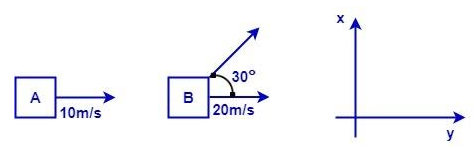
Two objects A and B are moving along the directions as shown in the figure. Find the magnitude and direction of the relative velocity of B w.r.t. A.
Answer
 Verified
571.8k+ views
Hint Relative velocity of B w.r.t. A is given by:
$\Rightarrow \overrightarrow{{{v}_{BA}}}=\overrightarrow{{{v}_{B}}}-\overrightarrow{{{v}_{A}}} $
Magnitude of this relative velocity is $ \left| \overrightarrow{{{v}_{BA}}} \right| $
Direction of this relative velocity is given by the angle $ \alpha $ which is calculated by:
$\Rightarrow \tan \alpha =\frac{{{v}_{B{{A}_{y}}}}}{{{v}_{B{{A}_{x}}}}} $
Where $ {{v}_{B{{A}_{y}}}} $ and $ {{v}_{B{{A}_{x}}}} $ are the y and x components of $ \overrightarrow{{{v}_{BA}}} $ .
Complete step by step solution
$ \begin{align}
&\Rightarrow \overrightarrow{{{v}_{A}}}=10\widehat{i} \\
&\Rightarrow \text{Here taking the components of velocity of B;} \\
&\Rightarrow \overrightarrow{{{v}_{B}}}=20\cos 30{}^\circ \widehat{i}+20\sin 30{}^\circ \widehat{j} \\
&\Rightarrow10\sqrt{3}\widehat{i}+10\widehat{j} \\
\end{align} $
Relative velocity of B w.r.t. A is
$ \begin{align}
&\Rightarrow \overrightarrow{{{v}_{BA}}}=\overrightarrow{{{v}_{B}}}-\overrightarrow{{{v}_{A}}} \\
&\Rightarrow =10\sqrt{3}\widehat{i}+10\widehat{j}-10\sqrt{3}\widehat{i} \\
&\Rightarrow =10\left( \sqrt{3}-1 \right)\widehat{i}+10\widehat{j} \\
\end{align} $
$ \begin{align}
& Now \\
&\Rightarrow \left| \overrightarrow{{{v}_{BA}}} \right|=10\sqrt{{{\left( \sqrt{3}-1 \right)}^{2}}+{{1}^{2}}} \\
&\Rightarrow10\sqrt{3+1-2\sqrt{3}+1} \\
&\Rightarrow \left| \overrightarrow{{{v}_{BA}}} \right|=10\sqrt{5-2\sqrt{3}}m{{s}^{-1}} \\
& \text{For direction;} \\
&\Rightarrow \tan \alpha =\frac{10}{10\left( \sqrt{3}-1 \right)} \\
&\Rightarrow \tan \alpha =\frac{1}{\sqrt{3}-1} \\
&\Rightarrow \alpha ={{\tan }^{-1}}\left( \frac{1}{\sqrt{3}-1} \right) \\
\end{align} $ .
Note
Alternate method:
Velocity of B w.r.t. A:
$\Rightarrow \overrightarrow{{{v}_{BA}}}=\overrightarrow{{{v}_{B}}}+\left( -\overrightarrow{{{v}_{A}}} \right) $
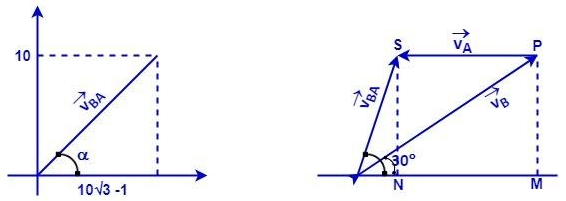
From the figure;
$ \begin{align}
&\Rightarrow NS=MP=20\sin 30{}^\circ \\
&\Rightarrow NS=10 \\
& and \\
&\Rightarrow ON=OM-NM \\
&\Rightarrow ON=20\cos 30{}^\circ -10 \\
&\Rightarrow ON=10\left( \sqrt{3}-1 \right) \\
&\Rightarrow \left| \overrightarrow{{{v}_{BA}}} \right|=\sqrt{O{{N}^{2}}+N{{S}^{2}}} \\
&\Rightarrow \left| \overrightarrow{{{v}_{BA}}} \right|=10\sqrt{{{\left( \sqrt{3}-1 \right)}^{2}}+{{1}^{2}}} \\
&\Rightarrow \left| \overrightarrow{{{v}_{BA}}} \right|=10\sqrt{5-2\sqrt{3}}m{{s}^{-1}} \\
\end{align} $
$ \begin{align}
& \text{For direction;} \\
&\Rightarrow \text{tan }\alpha =\frac{NS}{ON} \\
&\Rightarrow \tan \alpha =\frac{10}{10\left( \sqrt{3}-1 \right)} \\
&\Rightarrow \tan \alpha =\frac{1}{\sqrt{3}-1} \\
&\Rightarrow \alpha ={{\tan }^{-1}}\left( \frac{1}{\sqrt{3}-1} \right) \\
\end{align} $ .
$\Rightarrow \overrightarrow{{{v}_{BA}}}=\overrightarrow{{{v}_{B}}}-\overrightarrow{{{v}_{A}}} $
Magnitude of this relative velocity is $ \left| \overrightarrow{{{v}_{BA}}} \right| $
Direction of this relative velocity is given by the angle $ \alpha $ which is calculated by:
$\Rightarrow \tan \alpha =\frac{{{v}_{B{{A}_{y}}}}}{{{v}_{B{{A}_{x}}}}} $
Where $ {{v}_{B{{A}_{y}}}} $ and $ {{v}_{B{{A}_{x}}}} $ are the y and x components of $ \overrightarrow{{{v}_{BA}}} $ .
Complete step by step solution
$ \begin{align}
&\Rightarrow \overrightarrow{{{v}_{A}}}=10\widehat{i} \\
&\Rightarrow \text{Here taking the components of velocity of B;} \\
&\Rightarrow \overrightarrow{{{v}_{B}}}=20\cos 30{}^\circ \widehat{i}+20\sin 30{}^\circ \widehat{j} \\
&\Rightarrow10\sqrt{3}\widehat{i}+10\widehat{j} \\
\end{align} $
Relative velocity of B w.r.t. A is
$ \begin{align}
&\Rightarrow \overrightarrow{{{v}_{BA}}}=\overrightarrow{{{v}_{B}}}-\overrightarrow{{{v}_{A}}} \\
&\Rightarrow =10\sqrt{3}\widehat{i}+10\widehat{j}-10\sqrt{3}\widehat{i} \\
&\Rightarrow =10\left( \sqrt{3}-1 \right)\widehat{i}+10\widehat{j} \\
\end{align} $
$ \begin{align}
& Now \\
&\Rightarrow \left| \overrightarrow{{{v}_{BA}}} \right|=10\sqrt{{{\left( \sqrt{3}-1 \right)}^{2}}+{{1}^{2}}} \\
&\Rightarrow10\sqrt{3+1-2\sqrt{3}+1} \\
&\Rightarrow \left| \overrightarrow{{{v}_{BA}}} \right|=10\sqrt{5-2\sqrt{3}}m{{s}^{-1}} \\
& \text{For direction;} \\
&\Rightarrow \tan \alpha =\frac{10}{10\left( \sqrt{3}-1 \right)} \\
&\Rightarrow \tan \alpha =\frac{1}{\sqrt{3}-1} \\
&\Rightarrow \alpha ={{\tan }^{-1}}\left( \frac{1}{\sqrt{3}-1} \right) \\
\end{align} $ .
Note
Alternate method:
Velocity of B w.r.t. A:
$\Rightarrow \overrightarrow{{{v}_{BA}}}=\overrightarrow{{{v}_{B}}}+\left( -\overrightarrow{{{v}_{A}}} \right) $
From the figure;
$ \begin{align}
&\Rightarrow NS=MP=20\sin 30{}^\circ \\
&\Rightarrow NS=10 \\
& and \\
&\Rightarrow ON=OM-NM \\
&\Rightarrow ON=20\cos 30{}^\circ -10 \\
&\Rightarrow ON=10\left( \sqrt{3}-1 \right) \\
&\Rightarrow \left| \overrightarrow{{{v}_{BA}}} \right|=\sqrt{O{{N}^{2}}+N{{S}^{2}}} \\
&\Rightarrow \left| \overrightarrow{{{v}_{BA}}} \right|=10\sqrt{{{\left( \sqrt{3}-1 \right)}^{2}}+{{1}^{2}}} \\
&\Rightarrow \left| \overrightarrow{{{v}_{BA}}} \right|=10\sqrt{5-2\sqrt{3}}m{{s}^{-1}} \\
\end{align} $
$ \begin{align}
& \text{For direction;} \\
&\Rightarrow \text{tan }\alpha =\frac{NS}{ON} \\
&\Rightarrow \tan \alpha =\frac{10}{10\left( \sqrt{3}-1 \right)} \\
&\Rightarrow \tan \alpha =\frac{1}{\sqrt{3}-1} \\
&\Rightarrow \alpha ={{\tan }^{-1}}\left( \frac{1}{\sqrt{3}-1} \right) \\
\end{align} $ .
Recently Updated Pages
Master Class 11 Business Studies: Engaging Questions & Answers for Success

Master Class 11 Computer Science: Engaging Questions & Answers for Success
Master Class 11 Economics: Engaging Questions & Answers for Success
Master Class 11 Social Science: Engaging Questions & Answers for Success
Master Class 11 English: Engaging Questions & Answers for Success
Master Class 11 Chemistry: Engaging Questions & Answers for Success
Trending doubts
Draw a diagram of nephron and explain its structur class 11 biology CBSE
Explain zero factorial class 11 maths CBSE
Chemical formula of Bleaching powder is A Ca2OCl2 B class 11 chemistry CBSE
Name the part of the brain responsible for the precision class 11 biology CBSE
The growth of tendril in pea plants is due to AEffect class 11 biology CBSE
One Metric ton is equal to kg A 10000 B 1000 C 100 class 11 physics CBSE