




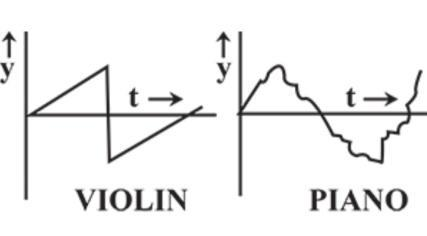
Two musical notes of the same pitch and same loudness are played on two different instruments. Their wave patterns are as shown in Figure. Explain why the wave patterns are different?
Answer
 Verified
635.4k+ views
Hint: Remember different instruments vibrate at different frequencies to produce sound. So they have different waveforms leading to different quality of the tone, in spite of the same musical note.
Complete step by step answer:
Each musical note has loudness and pitch as their characteristic. The lower the pitch the slower the vibration. Different pitched sounds are played by different types of musical instruments.
Loudness of a sound is related to its energy, so the sound gets softer when we move away from it. This is because as we move away from the sound, the more energy is used to spread in various directions.
Now coming to musical instruments, Musical instruments play sound by vibration. So, as the instrument vibrates, it compresses or expands the air around it thereby producing sound waves.
One interesting fact of musical instruments is that all instruments vibrate at different frequencies.
So as the frequency varies so does the waveform and thereby the quality of the note varies. Therefore, two notes of the same pitch and loudness, played from different instruments do not sound the same because the waveforms are different.
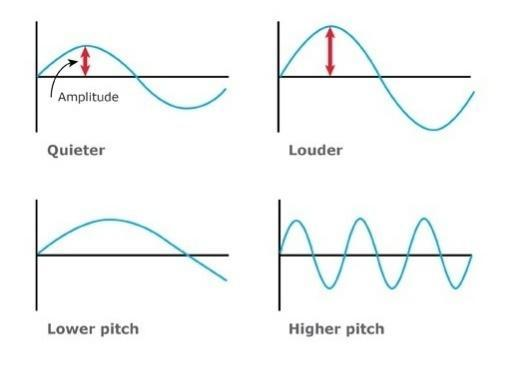
Have a look at the below diagram to understand how different characteristics of a sound wave changes its waveform.
Additional information:
(i)Amplitude and pitch are only two characteristics of sound. Different instruments generate a different sound envelope that represents its attack, sustain and decay. Plucking a guitar string results in a sound with a short attack, short sustain and long decay. Playing the same note on a violin results in a sound with a short attack, long sustain (as long as it’s bowed) and short decay.
(ii)Musical instruments not only generate a fundamental frequency (its pitch) but also multiples of that frequency known as harmonics. Harmonic content determines timbre. Instruments that produce higher harmonics have a sharper timbre than instruments that don't.
Note:
Altering the tone of each instrument can also make them more distinguishable, especially during recording or mixing, because the distribution of their energies across the same range of frequencies is different.
Complete step by step answer:
Each musical note has loudness and pitch as their characteristic. The lower the pitch the slower the vibration. Different pitched sounds are played by different types of musical instruments.
Loudness of a sound is related to its energy, so the sound gets softer when we move away from it. This is because as we move away from the sound, the more energy is used to spread in various directions.
Now coming to musical instruments, Musical instruments play sound by vibration. So, as the instrument vibrates, it compresses or expands the air around it thereby producing sound waves.
One interesting fact of musical instruments is that all instruments vibrate at different frequencies.
So as the frequency varies so does the waveform and thereby the quality of the note varies. Therefore, two notes of the same pitch and loudness, played from different instruments do not sound the same because the waveforms are different.
Have a look at the below diagram to understand how different characteristics of a sound wave changes its waveform.
Additional information:
(i)Amplitude and pitch are only two characteristics of sound. Different instruments generate a different sound envelope that represents its attack, sustain and decay. Plucking a guitar string results in a sound with a short attack, short sustain and long decay. Playing the same note on a violin results in a sound with a short attack, long sustain (as long as it’s bowed) and short decay.
(ii)Musical instruments not only generate a fundamental frequency (its pitch) but also multiples of that frequency known as harmonics. Harmonic content determines timbre. Instruments that produce higher harmonics have a sharper timbre than instruments that don't.
Note:
Altering the tone of each instrument can also make them more distinguishable, especially during recording or mixing, because the distribution of their energies across the same range of frequencies is different.
Recently Updated Pages
Master Class 11 English: Engaging Questions & Answers for Success

Master Class 11 Social Science: Engaging Questions & Answers for Success
Master Class 11 Maths: Engaging Questions & Answers for Success
Master Class 11 Chemistry: Engaging Questions & Answers for Success
Master Class 11 Biology: Engaging Questions & Answers for Success
Master Class 11 Physics: Engaging Questions & Answers for Success
Trending doubts
One Metric ton is equal to kg A 10000 B 1000 C 100 class 11 physics CBSE
Difference Between Prokaryotic Cells and Eukaryotic Cells
Find the value of the expression given below sin 30circ class 11 maths CBSE
1 ton equals to A 100 kg B 1000 kg C 10 kg D 10000 class 11 physics CBSE
Two of the body parts which do not appear in MRI are class 11 biology CBSE
Draw a diagram of nephron and explain its structur class 11 biology CBSE