




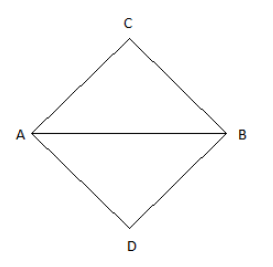
Two identical rectangular rods of metal are welded end to end in series between temperature \[{0^ \circ }C\] and \[{100^ \circ }C\] 10J of heat is conducted (in the steady-state process) through the rod in 2.00 min. If 5 such rods are taken and joined as shown in figure maintaining the same temperature difference between A and B.
(A) The time in which 20J heat will flow through the rods is 30 sec.
(B) The time in which 20J heat will flow through the rods is 60 sec.
(C) The net rate of heat transfer through the new structure is \[\dfrac{1}{3}{\text{J/sec}}\]
(D) The net rate of heat transfer through the new structure is \[\dfrac{2}{3}{\text{J/sec}}\].
Answer
 Verified
590.1k+ views
Hint: In this question, determine the temperature difference between the points A and B such that five similar rods have been joined as shown in the figure. For this, we will use the relation between the heat transfer between the two points and the temperature difference between the same points.
Complete step by step answer:
Given the temperature changes from \[{0^ \circ }C\] to \[{100^ \circ }C\] so, \[\Delta T = {100^ \circ }C\]
Let the cross-sectional area of the rod be A.
We know the heat transfer by conduction is given as, \[Q = \dfrac{{kA}}{l}\left( {{T_1} - {T_2}} \right) - - (i)\]
Here initially two identical rectangular rods of metal is welded, so the length become ‘2l’ and the temperature changes from \[{0^ \circ }C\] to \[{100^ \circ }C\] and 10 joules of heat is conducted for 2 minutes; hence we get
\[
\dfrac{{dQ}}{{dt}} = \dfrac{{kA}}{{2l}}\left( {{T_1} - {T_2}} \right) \\
\Rightarrow\dfrac{{20}}{{120}} = \dfrac{{kA}}{{2l}}\left( {100 - 0} \right) \\
\Rightarrow\dfrac{{kA}}{{2l}}\left( {100} \right) = \dfrac{{20}}{{120}} - - (ii) \\
\]
Now when 5 rods are welded
Let us assume the rods to be a resistor.
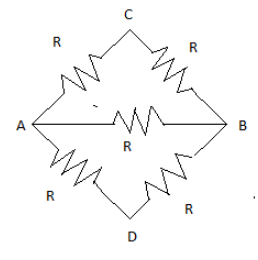
Where Resistances in ACB and ADB are in series hence their net resistances will be 2R respectively, and resistance R between AB is in parallel with resistances in ACB and ADB; hence the total equivalent resistance will be
\[
\Rightarrow\dfrac{1}{{{R_{eq}}}} = \dfrac{1}{{2R}} + \dfrac{1}{R} + \dfrac{1}{{2R}} \\
\Rightarrow\dfrac{1}{{{R_{eq}}}} = \dfrac{{1 + 2 + 1}}{{2R}} \\
\Rightarrow\dfrac{1}{{{R_{eq}}}} = \dfrac{4}{{2R}} \\
\Rightarrow\dfrac{1}{{{R_{eq}}}} = \dfrac{2}{R} \\
\]
Therefore the equivalent resistance is \[ = \dfrac{R}{2}\]
Similarly, the thermal conductivity will be
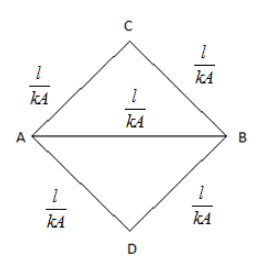
So the equivalent thermal conductivity between AB will be \[\dfrac{l}{{2kA}}\]
Therefore its heat transfer will be
\[
\Rightarrow\dfrac{{dQ}}{{dt}} = \dfrac{1}{{\left( {\dfrac{l}{{2kA}}} \right)}}\left( {{T_1} - {T_2}} \right) \\
\Rightarrow\dfrac{{20}}{x} = \dfrac{{2kA}}{l}\left( {100 - 0} \right) \\
\Rightarrow\dfrac{{20}}{x} = 2 \times 2\left( {\dfrac{{kA}}{{2l}}\left( {100 - 0} \right)} \right) \\
\]
Now since the value of \[\dfrac{{kA}}{{2l}}\left( {100} \right) = \dfrac{{20}}{{120}}\]from equation (ii), we can further write the equation
\[
\Rightarrow\dfrac{{20}}{x} = 2 \times 2 \times \dfrac{{20}}{{120}} \\
\Rightarrow x = \dfrac{{120 \times 20}}{{2 \times 2 \times 20}} \\
\therefore x= 30\sec \\
\]
Therefore the time in which $20 J$ heat will flow through the rods\[ = 30\sec \].
Hence, option A is correct.
Note:It is interesting to note here that, the equivalent formula for evaluating the thermal conductivity is equivalent to the formula used for calculating the equivalent resistance connected in a series-parallel connection. Moreover, heat transfer by thermal conduction is given by the formula \[Q = \dfrac{{kA}}{l}\left( {{T_1} - {T_2}} \right)\], where Q is the heat transferred, k is the thermal conductivity constant, area of the cross section of material, l is the length of material through which heat is being transferred.
Complete step by step answer:
Given the temperature changes from \[{0^ \circ }C\] to \[{100^ \circ }C\] so, \[\Delta T = {100^ \circ }C\]
Let the cross-sectional area of the rod be A.
We know the heat transfer by conduction is given as, \[Q = \dfrac{{kA}}{l}\left( {{T_1} - {T_2}} \right) - - (i)\]
Here initially two identical rectangular rods of metal is welded, so the length become ‘2l’ and the temperature changes from \[{0^ \circ }C\] to \[{100^ \circ }C\] and 10 joules of heat is conducted for 2 minutes; hence we get
\[
\dfrac{{dQ}}{{dt}} = \dfrac{{kA}}{{2l}}\left( {{T_1} - {T_2}} \right) \\
\Rightarrow\dfrac{{20}}{{120}} = \dfrac{{kA}}{{2l}}\left( {100 - 0} \right) \\
\Rightarrow\dfrac{{kA}}{{2l}}\left( {100} \right) = \dfrac{{20}}{{120}} - - (ii) \\
\]
Now when 5 rods are welded
Let us assume the rods to be a resistor.
Where Resistances in ACB and ADB are in series hence their net resistances will be 2R respectively, and resistance R between AB is in parallel with resistances in ACB and ADB; hence the total equivalent resistance will be
\[
\Rightarrow\dfrac{1}{{{R_{eq}}}} = \dfrac{1}{{2R}} + \dfrac{1}{R} + \dfrac{1}{{2R}} \\
\Rightarrow\dfrac{1}{{{R_{eq}}}} = \dfrac{{1 + 2 + 1}}{{2R}} \\
\Rightarrow\dfrac{1}{{{R_{eq}}}} = \dfrac{4}{{2R}} \\
\Rightarrow\dfrac{1}{{{R_{eq}}}} = \dfrac{2}{R} \\
\]
Therefore the equivalent resistance is \[ = \dfrac{R}{2}\]
Similarly, the thermal conductivity will be
So the equivalent thermal conductivity between AB will be \[\dfrac{l}{{2kA}}\]
Therefore its heat transfer will be
\[
\Rightarrow\dfrac{{dQ}}{{dt}} = \dfrac{1}{{\left( {\dfrac{l}{{2kA}}} \right)}}\left( {{T_1} - {T_2}} \right) \\
\Rightarrow\dfrac{{20}}{x} = \dfrac{{2kA}}{l}\left( {100 - 0} \right) \\
\Rightarrow\dfrac{{20}}{x} = 2 \times 2\left( {\dfrac{{kA}}{{2l}}\left( {100 - 0} \right)} \right) \\
\]
Now since the value of \[\dfrac{{kA}}{{2l}}\left( {100} \right) = \dfrac{{20}}{{120}}\]from equation (ii), we can further write the equation
\[
\Rightarrow\dfrac{{20}}{x} = 2 \times 2 \times \dfrac{{20}}{{120}} \\
\Rightarrow x = \dfrac{{120 \times 20}}{{2 \times 2 \times 20}} \\
\therefore x= 30\sec \\
\]
Therefore the time in which $20 J$ heat will flow through the rods\[ = 30\sec \].
Hence, option A is correct.
Note:It is interesting to note here that, the equivalent formula for evaluating the thermal conductivity is equivalent to the formula used for calculating the equivalent resistance connected in a series-parallel connection. Moreover, heat transfer by thermal conduction is given by the formula \[Q = \dfrac{{kA}}{l}\left( {{T_1} - {T_2}} \right)\], where Q is the heat transferred, k is the thermal conductivity constant, area of the cross section of material, l is the length of material through which heat is being transferred.
Recently Updated Pages
Master Class 11 Business Studies: Engaging Questions & Answers for Success

Master Class 11 Computer Science: Engaging Questions & Answers for Success
Master Class 11 Economics: Engaging Questions & Answers for Success
Master Class 11 Social Science: Engaging Questions & Answers for Success
Master Class 11 English: Engaging Questions & Answers for Success
Master Class 11 Chemistry: Engaging Questions & Answers for Success
Trending doubts
Draw a diagram of nephron and explain its structur class 11 biology CBSE
Explain zero factorial class 11 maths CBSE
Chemical formula of Bleaching powder is A Ca2OCl2 B class 11 chemistry CBSE
Name the part of the brain responsible for the precision class 11 biology CBSE
The growth of tendril in pea plants is due to AEffect class 11 biology CBSE
A solution of a substance X is used for white washing class 11 chemistry CBSE