




Two cubes have their volumes in the ratio 1:27. Find the ratio of their surface areas.
A) 3:9
B) 1:8
C) 1:9
D) 2:9
Answer
 Verified
657.6k+ views
Hint: The ratio of the volume of the cubes can be used to calculate the ratio of the sides. After obtaining the ratio of sides, the ratio of surface area can be easily determined.
Complete step-by-step answer:
Given in the problem, two cubes have their volumes in the ratio 1:27.
We need to find the ratio of their surface areas.
In geometry, a cube is a three-dimensional solid object bounded by six square faces, facets or sides, with three meeting at each vertex.
If a cube has a side $x {\text { unit}}$, then the volume of the cube is given by ${x^3}{\left( \text {unit} \right)^3}$.
Also, the surface area of the cube is given by $6{x^2}{\left( \text {unit} \right)^2}$.
In the problem there are two cubes given.
Let the side of the first cube be $x{\text{ }}unit$ and that of the second be $y{\text{ }}unit$ respectively.
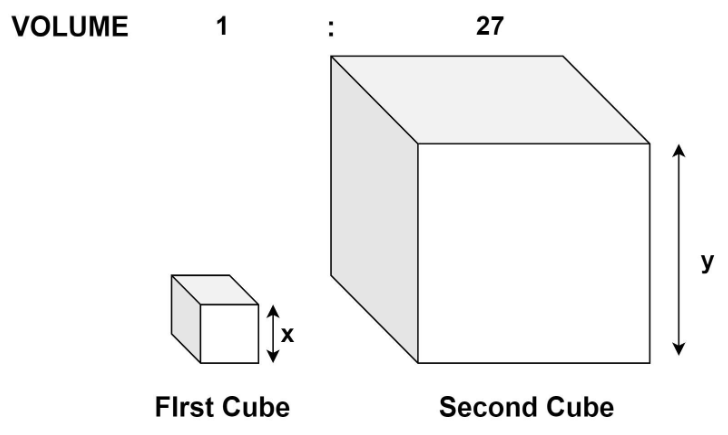
Hence, the volume of the first cube will be ${x^3}{\left( \text{unit} \right)^3}$.
And the volume of the second cube will be ${y^3}{\left( \text {unit} \right)^3}$.
It is given that the ratio of their volumes is 1:27.
\[
\Rightarrow \dfrac{{{\text{Volume of first cube}}}}{{{\text{Volume of second cube}}}} = \dfrac{1}{{27}} \\
\Rightarrow \dfrac{{{x^3}}}{{{y^3}}} = {\left( {\dfrac{x}{y}} \right)^3} = \dfrac{1}{{27}} \\
\Rightarrow \dfrac{x}{y} = {\left( {\dfrac{1}{{27}}} \right)^{\dfrac{1}{3}}} = \dfrac{1}{3} ………....(1) \\
\]
Hence the ratio of the side of the first cube to that of the second cube is 1:3.
We need to find the ratio of their surface area.
By using the above-mentioned formula, we get,
Surface area of the first cube $ = 6{x^2}{\left( \text {unit} \right)^2}$
Surface area of the second cube $ = 6{y^2}{\left( \text {unit} \right)^2}$
Therefore, ratio of their surface area is given by
\[ \Rightarrow \dfrac{{{\text{Surface area of first cube}}}}{{{\text{Surface area of second cube}}}} = \dfrac{{6{x^2}}}{{6{y^2}}} = {\left( {\dfrac{x}{y}} \right)^2}\]
Using equation (1) in the above, we get
\[ \Rightarrow \dfrac{{{\text{Surface area of first cube}}}}{{{\text{Surface area of second cube}}}} = {\left( {\dfrac{x}{y}} \right)^2} = {\left( {\dfrac{1}{3}} \right)^2} = \dfrac{1}{9}\]
Hence the ratio of surface area of the first cube to that of the second cube is 1:9.
Therefore, option (C). 1:9 is the correct answer.
Note: The formula of volume and surface area of the cube should be kept in mind while solving problems like above. Ratio is the quantitative relation between two amounts showing the number of times one value contains or is contained within the other. The unit of both the quantities in the ratio should be the same. In problems like the above effort should be made to obtain the desired result while assuming the minimum number of unknown quantities.
Complete step-by-step answer:
Given in the problem, two cubes have their volumes in the ratio 1:27.
We need to find the ratio of their surface areas.
In geometry, a cube is a three-dimensional solid object bounded by six square faces, facets or sides, with three meeting at each vertex.
If a cube has a side $x {\text { unit}}$, then the volume of the cube is given by ${x^3}{\left( \text {unit} \right)^3}$.
Also, the surface area of the cube is given by $6{x^2}{\left( \text {unit} \right)^2}$.
In the problem there are two cubes given.
Let the side of the first cube be $x{\text{ }}unit$ and that of the second be $y{\text{ }}unit$ respectively.
Hence, the volume of the first cube will be ${x^3}{\left( \text{unit} \right)^3}$.
And the volume of the second cube will be ${y^3}{\left( \text {unit} \right)^3}$.
It is given that the ratio of their volumes is 1:27.
\[
\Rightarrow \dfrac{{{\text{Volume of first cube}}}}{{{\text{Volume of second cube}}}} = \dfrac{1}{{27}} \\
\Rightarrow \dfrac{{{x^3}}}{{{y^3}}} = {\left( {\dfrac{x}{y}} \right)^3} = \dfrac{1}{{27}} \\
\Rightarrow \dfrac{x}{y} = {\left( {\dfrac{1}{{27}}} \right)^{\dfrac{1}{3}}} = \dfrac{1}{3} ………....(1) \\
\]
Hence the ratio of the side of the first cube to that of the second cube is 1:3.
We need to find the ratio of their surface area.
By using the above-mentioned formula, we get,
Surface area of the first cube $ = 6{x^2}{\left( \text {unit} \right)^2}$
Surface area of the second cube $ = 6{y^2}{\left( \text {unit} \right)^2}$
Therefore, ratio of their surface area is given by
\[ \Rightarrow \dfrac{{{\text{Surface area of first cube}}}}{{{\text{Surface area of second cube}}}} = \dfrac{{6{x^2}}}{{6{y^2}}} = {\left( {\dfrac{x}{y}} \right)^2}\]
Using equation (1) in the above, we get
\[ \Rightarrow \dfrac{{{\text{Surface area of first cube}}}}{{{\text{Surface area of second cube}}}} = {\left( {\dfrac{x}{y}} \right)^2} = {\left( {\dfrac{1}{3}} \right)^2} = \dfrac{1}{9}\]
Hence the ratio of surface area of the first cube to that of the second cube is 1:9.
Therefore, option (C). 1:9 is the correct answer.
Note: The formula of volume and surface area of the cube should be kept in mind while solving problems like above. Ratio is the quantitative relation between two amounts showing the number of times one value contains or is contained within the other. The unit of both the quantities in the ratio should be the same. In problems like the above effort should be made to obtain the desired result while assuming the minimum number of unknown quantities.
Recently Updated Pages
Master Class 11 English: Engaging Questions & Answers for Success

Master Class 11 Social Science: Engaging Questions & Answers for Success
Master Class 11 Maths: Engaging Questions & Answers for Success
Master Class 11 Biology: Engaging Questions & Answers for Success
Master Class 11 Physics: Engaging Questions & Answers for Success
Master Class 11 Chemistry: Engaging Questions & Answers for Success
Trending doubts
Explain the Treaty of Vienna of 1815 class 10 social science CBSE
What is the Total Duration of Football Match?
First Cotton Mill of India
In which year voting age was reduced from 21 to 18?
10 examples of evaporation in daily life with explanations
What planets have no moons Which one has only one moon class 10 physics CBSE