




Two concentric circles are of radius 5 cm and 3 cm. Find the length of the chord of the larger circle which touches the smaller circle.
Answer
 Verified
576.9k+ views
Hint: ${{C}_{1}}$ as the circle with radius 3 cm and ${{C}_{2}}$ as the circle with radius 5 cm. Let us assume O to be the center of the circles. Let the chord of ${{C}_{2}}$ that touches ${{C}_{1}}$ be BD. We will denote the point of contact as C. We can write \[OC=3\text{ cm},OB=OD=5\text{ cm}\] . We have to find BD. We know that tangent at any point of a circle is perpendicular to the radius through the point of contact. Hence, we can write $OC\bot BD$ . Let us consider triangle OBC and OCD and find the side BC and CD respectively using Pythagoras theorem which is given as $\text{Hypotenus}{{\text{e}}^{2}}=\text{Heigh}{{\text{t}}^{2}}+\text{Bas}{{\text{e}}^{2}}$ . Then add BC and CD to get BD which is the required answer.
Complete step-by-step answer:
We are given that two concentric circles are of radius 5 cm and 3 cm. Let us denote ${{C}_{1}}$ as the circle with radius 3 cm and ${{C}_{2}}$ as the circle with radius 5 cm. Let us assume O to be the center of the circles. Let the chord of ${{C}_{2}}$ that touches ${{C}_{1}}$ be BD. We will denote the point of contact as C. This is shown below.
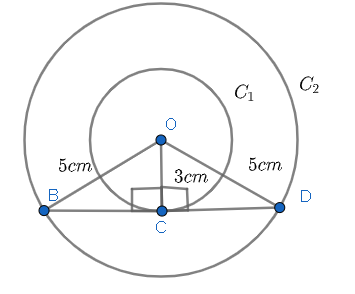
From the figure, we can write \[OC=3\text{ cm},OB=OD=5\text{ cm}\] . We have to find BD.
We know that tangent at any point of a circle is perpendicular to the radius through the point of contact. Hence, we can write $OC\bot BD$ .
Now, let us consider triangle OBC. Since $\angle OCB={{90}^{\circ }}$ , we can use the Pythagoras theorem to find BC.
We know that, $\text{Hypotenus}{{\text{e}}^{2}}=\text{Heigh}{{\text{t}}^{2}}+\text{Bas}{{\text{e}}^{2}}$
$\Rightarrow O{{B}^{2}}=O{{C}^{2}}+B{{C}^{2}}$
Let us substitute the values. We will get
$\begin{align}
& {{5}^{2}}={{3}^{2}}+B{{C}^{2}} \\
& \Rightarrow 25=9+B{{C}^{2}} \\
\end{align}$
Let us find BC.
$\begin{align}
& \Rightarrow 25-9=B{{C}^{2}} \\
& \Rightarrow B{{C}^{2}}=16 \\
\end{align}$
Let us take the square root. We will get
$BC=\sqrt{16}=4\text{ cm}$
Similarly, we can find CD.
Let us consider triangle OCD. We found that $\angle OCD={{90}^{\circ }}$ . Thus,
$\Rightarrow O{{D}^{2}}=O{{C}^{2}}+C{{D}^{2}}$
Let us substitute the values. We will get
$\begin{align}
& {{5}^{2}}={{3}^{2}}+C{{D}^{2}} \\
& \Rightarrow 25=9+C{{D}^{2}} \\
\end{align}$
Let us find CD.
$\begin{align}
& \Rightarrow 25-9=C{{D}^{2}} \\
& \Rightarrow C{{D}^{2}}=16 \\
\end{align}$
Let us take the square root. We will get
$CD=\sqrt{16}=4\text{ cm}$
Hence, we can write the length of the cord BD as
$BD=BC+CD=4+4=8\text{ cm}$
Hence, the length of the chord of the larger circle which touches the smaller circle is 8 cm.
Note: You have to draw diagrams with given data in order to solve the problems of this type. We can apply Pythagoras theorem in a triangle only when one the angles of the triangle is ${{90}^{\circ }}$ . Do not make mistake by writing Pythagoras theorem as $\text{Hypotenus}{{\text{e}}^{2}}=\text{Heigh}{{\text{t}}^{2}}-\text{Bas}{{\text{e}}^{2}}$ . Also, be careful with the units. Do not forget to write them at the end. You must know the theorems associated with circles to move forward with the solution.
Complete step-by-step answer:
We are given that two concentric circles are of radius 5 cm and 3 cm. Let us denote ${{C}_{1}}$ as the circle with radius 3 cm and ${{C}_{2}}$ as the circle with radius 5 cm. Let us assume O to be the center of the circles. Let the chord of ${{C}_{2}}$ that touches ${{C}_{1}}$ be BD. We will denote the point of contact as C. This is shown below.
From the figure, we can write \[OC=3\text{ cm},OB=OD=5\text{ cm}\] . We have to find BD.
We know that tangent at any point of a circle is perpendicular to the radius through the point of contact. Hence, we can write $OC\bot BD$ .
Now, let us consider triangle OBC. Since $\angle OCB={{90}^{\circ }}$ , we can use the Pythagoras theorem to find BC.
We know that, $\text{Hypotenus}{{\text{e}}^{2}}=\text{Heigh}{{\text{t}}^{2}}+\text{Bas}{{\text{e}}^{2}}$
$\Rightarrow O{{B}^{2}}=O{{C}^{2}}+B{{C}^{2}}$
Let us substitute the values. We will get
$\begin{align}
& {{5}^{2}}={{3}^{2}}+B{{C}^{2}} \\
& \Rightarrow 25=9+B{{C}^{2}} \\
\end{align}$
Let us find BC.
$\begin{align}
& \Rightarrow 25-9=B{{C}^{2}} \\
& \Rightarrow B{{C}^{2}}=16 \\
\end{align}$
Let us take the square root. We will get
$BC=\sqrt{16}=4\text{ cm}$
Similarly, we can find CD.
Let us consider triangle OCD. We found that $\angle OCD={{90}^{\circ }}$ . Thus,
$\Rightarrow O{{D}^{2}}=O{{C}^{2}}+C{{D}^{2}}$
Let us substitute the values. We will get
$\begin{align}
& {{5}^{2}}={{3}^{2}}+C{{D}^{2}} \\
& \Rightarrow 25=9+C{{D}^{2}} \\
\end{align}$
Let us find CD.
$\begin{align}
& \Rightarrow 25-9=C{{D}^{2}} \\
& \Rightarrow C{{D}^{2}}=16 \\
\end{align}$
Let us take the square root. We will get
$CD=\sqrt{16}=4\text{ cm}$
Hence, we can write the length of the cord BD as
$BD=BC+CD=4+4=8\text{ cm}$
Hence, the length of the chord of the larger circle which touches the smaller circle is 8 cm.
Note: You have to draw diagrams with given data in order to solve the problems of this type. We can apply Pythagoras theorem in a triangle only when one the angles of the triangle is ${{90}^{\circ }}$ . Do not make mistake by writing Pythagoras theorem as $\text{Hypotenus}{{\text{e}}^{2}}=\text{Heigh}{{\text{t}}^{2}}-\text{Bas}{{\text{e}}^{2}}$ . Also, be careful with the units. Do not forget to write them at the end. You must know the theorems associated with circles to move forward with the solution.
Recently Updated Pages
Master Class 10 Computer Science: Engaging Questions & Answers for Success

Master Class 10 General Knowledge: Engaging Questions & Answers for Success
Master Class 10 English: Engaging Questions & Answers for Success
Master Class 10 Social Science: Engaging Questions & Answers for Success
Master Class 10 Maths: Engaging Questions & Answers for Success
Master Class 10 Science: Engaging Questions & Answers for Success
Trending doubts
What is the median of the first 10 natural numbers class 10 maths CBSE
Which women's tennis player has 24 Grand Slam singles titles?
Who is the Brand Ambassador of Incredible India?
Why is there a time difference of about 5 hours between class 10 social science CBSE
Write a letter to the principal requesting him to grant class 10 english CBSE
State and prove converse of BPT Basic Proportionality class 10 maths CBSE