




Two concentric circles are of radii 5 cm and 3 cm. Find the length of chord of the larger circle which touches the smaller circle.
Answer
 Verified
625.8k+ views
Hint: In this question first draw the diagram it will give us a clear picture of what we have to find out. Then use the property that the radius is perpendicular to a chord and it divides the chord into two equal parts. So, use this property to reach the solution of the given problem.
Complete step-by-step answer:
Let the radius of the bigger circle be \[R\]and the radius of the smaller circle is \[r\].
It is given that \[R = 5{\text{ cm}}\]and \[r = 3{\text{ cm}}\]
The diagram of the two concentric circles is given below:
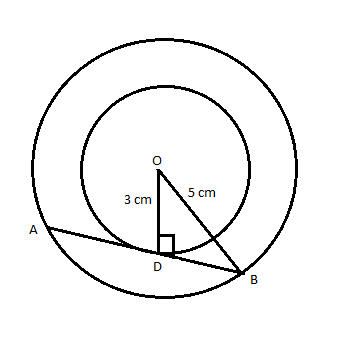
Here AB is the larger chord whose length we have to find.
By using the property that the radius is perpendicular to a chord and it divides the chord into two equal parts, we have \[AD = BD\]and \[OD \bot AB\]
Therefore, \[\Delta ODB\]is a right-angled triangle.
As \[\Delta ODB\]is a right-angled, we have
\[
\Rightarrow O{D^2} + B{D^2} = O{B^2} \\
\Rightarrow {\left( 3 \right)^2} + B{D^2} = {\left( 5 \right)^2} \\
\Rightarrow B{D^2} = {\left( 5 \right)^2} - {\left( 3 \right)^2} \\
\Rightarrow B{D^2} = 25 - 9 \\
\Rightarrow B{D^2} = 16 \\
\therefore BD = 4{\text{ cm}} \\
\]
So, AD = BD = 4 cm
Hence, AB = AD + BD = 4 + 4 = 8 cm.
Thus, the length of the larger chord is 8 cm.
Note: Here we have not considered the negative of BD because the length of the chord is always positive. Concentric circles are circles with a common centre. They fit inside each other and are the same distance apart all the way around.
Complete step-by-step answer:
Let the radius of the bigger circle be \[R\]and the radius of the smaller circle is \[r\].
It is given that \[R = 5{\text{ cm}}\]and \[r = 3{\text{ cm}}\]
The diagram of the two concentric circles is given below:
Here AB is the larger chord whose length we have to find.
By using the property that the radius is perpendicular to a chord and it divides the chord into two equal parts, we have \[AD = BD\]and \[OD \bot AB\]
Therefore, \[\Delta ODB\]is a right-angled triangle.
As \[\Delta ODB\]is a right-angled, we have
\[
\Rightarrow O{D^2} + B{D^2} = O{B^2} \\
\Rightarrow {\left( 3 \right)^2} + B{D^2} = {\left( 5 \right)^2} \\
\Rightarrow B{D^2} = {\left( 5 \right)^2} - {\left( 3 \right)^2} \\
\Rightarrow B{D^2} = 25 - 9 \\
\Rightarrow B{D^2} = 16 \\
\therefore BD = 4{\text{ cm}} \\
\]
So, AD = BD = 4 cm
Hence, AB = AD + BD = 4 + 4 = 8 cm.
Thus, the length of the larger chord is 8 cm.
Note: Here we have not considered the negative of BD because the length of the chord is always positive. Concentric circles are circles with a common centre. They fit inside each other and are the same distance apart all the way around.
Recently Updated Pages
Basicity of sulphurous acid and sulphuric acid are

Master Class 10 English: Engaging Questions & Answers for Success
Master Class 10 Social Science: Engaging Questions & Answers for Success
Master Class 10 Computer Science: Engaging Questions & Answers for Success
Class 10 Question and Answer - Your Ultimate Solutions Guide
Master Class 10 General Knowledge: Engaging Questions & Answers for Success
Trending doubts
Who is known as the "Little Master" in Indian cricket history?
A boat goes 24 km upstream and 28 km downstream in class 10 maths CBSE
Who Won 36 Oscar Awards? Record Holder Revealed
Why is there a time difference of about 5 hours between class 10 social science CBSE
Explain the Treaty of Vienna of 1815 class 10 social science CBSE
What is the median of the first 10 natural numbers class 10 maths CBSE