




Two circles of radii $5cm$ and $3cm$ intersect at two points and the distance between their centers is $4cm$. Find the length of the common chord.
Answer
 Verified
654.6k+ views
Hint:A circle is the path of a point which moves in a plane so that it remains at a constant distance from a fixed point in the plane. The fixed point is called the center and the constant distance from a fixed point in the plane. A line segment joining any two points of a circle is called a chord of the circle. The perpendicular from the center of a circle to a chord bisects the chord. Pythagoras theorem, “in a right-angled triangle, the square of the hypotenuse side is equal to the sum of the squares of the other two sides”.
Complete step-by-step answer:
Let us draw two circles of radii $5cm$ and $3cm$ intersect at two points A and B on the circumference of the circle.
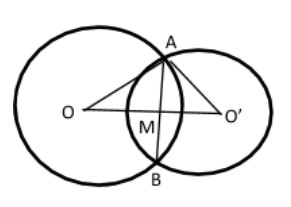
Let O and O’ be the centers of the circles of radii $5cm$ and $3cm$ respectively.
Let AB be the common chord of the two circles.
As the line of centers is the perpendicular bisector of the common chord,
OO’$ \bot $AB and M is midpoint of AB.
Let AM $ = x$ cm and OM $ = y$ cm.
As OO’ $ = 4$ cm (given), so MO’$ = (4 - x)cm$.
In $\Delta OMA$,$\angle M = 90^\circ $, by Pythagoras theorem,
$O{A^2} = O{M^2} + A{M^2}$
Substituting the values of OA, OM and AM in the above equation, we get
$ \Rightarrow {5^2} = {y^2} + {x^2}$ ………....(i)
Now, In$\Delta O'MA$,$\angle M = 90^\circ $, by Pythagoras theorem,
$O'{A^2} = OM{'^2} + A{M^2}$
Substituting the values of O’A, OM’ and AM in the above equation, we get
$ \Rightarrow {3^2} = {(4 - y)^2} + {x^2}$ ………….(ii)
Subtracting equation (ii) from (i), we get
$25 - 9 = {y^2} - {(4 - y)^2}$
By applying identity ${(a - b)^2} = {a^2} + {b^2} - 2ab$, we get
$16 = {y^2} - ({4^2} + {y^2} - 2 \times 4 \times y)$
Simplifying the bracket first, we get
$ \Rightarrow 16 = {y^2} - (16 + {y^2} - 8y)$
As we know, $( - ) \times ( + ) = ( - )$and$( - ) \times ( - ) = ( + )$, therefore
$16 = {y^2} - 16 - {y^2} + 8y$
Cancelling ${y^2}$from the R.H.S as one is having a positive sign and another is having a negative sign, we get
$16 = 8y - 16$
Transposing 16 from R.H.S to L.H.S, we get
$ \Rightarrow 16 + 16 = 8y$
$ \Rightarrow 32 = 8y$
Now as 8 is multiplied by y in the R.H.S, so it will shift into the denominator of the L.H.S.
$ \Rightarrow \dfrac{{32}}{8} = y$
As we know $8 \times 4 = 32$, therefore
$4 = y$
Now putting $4 = y$ in (ii), we get
\[{3^2} = {(4 - 4)^2} + {x^2}\]
\[ \Rightarrow {3^2} = {0^2} + {x^2}\]
\[ \Rightarrow {3^2} = {x^2}\]
Taking square root of boot sides, we get
\[3 = x\]
$\therefore $Length of common chord $AB = 2 \times AM$
$ \Rightarrow AB = 2 \times x$
As $x = 3cm$, therefore $AB = (2 \times 3)cm$
$ \Rightarrow AB = 6cm$
$\therefore $Length of common chord$AB = 6cm$.
Note:In the above question, we observe that $x = 4 \Rightarrow $MO’=0
$ \Rightarrow $The points M and O’ coincide.
$ \Rightarrow $The center of the smaller circle lies on the common chord.
$ \Rightarrow $The common chord is a diameter of the smaller circle.
Complete step-by-step answer:
Let us draw two circles of radii $5cm$ and $3cm$ intersect at two points A and B on the circumference of the circle.
Let O and O’ be the centers of the circles of radii $5cm$ and $3cm$ respectively.
Let AB be the common chord of the two circles.
As the line of centers is the perpendicular bisector of the common chord,
OO’$ \bot $AB and M is midpoint of AB.
Let AM $ = x$ cm and OM $ = y$ cm.
As OO’ $ = 4$ cm (given), so MO’$ = (4 - x)cm$.
In $\Delta OMA$,$\angle M = 90^\circ $, by Pythagoras theorem,
$O{A^2} = O{M^2} + A{M^2}$
Substituting the values of OA, OM and AM in the above equation, we get
$ \Rightarrow {5^2} = {y^2} + {x^2}$ ………....(i)
Now, In$\Delta O'MA$,$\angle M = 90^\circ $, by Pythagoras theorem,
$O'{A^2} = OM{'^2} + A{M^2}$
Substituting the values of O’A, OM’ and AM in the above equation, we get
$ \Rightarrow {3^2} = {(4 - y)^2} + {x^2}$ ………….(ii)
Subtracting equation (ii) from (i), we get
$25 - 9 = {y^2} - {(4 - y)^2}$
By applying identity ${(a - b)^2} = {a^2} + {b^2} - 2ab$, we get
$16 = {y^2} - ({4^2} + {y^2} - 2 \times 4 \times y)$
Simplifying the bracket first, we get
$ \Rightarrow 16 = {y^2} - (16 + {y^2} - 8y)$
As we know, $( - ) \times ( + ) = ( - )$and$( - ) \times ( - ) = ( + )$, therefore
$16 = {y^2} - 16 - {y^2} + 8y$
Cancelling ${y^2}$from the R.H.S as one is having a positive sign and another is having a negative sign, we get
$16 = 8y - 16$
Transposing 16 from R.H.S to L.H.S, we get
$ \Rightarrow 16 + 16 = 8y$
$ \Rightarrow 32 = 8y$
Now as 8 is multiplied by y in the R.H.S, so it will shift into the denominator of the L.H.S.
$ \Rightarrow \dfrac{{32}}{8} = y$
As we know $8 \times 4 = 32$, therefore
$4 = y$
Now putting $4 = y$ in (ii), we get
\[{3^2} = {(4 - 4)^2} + {x^2}\]
\[ \Rightarrow {3^2} = {0^2} + {x^2}\]
\[ \Rightarrow {3^2} = {x^2}\]
Taking square root of boot sides, we get
\[3 = x\]
$\therefore $Length of common chord $AB = 2 \times AM$
$ \Rightarrow AB = 2 \times x$
As $x = 3cm$, therefore $AB = (2 \times 3)cm$
$ \Rightarrow AB = 6cm$
$\therefore $Length of common chord$AB = 6cm$.
Note:In the above question, we observe that $x = 4 \Rightarrow $MO’=0
$ \Rightarrow $The points M and O’ coincide.
$ \Rightarrow $The center of the smaller circle lies on the common chord.
$ \Rightarrow $The common chord is a diameter of the smaller circle.
Recently Updated Pages
If x a + bt + ct2 where x is in meters and t is in class 11 physics CBSE

A car covers the first half distance between two places class 11 physics CBSE
The resultant of two vectors overrightarrow P and overrightarrow class 11 physics CBSE
Find the value of cos 135 class 11 maths CBSE
A mass M is held in place by an applied force F and class 11 physics CBSE
A solution of glucose in water is labelled as 10 dfracwv class 11 chemistry CBSE
Trending doubts
Find the value of the expression given below sin 30circ class 11 maths CBSE
One Metric ton is equal to kg A 10000 B 1000 C 100 class 11 physics CBSE
Draw a diagram of nephron and explain its structur class 11 biology CBSE
10 examples of friction in our daily life
Proton was discovered by A Thomson B Rutherford C Chadwick class 11 chemistry CBSE
Bond order ofO2 O2+ O2 and O22 is in order A O2 langle class 11 chemistry CBSE