




Two charges each of +Q units are placed along a line. A third charge -q is placed between them. At what position and for what value of q, will the system be in equilibrium?
Answer
 Verified
651k+ views
Hint: Draw the diagram showing charges +Q units placed along a line and the third charge placed between them. Assume the total distance between +Q units charges be r.
Formula used - \[F = \dfrac{{{Q_1}{Q_2}}}{{4\pi { \in _ \circ }{a^2}}}\]
Complete step by step answer:
Given that- Two charges each of +Q units are placed along a line, the third charge -q is placed between them.
Refer to the figure below-
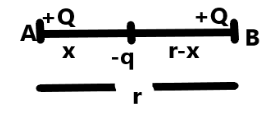
Let the charge q be placed at O, so that its distance from charge at A be x and its distance from charge at B be (r – x).
Now, the electrostatic force on a charge due to other charge is given by the formula, \[F = \dfrac{{{Q_1}{Q_2}}}{{4\pi { \in _ \circ }{a^2}}}\]
Here Q1 and Q2 are the charges, F is the electrostatic force and a is the distance between the two charges.
So, electrostatic force on q due to +Q charge at A is \[\dfrac{{qQ}}{{4\pi { \in _ \circ }{x^2}}}\]
And, electrostatic force on q due to +Q charge at B is \[\dfrac{{qQ}}{{4\pi { \in _ \circ }{{(r - x)}^2}}}\]
Now, the system is in equilibrium, if electrostatic force on q due to charge at A = electrostatic force on q due to charge at B, i.e.,
\[\dfrac{{qQ}}{{4\pi { \in _ \circ }{x^2}}} = \dfrac{{qQ}}{{4\pi { \in _ \circ }{{(r - x)}^2}}}\]
Solving further we get-
$
{(r - x)^2} = {x^2} \\
\Rightarrow {r^2} + {x^2} - 2rx = {x^2} \\
\Rightarrow {r^2} = 2rx \\
\Rightarrow x = \dfrac{r}{2} \\
$
Also, the three charges will be in equilibrium if net force on each charge is zero i.e.
\[
\dfrac{{qQ}}{{4\pi { \in _ \circ }{{\left( {\dfrac{r}{2}} \right)}^2}}} = \dfrac{{QQ}}{{4\pi { \in _ \circ }{{(r)}^2}}} \\
\Rightarrow \dfrac{q}{{4\pi { \in _ \circ }{{\left( {\dfrac{r}{2}} \right)}^2}}} = \dfrac{Q}{{4\pi { \in _ \circ }{{\left( r \right)}^2}}} \\
\Rightarrow q = \dfrac{Q}{4} \\
\]
Therefore, the third charge has magnitude equal to Q/4 and is placed between the two charges at centre.
Note – According to the Coulomb’s law, the electrostatic force on a charge due to other charge is given by the formula, \[F = \dfrac{{{Q_1}{Q_2}}}{{4\pi { \in _ \circ }{a^2}}}\] . Then, for charge -q to be in equilibrium, the force acting on -q due to +Q at A and +Q at B should be equal and opposite and to find the magnitude of the charge we have consider the case where charge +Q at A or at B are in equilibrium.
Formula used - \[F = \dfrac{{{Q_1}{Q_2}}}{{4\pi { \in _ \circ }{a^2}}}\]
Complete step by step answer:
Given that- Two charges each of +Q units are placed along a line, the third charge -q is placed between them.
Refer to the figure below-
Let the charge q be placed at O, so that its distance from charge at A be x and its distance from charge at B be (r – x).
Now, the electrostatic force on a charge due to other charge is given by the formula, \[F = \dfrac{{{Q_1}{Q_2}}}{{4\pi { \in _ \circ }{a^2}}}\]
Here Q1 and Q2 are the charges, F is the electrostatic force and a is the distance between the two charges.
So, electrostatic force on q due to +Q charge at A is \[\dfrac{{qQ}}{{4\pi { \in _ \circ }{x^2}}}\]
And, electrostatic force on q due to +Q charge at B is \[\dfrac{{qQ}}{{4\pi { \in _ \circ }{{(r - x)}^2}}}\]
Now, the system is in equilibrium, if electrostatic force on q due to charge at A = electrostatic force on q due to charge at B, i.e.,
\[\dfrac{{qQ}}{{4\pi { \in _ \circ }{x^2}}} = \dfrac{{qQ}}{{4\pi { \in _ \circ }{{(r - x)}^2}}}\]
Solving further we get-
$
{(r - x)^2} = {x^2} \\
\Rightarrow {r^2} + {x^2} - 2rx = {x^2} \\
\Rightarrow {r^2} = 2rx \\
\Rightarrow x = \dfrac{r}{2} \\
$
Also, the three charges will be in equilibrium if net force on each charge is zero i.e.
\[
\dfrac{{qQ}}{{4\pi { \in _ \circ }{{\left( {\dfrac{r}{2}} \right)}^2}}} = \dfrac{{QQ}}{{4\pi { \in _ \circ }{{(r)}^2}}} \\
\Rightarrow \dfrac{q}{{4\pi { \in _ \circ }{{\left( {\dfrac{r}{2}} \right)}^2}}} = \dfrac{Q}{{4\pi { \in _ \circ }{{\left( r \right)}^2}}} \\
\Rightarrow q = \dfrac{Q}{4} \\
\]
Therefore, the third charge has magnitude equal to Q/4 and is placed between the two charges at centre.
Note – According to the Coulomb’s law, the electrostatic force on a charge due to other charge is given by the formula, \[F = \dfrac{{{Q_1}{Q_2}}}{{4\pi { \in _ \circ }{a^2}}}\] . Then, for charge -q to be in equilibrium, the force acting on -q due to +Q at A and +Q at B should be equal and opposite and to find the magnitude of the charge we have consider the case where charge +Q at A or at B are in equilibrium.
Recently Updated Pages
Master Class 11 English: Engaging Questions & Answers for Success

Master Class 11 Social Science: Engaging Questions & Answers for Success
Master Class 11 Maths: Engaging Questions & Answers for Success
Master Class 11 Biology: Engaging Questions & Answers for Success
Master Class 11 Physics: Engaging Questions & Answers for Success
Master Class 11 Chemistry: Engaging Questions & Answers for Success
Trending doubts
Explain the Treaty of Vienna of 1815 class 10 social science CBSE
What is the Total Duration of Football Match?
First Cotton Mill of India
In which year voting age was reduced from 21 to 18?
10 examples of evaporation in daily life with explanations
What planets have no moons Which one has only one moon class 10 physics CBSE