




Two cars are moving in the same direction with a speed of 30km/hr. They are separated from each other by 5km. Third car moving in the opposite direction meets the two cars after an interval of 4 minutes. What is the speed of the third car?
A. 35km/hr
B. 40km/hr
C .45km/hr
D. 75km/hr
Answer
 Verified
591.4k+ views
Hint: View the scenario taking the second car as the reference frame. Apply distance formula on car3 to find its velocity. Use the formula for relative velocity which is \[\overrightarrow{{{V}_{AB}}}=\overrightarrow{{{V}_{A}}}-\overrightarrow{{{V}_{B}}}\] and the formula for speed, $\text{speed}=\dfrac{\text{distance}}{\text{time}}$.
Complete step by step answer:
Let the velocity of the first two cars be ${{v}_{1}}=30km/hr$ and ${{v}_{2}}=30km/hr$, the distance between them be $d=5km$.
Since the velocities of the two cars are the same, the relative speed between them is zero. That is, for a person in car2, car1 seems stationary. This also implies that the distance between car1 and car2 is $d=5km$throughout the motion.
Let us assume that car3 has a velocity $-xkm/hr$ since it is moving in the opposite direction as of car1 and car2.
We take car2 as the reference frame. From this frame, it seems that on a 1-dimension plane, two points (car1 and car2) are separated by a distance $d$. And car3 is approaching the points.
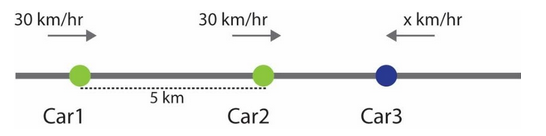
The velocity of car3 observed by a person in car2 will be:
\[\overrightarrow{{{V}_{32}}}=\overrightarrow{{{V}_{3}}}-\overrightarrow{{{V}_{2}}}=-x-30=-\left( x+30 \right)km/hr\]
It is given that the time taken by car3 to cross the other cars is
$t=4\text{min}=\dfrac{4}{60}hr=\dfrac{1}{15}hr$ .
Since, we are dealing with a 1-dimensional problem, let us only take speed and distance into consideration.
Applying the basic formula for speed,
$\begin{align}
& \text{speed}=\dfrac{\text{distance}}{\text{time}} \\
& \Rightarrow 30+x=\dfrac{5}{1/15}=75km/hr \\
& \Rightarrow x=45km/hr \\
\end{align}$
Therefore, option C. is the correct answer.
Note: Since, car1 and car2 had the same velocities, taking any one car as the reference frame did the job. But, be careful while applying this concept to other questions. Car1 and car2 might move with respect to one another.
Complete step by step answer:
Let the velocity of the first two cars be ${{v}_{1}}=30km/hr$ and ${{v}_{2}}=30km/hr$, the distance between them be $d=5km$.
Since the velocities of the two cars are the same, the relative speed between them is zero. That is, for a person in car2, car1 seems stationary. This also implies that the distance between car1 and car2 is $d=5km$throughout the motion.
Let us assume that car3 has a velocity $-xkm/hr$ since it is moving in the opposite direction as of car1 and car2.
We take car2 as the reference frame. From this frame, it seems that on a 1-dimension plane, two points (car1 and car2) are separated by a distance $d$. And car3 is approaching the points.
The velocity of car3 observed by a person in car2 will be:
\[\overrightarrow{{{V}_{32}}}=\overrightarrow{{{V}_{3}}}-\overrightarrow{{{V}_{2}}}=-x-30=-\left( x+30 \right)km/hr\]
It is given that the time taken by car3 to cross the other cars is
$t=4\text{min}=\dfrac{4}{60}hr=\dfrac{1}{15}hr$ .
Since, we are dealing with a 1-dimensional problem, let us only take speed and distance into consideration.
Applying the basic formula for speed,
$\begin{align}
& \text{speed}=\dfrac{\text{distance}}{\text{time}} \\
& \Rightarrow 30+x=\dfrac{5}{1/15}=75km/hr \\
& \Rightarrow x=45km/hr \\
\end{align}$
Therefore, option C. is the correct answer.
Note: Since, car1 and car2 had the same velocities, taking any one car as the reference frame did the job. But, be careful while applying this concept to other questions. Car1 and car2 might move with respect to one another.
Recently Updated Pages
If x a + bt + ct2 where x is in meters and t is in class 11 physics CBSE

A car covers the first half distance between two places class 11 physics CBSE
The resultant of two vectors overrightarrow P and overrightarrow class 11 physics CBSE
Find the value of cos 135 class 11 maths CBSE
A mass M is held in place by an applied force F and class 11 physics CBSE
A solution of glucose in water is labelled as 10 dfracwv class 11 chemistry CBSE
Trending doubts
Find the value of the expression given below sin 30circ class 11 maths CBSE
One Metric ton is equal to kg A 10000 B 1000 C 100 class 11 physics CBSE
Draw a diagram of nephron and explain its structur class 11 biology CBSE
10 examples of friction in our daily life
Proton was discovered by A Thomson B Rutherford C Chadwick class 11 chemistry CBSE
Bond order ofO2 O2+ O2 and O22 is in order A O2 langle class 11 chemistry CBSE