




Two bulbs, one of $50$ watt and another of \[25\] watt are connected in series to the mains. Find the ratio of currents through them.
Answer
 Verified
516.6k+ views
Hint: When the same current passes through all of the components in a circuit, it is said to be connected in series. The current in such circuits has only one route. Consider a series circuit as a set of decorative string lights for the home. This is nothing more than a string of small lights connected in a series. If one bulb in a series burns out, the rest of the bulbs in the series will not light up.
Complete step by step solution:
As the power given is given for both lamps in series. We can calculate the current from power by formula $I = \sqrt {\dfrac{P}{R}} $ .
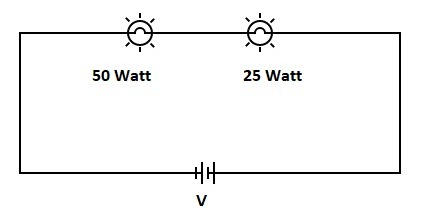
The same amount of current runs across all parts in a series configuration.
Because the bulbs are connected in series, the current flowing through them will be the same. When resistors are connected in a series circuit, the voltage across each resistor varies, despite the fact that the current flow through all of them is the same.
The ratio of current through the above given bulbs will be $1:1$ .
Therefore, the answer will be \[1:1\] .
Note: All components in a series circuit are connected end-to-end, forming a single current flow route. All components in a parallel circuit are linked across each other, forming two sets of electrically common points. In a parallel circuit, a "branch" is an electric current path formed by one of the load components (such as a resistor).
Complete step by step solution:
As the power given is given for both lamps in series. We can calculate the current from power by formula $I = \sqrt {\dfrac{P}{R}} $ .
The same amount of current runs across all parts in a series configuration.
Because the bulbs are connected in series, the current flowing through them will be the same. When resistors are connected in a series circuit, the voltage across each resistor varies, despite the fact that the current flow through all of them is the same.
The ratio of current through the above given bulbs will be $1:1$ .
Therefore, the answer will be \[1:1\] .
Note: All components in a series circuit are connected end-to-end, forming a single current flow route. All components in a parallel circuit are linked across each other, forming two sets of electrically common points. In a parallel circuit, a "branch" is an electric current path formed by one of the load components (such as a resistor).
Recently Updated Pages
Master Class 12 Business Studies: Engaging Questions & Answers for Success

Master Class 12 Biology: Engaging Questions & Answers for Success
Master Class 12 Chemistry: Engaging Questions & Answers for Success
Class 12 Question and Answer - Your Ultimate Solutions Guide
Master Class 11 Social Science: Engaging Questions & Answers for Success
Master Class 11 English: Engaging Questions & Answers for Success
Trending doubts
Which are the Top 10 Largest Countries of the World?
Draw a labelled sketch of the human eye class 12 physics CBSE
Name the crygenes that control cotton bollworm and class 12 biology CBSE
Differentiate between homogeneous and heterogeneous class 12 chemistry CBSE
Ribosomal RNA is actively synthesised in A Nucleoplasm class 12 biology CBSE
How many molecules of ATP and NADPH are required information class 12 biology CBSE