




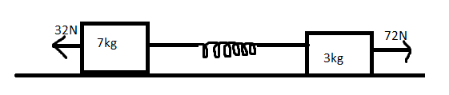
Two blocks of masses 7 kg and 3 kg are connected by a spring of stiffness 1000 N/m and placed on a smooth horizontal surface. They are acted by horizontal forces of 72 N and 32N in opposite directions as shown in figure. When accelerations of the blocks are equal and constant, the extensions of the spring is
(A) 4cm
(B) 5cm
(C) 6cm
(D) 8cm
Answer
 Verified
579.6k+ views
Hint: This could be simply solved by breaking the diagrams into simple free body diagrams of both the blocks. Then we need to apply Newton’s law of motion.
Formula used: Here, we will use the basic formula NLM-2:
${\text{F = ma}}$
Here, ${\text{F}}$ is the force exerted on the block
${\text{m}}$ is the mass of the block
${\text{a}}$ is acceleration of the block
Also, spring force = ${\text{kx}}$
Here, ${\text{k}}$ is the spring constant
${\text{x}}$ is the extension due to force
Complete step by step answer:
We already know that the bodies are connected together by rope,
So, both the bodies will have the same acceleration.
First, we will consider the block of mass 3kg:
Let us assume the acceleration of the block to be${\text{a}}$,
There will also be a tension ${\text{T}}$ in the block on cutting the rope with which it is attached.
UsingNLM-2:
${\text{F = ma}}$
${\text{72 - T = 3a}}$
Also, for the block of mass 7kg,
${\text{T - 32 = 7a}}$
On solving, the above equations,
${\text{a = 4m/}}{{\text{s}}^{\text{2}}}$
${\text{T = 60N}}$
Now, we will calculate the extension in the spring:
${\text{T = kx}}$
On putting the values,
${\text{x = }}\dfrac{{\text{T}}}{{\text{k}}}{\text{ = }}\dfrac{{{\text{60}}}}{{{\text{1000}}}}$
$ \Rightarrow {\text{x = }}6 \times {10^{ - 2}}$
So, the extension in the spring is 0.06m or 6cm.
The correct option is C.
Note:
It should be always kept in mind that we should always draw the FBD of the body before solving any force questions.
Also, never forget to assume tension force away from the body wherever there is rope in pulley or block questions.
Similarly, spring forces also are there is case of springs acting tensile (away) from the body.
Also, if the bodies are connected together, they will have the same acceleration.
Formula used: Here, we will use the basic formula NLM-2:
${\text{F = ma}}$
Here, ${\text{F}}$ is the force exerted on the block
${\text{m}}$ is the mass of the block
${\text{a}}$ is acceleration of the block
Also, spring force = ${\text{kx}}$
Here, ${\text{k}}$ is the spring constant
${\text{x}}$ is the extension due to force
Complete step by step answer:
We already know that the bodies are connected together by rope,
So, both the bodies will have the same acceleration.
First, we will consider the block of mass 3kg:
Let us assume the acceleration of the block to be${\text{a}}$,
There will also be a tension ${\text{T}}$ in the block on cutting the rope with which it is attached.
UsingNLM-2:
${\text{F = ma}}$
${\text{72 - T = 3a}}$
Also, for the block of mass 7kg,
${\text{T - 32 = 7a}}$
On solving, the above equations,
${\text{a = 4m/}}{{\text{s}}^{\text{2}}}$
${\text{T = 60N}}$
Now, we will calculate the extension in the spring:
${\text{T = kx}}$
On putting the values,
${\text{x = }}\dfrac{{\text{T}}}{{\text{k}}}{\text{ = }}\dfrac{{{\text{60}}}}{{{\text{1000}}}}$
$ \Rightarrow {\text{x = }}6 \times {10^{ - 2}}$
So, the extension in the spring is 0.06m or 6cm.
The correct option is C.
Note:
It should be always kept in mind that we should always draw the FBD of the body before solving any force questions.
Also, never forget to assume tension force away from the body wherever there is rope in pulley or block questions.
Similarly, spring forces also are there is case of springs acting tensile (away) from the body.
Also, if the bodies are connected together, they will have the same acceleration.
Recently Updated Pages
Master Class 11 Social Science: Engaging Questions & Answers for Success

Master Class 11 Physics: Engaging Questions & Answers for Success
Master Class 11 Maths: Engaging Questions & Answers for Success
Master Class 11 Economics: Engaging Questions & Answers for Success
Master Class 11 Computer Science: Engaging Questions & Answers for Success
Master Class 11 Chemistry: Engaging Questions & Answers for Success
Trending doubts
One Metric ton is equal to kg A 10000 B 1000 C 100 class 11 physics CBSE
There are 720 permutations of the digits 1 2 3 4 5 class 11 maths CBSE
1 Quintal is equal to a 110 kg b 10 kg c 100kg d 1000 class 11 physics CBSE
State and prove Bernoullis theorem class 11 physics CBSE
Difference Between Prokaryotic Cells and Eukaryotic Cells
Which among the following are examples of coming together class 11 social science CBSE