




Two adjacent angles of a parallelogram are equal. What is the measure of each angle? Write the angle name of this parallelogram.
Answer
 Verified
502.2k+ views
Hint: First, the adjacent angles of the parallelogram are supplementary and add them to get the overall angles ${180^0}$. Also, it is given that the two adjacent angles are equal in the given. Hence equate them and we are able to find all the angles. And also, we are able to say the name of the angle which we used.
Complete answer:
Since a quadrilateral is a closed polygon with four sides. A parallelogram is the opposite sides that are equal and parallel. Since the two pairs of the opposite sides are parallel to each other, the opposite angles of a parallelogram are equal and the adjacent angles are supplementary.
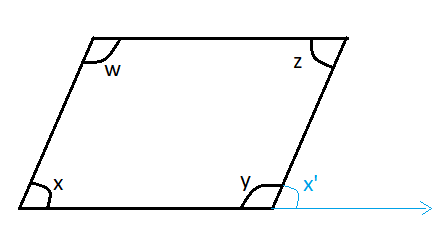
In the above diagram, the angles $x$ and $y$ are adjacent angles, angles $x$ and $x'$ are equal and $y + x' = 180^\circ $ .
Hence the supplementary angles are two angles that added to the sum of ${180^0}$
Fix the two adjacent sides as $x,y$ then they add up to get $x + y = {180^0}$
Since from the given that we have the two adjacent sides are equal and hence $x = y$.
Substitute the values we have $2x = {180^0}$ and further solving we get $x = {90^0}$
Therefore, all the angles are found as ${90^0}$ and $x = {90^0}$ can be also known as the right angles.
Note:
The adjacent angles are given to be equal; we know that the opposite angles are also equal. Hence all the angles are equal to each other. Thus, we can equate them to the sum of all angles of the quadrilateral and which is ${180^0}$. Hence solving we get the required answers. Also square has four sides and all the sides are equal in length too.
Complete answer:
Since a quadrilateral is a closed polygon with four sides. A parallelogram is the opposite sides that are equal and parallel. Since the two pairs of the opposite sides are parallel to each other, the opposite angles of a parallelogram are equal and the adjacent angles are supplementary.
In the above diagram, the angles $x$ and $y$ are adjacent angles, angles $x$ and $x'$ are equal and $y + x' = 180^\circ $ .
Hence the supplementary angles are two angles that added to the sum of ${180^0}$
Fix the two adjacent sides as $x,y$ then they add up to get $x + y = {180^0}$
Since from the given that we have the two adjacent sides are equal and hence $x = y$.
Substitute the values we have $2x = {180^0}$ and further solving we get $x = {90^0}$
Therefore, all the angles are found as ${90^0}$ and $x = {90^0}$ can be also known as the right angles.
Note:
The adjacent angles are given to be equal; we know that the opposite angles are also equal. Hence all the angles are equal to each other. Thus, we can equate them to the sum of all angles of the quadrilateral and which is ${180^0}$. Hence solving we get the required answers. Also square has four sides and all the sides are equal in length too.
Recently Updated Pages
Master Class 12 Economics: Engaging Questions & Answers for Success

Master Class 12 English: Engaging Questions & Answers for Success
Master Class 12 Social Science: Engaging Questions & Answers for Success
Master Class 12 Maths: Engaging Questions & Answers for Success
Master Class 12 Physics: Engaging Questions & Answers for Success
Master Class 9 General Knowledge: Engaging Questions & Answers for Success
Trending doubts
Explain the Treaty of Vienna of 1815 class 10 social science CBSE
Who Won 36 Oscar Awards? Record Holder Revealed
Why is it 530 pm in india when it is 1200 afternoon class 10 social science CBSE
Make a sketch of the human nerve cell What function class 10 biology CBSE
What is the full form of POSCO class 10 social science CBSE
Define Potential, Developed, Stock and Reserved resources