




When trying to catch a fish, should a pelican dive into the water horizontally in front of or behind the image of the fish it sees?
A. In front of image
B. Behind the image
C. Cannot be inferred
D. None
Answer
 Verified
587.1k+ views
Hint: Velocity of light will be different in different media. If velocity of light is higher in one medium and lesser in another medium then the first one is called a rarer medium and the second one is called a denser medium. The path travelled by light also varies with its velocity.
Complete step by step answer:
Velocity is nothing but the rate of change of displacement i.e the ratio of displacement to the time taken. So the time taken will be displacement upon the velocity.
Velocity of light in any medium of refractive index(n) will be
$v = \dfrac{c}{n}$ where ‘c’ is the velocity of light in the free space and ‘n’ is the refractive index of the medium.
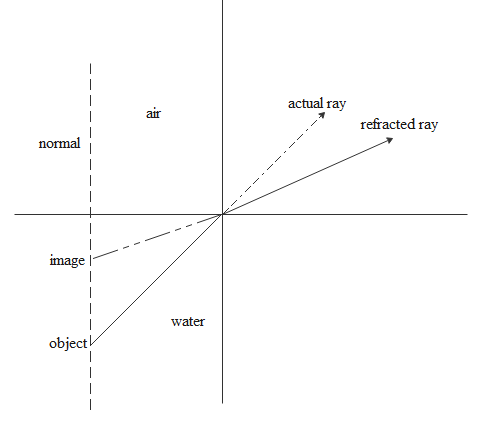
For air, the refractive index will be one. The water refractive index will be greater than one. Hence when light enters from water to air, its velocity increases. In order to maintain the same time displacement also must increase. That means the path travelled in the air by the light must increase. This will be possible if the light bends away from the normal. This is clearly shown in the diagram below.
The image of the fish appears nearer to the pelican than at the actual place. So the pelican should dive in front of the image to catch the fish.
Hence option A will be the correct answer.
Note:
If the fish is seeing the pelican from the water, then the opposite happens. Pelican appears at a longer distance than the actual distance. For pelican fish appears nearer so when the pelican tries to catch the image of the fish, the actual fish becomes alert and escapes from the pelican.
Complete step by step answer:
Velocity is nothing but the rate of change of displacement i.e the ratio of displacement to the time taken. So the time taken will be displacement upon the velocity.
Velocity of light in any medium of refractive index(n) will be
$v = \dfrac{c}{n}$ where ‘c’ is the velocity of light in the free space and ‘n’ is the refractive index of the medium.
For air, the refractive index will be one. The water refractive index will be greater than one. Hence when light enters from water to air, its velocity increases. In order to maintain the same time displacement also must increase. That means the path travelled in the air by the light must increase. This will be possible if the light bends away from the normal. This is clearly shown in the diagram below.
The image of the fish appears nearer to the pelican than at the actual place. So the pelican should dive in front of the image to catch the fish.
Hence option A will be the correct answer.
Note:
If the fish is seeing the pelican from the water, then the opposite happens. Pelican appears at a longer distance than the actual distance. For pelican fish appears nearer so when the pelican tries to catch the image of the fish, the actual fish becomes alert and escapes from the pelican.
Recently Updated Pages
Basicity of sulphurous acid and sulphuric acid are

Master Class 12 English: Engaging Questions & Answers for Success
Master Class 12 Social Science: Engaging Questions & Answers for Success
Master Class 12 Maths: Engaging Questions & Answers for Success
Master Class 12 Economics: Engaging Questions & Answers for Success
Master Class 12 Physics: Engaging Questions & Answers for Success
Trending doubts
Draw a labelled sketch of the human eye class 12 physics CBSE
Which are the Top 10 Largest Countries of the World?
Draw ray diagrams each showing i myopic eye and ii class 12 physics CBSE
Giving reasons state the signs positive or negative class 12 physics CBSE
Explain esterification reaction with the help of a class 12 chemistry CBSE
What is defined as a solenoid Depict a diagram with class 12 physics CBSE