




True nucleus is absent in
A. Green algae
B. Fungi
C. Lichens
D. Bacteria
Answer
 Verified
639.3k+ views
Hint: They are a typical biological cell with a large group of prokaryotic organisms varying in shapes, structures, and sizes, and are found in almost all the habitats.
Complete answer:
A true nucleus is absent in the case of the prokaryotic cell of an organism and it is present in the eukaryotic cells. The prokaryotic cells mostly belong to the bacteria cells, instead of nucleus they contain a nucleoid region where the genetic material is present.
Additional Information: -Bacteria were among the first life forms to appear on the earth, and are found in almost all the habitats.
-The word bacteria is derived from the Greek word bakteria meaning “staff, cane” because the first discovered were the rod-shaped bacteria.
-The evolution of archaea and eukaryotes was the second-largest evolutionary divergence that involved bacteria also.
-The cells lack any membrane and membrane-bound cell organelles. They do not have a true genetic material instead consisting of DNA which is composed of single circular bacterial chromosomes. All the genetic material is arranged irregularly and is found in the nucleoid.
-The nucleoid consists of the chromosome with its associated proteins and RNA.
-Bacteria usually lack large membrane-bound organelles like the nucleus, mitochondria, chloroplast, etc.
-Bacteria contain ribosomes for the synthesis of the proteins.
-The outer layer of the prokaryotic cell has attached flagella which help in the movement.
So, the correct answer is ‘Bacteria’.
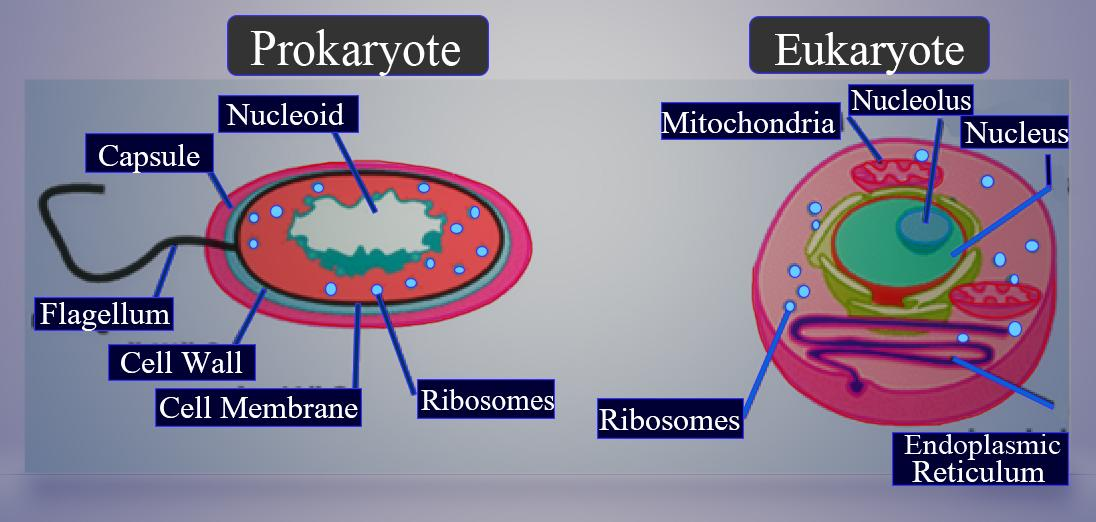
Note: Green algae are the eukaryotic cells while blue-green algae come under prokaryotic cells that lack a nucleus. The fungi are eukaryotic organisms having a small nucleus containing the genetic material (DNA). The lichens may be prokaryotic or eukaryotic organisms, but most commonly they belong to the eukaryotic group.
Complete answer:
A true nucleus is absent in the case of the prokaryotic cell of an organism and it is present in the eukaryotic cells. The prokaryotic cells mostly belong to the bacteria cells, instead of nucleus they contain a nucleoid region where the genetic material is present.
Additional Information: -Bacteria were among the first life forms to appear on the earth, and are found in almost all the habitats.
-The word bacteria is derived from the Greek word bakteria meaning “staff, cane” because the first discovered were the rod-shaped bacteria.
-The evolution of archaea and eukaryotes was the second-largest evolutionary divergence that involved bacteria also.
-The cells lack any membrane and membrane-bound cell organelles. They do not have a true genetic material instead consisting of DNA which is composed of single circular bacterial chromosomes. All the genetic material is arranged irregularly and is found in the nucleoid.
-The nucleoid consists of the chromosome with its associated proteins and RNA.
-Bacteria usually lack large membrane-bound organelles like the nucleus, mitochondria, chloroplast, etc.
-Bacteria contain ribosomes for the synthesis of the proteins.
-The outer layer of the prokaryotic cell has attached flagella which help in the movement.
So, the correct answer is ‘Bacteria’.
Note: Green algae are the eukaryotic cells while blue-green algae come under prokaryotic cells that lack a nucleus. The fungi are eukaryotic organisms having a small nucleus containing the genetic material (DNA). The lichens may be prokaryotic or eukaryotic organisms, but most commonly they belong to the eukaryotic group.
Recently Updated Pages
Basicity of sulphurous acid and sulphuric acid are

Master Class 11 English: Engaging Questions & Answers for Success
Master Class 11 Physics: Engaging Questions & Answers for Success
Master Class 11 Computer Science: Engaging Questions & Answers for Success
Master Class 11 Chemistry: Engaging Questions & Answers for Success
Master Class 11 Social Science: Engaging Questions & Answers for Success
Trending doubts
Difference Between Prokaryotic Cells and Eukaryotic Cells
Two of the body parts which do not appear in MRI are class 11 biology CBSE
One Metric ton is equal to kg A 10000 B 1000 C 100 class 11 physics CBSE
10 examples of friction in our daily life
Draw a diagram of nephron and explain its structur class 11 biology CBSE
What will happen if the mucus is not secreted by the class 11 biology CBSE