




What is true about distal convoluted tubule
A. \[N{{a}^{+}}\] reabsorption requires energy.
B. \[{{K}^{+}}\] reabsorption does not require energy.
C. Ammonia is exerted.
D. Water Reabsorption requires energy.
Answer
 Verified
610.2k+ views
Hint: The distal convoluted tube could be defined as a part of the tubule that is the structural and useful unit of the urinary organ. DCT conjointly reabsorbs bicarbonate and helps in the filtration of water.
Complete answer: The Distal Convoluted tubule is the structural and useful unit of the urinary organ. The tubule consists of a tissue layer called Bowman's capsule, proximal convoluted tube-shaped structure, Loop of Henle, and distal convoluted tube-shaped structure. In the distal convoluted tube, the reabsorption of Na+ ion and water takes place also this is an active process which means it needs energy. Reabsorption of \[N{{a}^{+}}\] and water takes place in a distal convoluted tube-shaped structure (DCT) because of which it passes through the distal tube and there are chances that the filtrate might become even dilute. The DCT is impermeable to water since it doesn’t allow water to pass through however it actively transports salt out into the interstitial fluid. DCT is additionally capable of reabsorbing \[HC{{O}_{3}}\] and selective secretion of gas and metallic element ions and \[N{{H}_{3}}\] to keep up the hydrogen ion concentration and sodium-potassium balance in the blood.
Let us look at all the options to get the correct answer,
Option A: About \[5%\] of Sodium-ion is reabsorbed in DCT through the active method.
Option B: Potassium ion is actively secreted within the DCT.
Option C: Ammonia is secreted into the DCT through diffusion.
Option D: Water is reabsorbed in DCT through diffusion solely below the influence of internal secretion.
So, the right answer is option A.
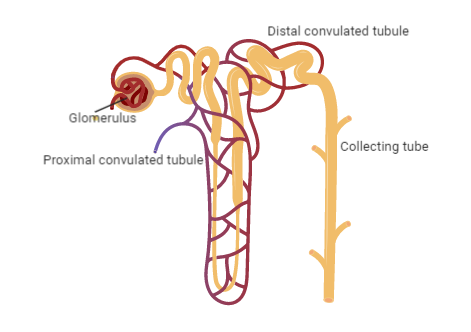
Note: Nephron which is located within the excretory organ consists of four regions-Bowman’s capsule, proximal convoluted tube-shaped structure (PCT), a loop of Henle, and distal convoluted tube-shaped structure (DCT). The Bowman’s capsule performs ultrafiltration that is that the step in urine formation, proximal convoluted tube-shaped structure is that the region where about \[70-80%\] of electrolytes and water are reabsorbed. The loop of Henle has two parts-one part is ascending and the other one is the descending limbs. The ascending limb is impervious to water and concentrates the filtrate whereas the down limb is impervious to electrolytes and therefore dilutes the filtrate. Distal convoluted tubules do not absolutely reabsorb water and sodium ions. The mineralocorticoid internal secretion reabsorbs sodium ions actively and internal secretion reabsorbs water passively.
Complete answer: The Distal Convoluted tubule is the structural and useful unit of the urinary organ. The tubule consists of a tissue layer called Bowman's capsule, proximal convoluted tube-shaped structure, Loop of Henle, and distal convoluted tube-shaped structure. In the distal convoluted tube, the reabsorption of Na+ ion and water takes place also this is an active process which means it needs energy. Reabsorption of \[N{{a}^{+}}\] and water takes place in a distal convoluted tube-shaped structure (DCT) because of which it passes through the distal tube and there are chances that the filtrate might become even dilute. The DCT is impermeable to water since it doesn’t allow water to pass through however it actively transports salt out into the interstitial fluid. DCT is additionally capable of reabsorbing \[HC{{O}_{3}}\] and selective secretion of gas and metallic element ions and \[N{{H}_{3}}\] to keep up the hydrogen ion concentration and sodium-potassium balance in the blood.
Let us look at all the options to get the correct answer,
Option A: About \[5%\] of Sodium-ion is reabsorbed in DCT through the active method.
Option B: Potassium ion is actively secreted within the DCT.
Option C: Ammonia is secreted into the DCT through diffusion.
Option D: Water is reabsorbed in DCT through diffusion solely below the influence of internal secretion.
So, the right answer is option A.
Note: Nephron which is located within the excretory organ consists of four regions-Bowman’s capsule, proximal convoluted tube-shaped structure (PCT), a loop of Henle, and distal convoluted tube-shaped structure (DCT). The Bowman’s capsule performs ultrafiltration that is that the step in urine formation, proximal convoluted tube-shaped structure is that the region where about \[70-80%\] of electrolytes and water are reabsorbed. The loop of Henle has two parts-one part is ascending and the other one is the descending limbs. The ascending limb is impervious to water and concentrates the filtrate whereas the down limb is impervious to electrolytes and therefore dilutes the filtrate. Distal convoluted tubules do not absolutely reabsorb water and sodium ions. The mineralocorticoid internal secretion reabsorbs sodium ions actively and internal secretion reabsorbs water passively.
Recently Updated Pages
Master Class 12 Economics: Engaging Questions & Answers for Success

Master Class 12 English: Engaging Questions & Answers for Success
Master Class 12 Social Science: Engaging Questions & Answers for Success
Master Class 12 Maths: Engaging Questions & Answers for Success
Master Class 12 Physics: Engaging Questions & Answers for Success
Master Class 11 Social Science: Engaging Questions & Answers for Success
Trending doubts
One Metric ton is equal to kg A 10000 B 1000 C 100 class 11 physics CBSE
Difference Between Prokaryotic Cells and Eukaryotic Cells
Find the value of the expression given below sin 30circ class 11 maths CBSE
1 ton equals to A 100 kg B 1000 kg C 10 kg D 10000 class 11 physics CBSE
Two of the body parts which do not appear in MRI are class 11 biology CBSE
Draw a diagram of nephron and explain its structur class 11 biology CBSE