




Tripinnate leaves occur in
(a) Acacia
(b) Oxalis
(c) Moringa
(d) Gynandropsis
Answer
 Verified
602.1k+ views
Hint: Compound leaves are the leaves that show the presence of many leaflets. These can be either pinnate or palmate. In the pinnate type of compound leaves, the leaflets arise on either side of the midrib and based on the leaflet pattern, they are divided into various pinnations. Tripinnate leaves are present in the drumstick trees.
Complete Step by Step Answer:
The term tripinnate means the pinnately compound leaves in which the leaflets are themselves bipinnate. Such an arrangement of the leaflets in the drumstick trees i.e. Moringa oleifera
- Pinnation is the feather- like or multi- divided arrangement of leaflets on both the sides of a common axis.
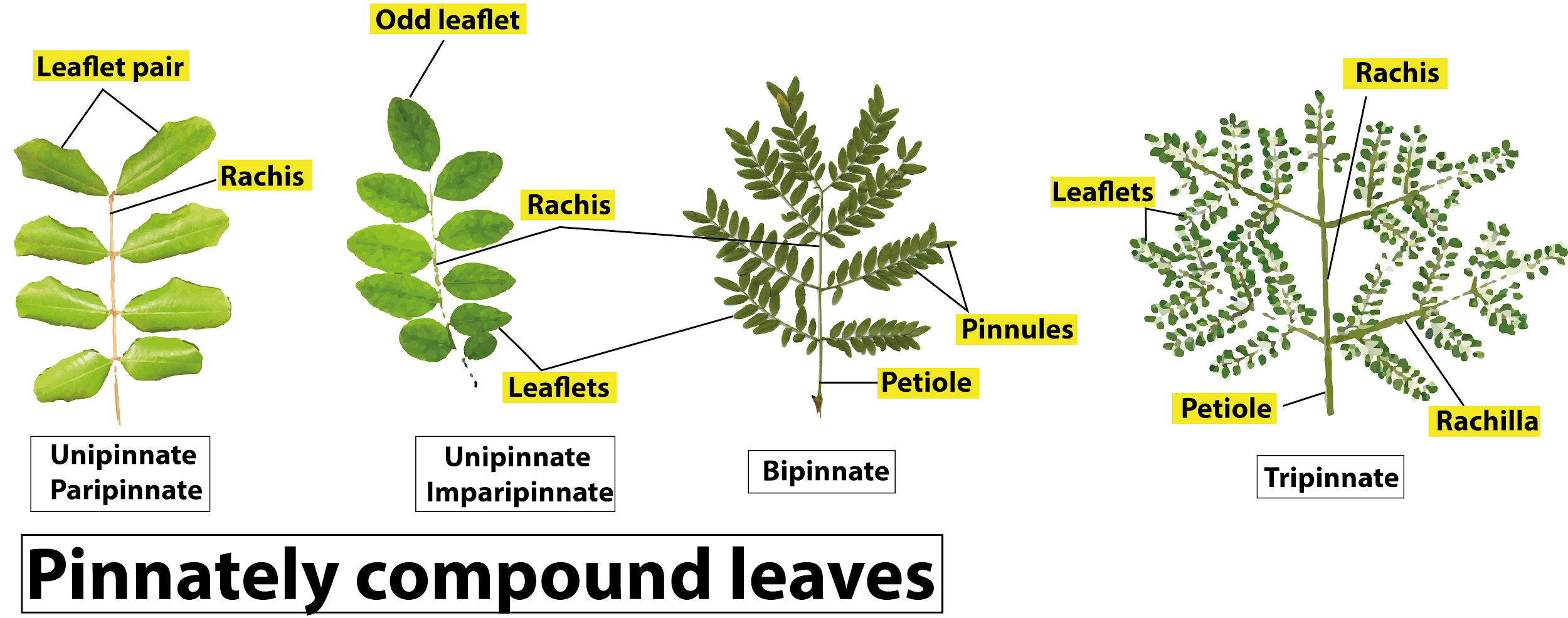
- This pinnation can be further classified as:
- Unipinnate: It is the simplest form of pinnation in which a single row of leaflets is arranged on both sides of a common axis.
- Bipinnate: In this kind, the leaflets themselves are pinnately compound.
- Tripinnate: In this type of pinnately compound leaves, the leaflets themselves are bipinnate in the arrangement.
- Tripinnate: The pinnately compound leaves have leaflets that are themselves tripinnate.
So, the correct answer is, ‘(c) Moringa.’
Note:
Another form of classifying the pinnation is:
- Paripinnate: In this form of pinnation, the leaflets are present along the rachis as pairs without a single terminal leaflet. It is also called even- pinnate.
- Imparipinnate: In this type of pinnation, there is a lone terminal leaflet that is present at the tip of the rachis and it is also called odd- pinnate.
- Compound leaves can also be Palmately compound in which the leaflets arise from a common petiole.
Complete Step by Step Answer:
The term tripinnate means the pinnately compound leaves in which the leaflets are themselves bipinnate. Such an arrangement of the leaflets in the drumstick trees i.e. Moringa oleifera
- Pinnation is the feather- like or multi- divided arrangement of leaflets on both the sides of a common axis.
- This pinnation can be further classified as:
- Unipinnate: It is the simplest form of pinnation in which a single row of leaflets is arranged on both sides of a common axis.
- Bipinnate: In this kind, the leaflets themselves are pinnately compound.
- Tripinnate: In this type of pinnately compound leaves, the leaflets themselves are bipinnate in the arrangement.
- Tripinnate: The pinnately compound leaves have leaflets that are themselves tripinnate.
So, the correct answer is, ‘(c) Moringa.’
Note:
Another form of classifying the pinnation is:
- Paripinnate: In this form of pinnation, the leaflets are present along the rachis as pairs without a single terminal leaflet. It is also called even- pinnate.
- Imparipinnate: In this type of pinnation, there is a lone terminal leaflet that is present at the tip of the rachis and it is also called odd- pinnate.
- Compound leaves can also be Palmately compound in which the leaflets arise from a common petiole.
Recently Updated Pages
Master Class 11 Social Science: Engaging Questions & Answers for Success

Master Class 11 Physics: Engaging Questions & Answers for Success
Master Class 11 Maths: Engaging Questions & Answers for Success
Master Class 11 Economics: Engaging Questions & Answers for Success
Master Class 11 Computer Science: Engaging Questions & Answers for Success
Master Class 11 Chemistry: Engaging Questions & Answers for Success
Trending doubts
One Metric ton is equal to kg A 10000 B 1000 C 100 class 11 physics CBSE
There are 720 permutations of the digits 1 2 3 4 5 class 11 maths CBSE
1 Quintal is equal to a 110 kg b 10 kg c 100kg d 1000 class 11 physics CBSE
State and prove Bernoullis theorem class 11 physics CBSE
Difference Between Prokaryotic Cells and Eukaryotic Cells
Discuss the various forms of bacteria class 11 biology CBSE