




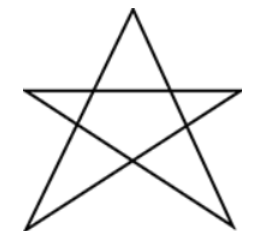
How many triangles are there in the diagram given below?
$ {\text{A}}{\text{. 6}} \\
{\text{B}}{\text{. 10}} \\
{\text{C}}{\text{. 12}} \\
{\text{D}}{\text{. 14}} $
Answer
 Verified
654.6k+ views
Hint: Here, we will proceed by naming all the points which are present in the diagram. Then, we will count all the small and large triangles present in the given diagram and add all of those.
Complete step-by-step answer:
As seen from the figure, it is very obvious that triangles present in the given diagram can be seen by finding out all the geometrical shapes made by joining three points and having three sides or edges. In the figure itself there are various small triangles and various large triangles which are formed by joining some small geometrical shapes.
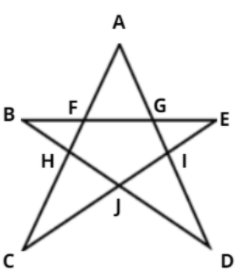
Let us name all the points visible on the given diagram as shown in the other diagram. Clearly, from the figure we can see that there are total five small triangles named AFG, BFH, CHJ, DJI and EGI i.e., \[\vartriangle {\text{AFG}},\vartriangle {\text{BFH}},\vartriangle {\text{CHJ}},\vartriangle {\text{DJI}}\]and \[\vartriangle {\text{EGI}}\].
Also, it can be easily seen that there are total five large triangles named EJB, AIC, GDB, FEC and ADH i.e., \[\vartriangle {\text{EJB}},\vartriangle {\text{AIC}},\vartriangle {\text{GDB}},\vartriangle {\text{FEC}}\] and \[\vartriangle {\text{ADH}}\].
Total number of triangles present in the given diagram = Number of small triangles + Number of large triangles
Total number of triangles present in the given diagram = 5+5 = 10
Therefore, there are a total of five small triangles and five large triangles in the given diagram. So, total 10 triangles are there in the given diagram.
Hence, option B is correct.
Note: In this problem, it is important to note some important parameters of a triangle. A triangle is usually defined as a polygon having three vertices and three edges. Any triangle consists of three sides. For any three distinct points to form a triangle, all these three points should be non-collinear.
Complete step-by-step answer:
As seen from the figure, it is very obvious that triangles present in the given diagram can be seen by finding out all the geometrical shapes made by joining three points and having three sides or edges. In the figure itself there are various small triangles and various large triangles which are formed by joining some small geometrical shapes.
Let us name all the points visible on the given diagram as shown in the other diagram. Clearly, from the figure we can see that there are total five small triangles named AFG, BFH, CHJ, DJI and EGI i.e., \[\vartriangle {\text{AFG}},\vartriangle {\text{BFH}},\vartriangle {\text{CHJ}},\vartriangle {\text{DJI}}\]and \[\vartriangle {\text{EGI}}\].
Also, it can be easily seen that there are total five large triangles named EJB, AIC, GDB, FEC and ADH i.e., \[\vartriangle {\text{EJB}},\vartriangle {\text{AIC}},\vartriangle {\text{GDB}},\vartriangle {\text{FEC}}\] and \[\vartriangle {\text{ADH}}\].
Total number of triangles present in the given diagram = Number of small triangles + Number of large triangles
Total number of triangles present in the given diagram = 5+5 = 10
Therefore, there are a total of five small triangles and five large triangles in the given diagram. So, total 10 triangles are there in the given diagram.
Hence, option B is correct.
Note: In this problem, it is important to note some important parameters of a triangle. A triangle is usually defined as a polygon having three vertices and three edges. Any triangle consists of three sides. For any three distinct points to form a triangle, all these three points should be non-collinear.

Recently Updated Pages
Which will be the least stable resonating structure class 11 chemistry CBSE

Explain the structure of megasporangium class 12 biology CBSE
Differentiate between voluntary action and reflex class 10 biology CBSE
How many 5 digit telephone numbers can be construc-class-11-maths-CBSE
How do you find the angle of the resultant vector class 11 physics CBSE
Why is chloroform kept in dark coloured bottles class 12 chemistry CBSE
Trending doubts
Give 10 examples for herbs , shrubs , climbers , creepers
Number of Prime between 1 to 100 is class 6 maths CBSE
Which mathematician invented zero and decimal system? Quiz
Check whether the given numbers are divisible by 11 class 6 maths CBSE
How many sides does a circle have a 10 sides b 20 sides class 8 maths CBSE
The common name of Rheo leaf is A Oyster plant B Boat class 9 biology CBSE