




Triangle with side 2cm, 3cm, 4cm is similar to the triangle of following measures
(a).4, 5, 6
(b).5, 6, 7
(c).12, 13, 14
(d).6, 9, 12
Answer
 Verified
574.5k+ views
Hint: Here in this question given the sides of the triangle. We have to check or find the similar triangle of given length of triangle and from the given option by using the some conditions for the similarity of two triangles. And observing the triangles we can easily say the similar triangle.
Complete answer:
Triangle is also a polygon. So we have some conditions for the similarity of two triangles. That is: Two triangles are similar, if
their corresponding angles are equal and
their corresponding sides are in the same ratio (or proportion).
if corresponding angles of two triangles are equal, then they are known as equiangular triangles.
A famous Greek mathematician Thales gave an important truth relating to two equiangular triangles which is as follows:
“The ratio of any two corresponding sides in two equiangular triangles is always the same”
i.e., \[\dfrac{{AB}}{{DE}} = \dfrac{{BC}}{{EF}} = \dfrac{{AC}}{{DF}}\]
By using the Thales theorem we can find easily the similar triangle
Consider the given length of the triangle with side 2cm, 3cm, 4cm is:
Option (a) The triangle of length 4, 5 and 6 is comparing with the given triangle of length 2, 3 and 4
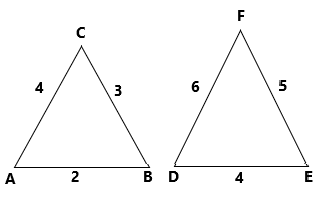
By the Thales theorem
\[\dfrac{2}{4} = \dfrac{3}{5} = \dfrac{4}{6}\]
On simplification
\[ \Rightarrow \dfrac{1}{2} \ne \dfrac{3}{5} \ne \dfrac{2}{3}\]
The Thales theorem does not satisfy. hence the option (a) is not correct one
Option (b) The triangle of length 5, 6 and 7 is comparing with the given triangle of length 2, 3 and 4
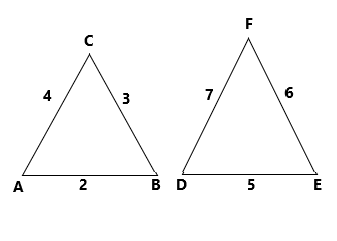
By the Thales theorem
\[\dfrac{2}{5} = \dfrac{3}{6} = \dfrac{4}{7}\]
On simplification
\[ \Rightarrow \dfrac{2}{5} \ne \dfrac{1}{2} \ne \dfrac{4}{7}\]
The Thales theorem does not satisfy. hence the option (b) is not correct one
Option (c) The triangle of length 12, 13 and 14 is comparing with the given triangle of length 2, 3 and 4
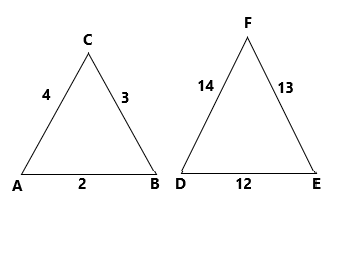
By the Thales theorem
\[\dfrac{2}{{12}} = \dfrac{3}{{13}} = \dfrac{4}{{14}}\]
On simplification
\[ \Rightarrow \dfrac{1}{6} \ne \dfrac{3}{{13}} \ne \dfrac{2}{7}\]
The Thales theorem does not satisfy. hence the option (c) is not correct one
Option (d) The triangle of length 6, 9 and 12 is comparing with the given triangle of length 2, 3 and 4
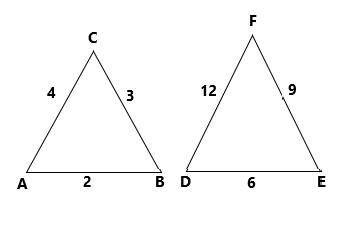
By the Thales theorem
\[\dfrac{2}{6} = \dfrac{3}{9} = \dfrac{4}{{12}}\]
On simplification
\[ \Rightarrow \dfrac{1}{3} = \dfrac{1}{3} = \dfrac{1}{3}\]
The Thales theorem satisfies. Hence the option (d) is a correct one .
Note:
The condition of a triangle must know that their corresponding angles are equal and their corresponding sides are in the same ratio (or proportion). The Thales theorem is stated on the similar triangles, considering the theorem we have solved the given question and got the solution.
Complete answer:
Triangle is also a polygon. So we have some conditions for the similarity of two triangles. That is: Two triangles are similar, if
their corresponding angles are equal and
their corresponding sides are in the same ratio (or proportion).
if corresponding angles of two triangles are equal, then they are known as equiangular triangles.
A famous Greek mathematician Thales gave an important truth relating to two equiangular triangles which is as follows:
“The ratio of any two corresponding sides in two equiangular triangles is always the same”
i.e., \[\dfrac{{AB}}{{DE}} = \dfrac{{BC}}{{EF}} = \dfrac{{AC}}{{DF}}\]
By using the Thales theorem we can find easily the similar triangle
Consider the given length of the triangle with side 2cm, 3cm, 4cm is:
Option (a) The triangle of length 4, 5 and 6 is comparing with the given triangle of length 2, 3 and 4
By the Thales theorem
\[\dfrac{2}{4} = \dfrac{3}{5} = \dfrac{4}{6}\]
On simplification
\[ \Rightarrow \dfrac{1}{2} \ne \dfrac{3}{5} \ne \dfrac{2}{3}\]
The Thales theorem does not satisfy. hence the option (a) is not correct one
Option (b) The triangle of length 5, 6 and 7 is comparing with the given triangle of length 2, 3 and 4
By the Thales theorem
\[\dfrac{2}{5} = \dfrac{3}{6} = \dfrac{4}{7}\]
On simplification
\[ \Rightarrow \dfrac{2}{5} \ne \dfrac{1}{2} \ne \dfrac{4}{7}\]
The Thales theorem does not satisfy. hence the option (b) is not correct one
Option (c) The triangle of length 12, 13 and 14 is comparing with the given triangle of length 2, 3 and 4
By the Thales theorem
\[\dfrac{2}{{12}} = \dfrac{3}{{13}} = \dfrac{4}{{14}}\]
On simplification
\[ \Rightarrow \dfrac{1}{6} \ne \dfrac{3}{{13}} \ne \dfrac{2}{7}\]
The Thales theorem does not satisfy. hence the option (c) is not correct one
Option (d) The triangle of length 6, 9 and 12 is comparing with the given triangle of length 2, 3 and 4
By the Thales theorem
\[\dfrac{2}{6} = \dfrac{3}{9} = \dfrac{4}{{12}}\]
On simplification
\[ \Rightarrow \dfrac{1}{3} = \dfrac{1}{3} = \dfrac{1}{3}\]
The Thales theorem satisfies. Hence the option (d) is a correct one .
Note:
The condition of a triangle must know that their corresponding angles are equal and their corresponding sides are in the same ratio (or proportion). The Thales theorem is stated on the similar triangles, considering the theorem we have solved the given question and got the solution.
Recently Updated Pages
Master Class 12 Economics: Engaging Questions & Answers for Success

Master Class 12 English: Engaging Questions & Answers for Success
Master Class 12 Social Science: Engaging Questions & Answers for Success
Master Class 12 Maths: Engaging Questions & Answers for Success
Master Class 12 Physics: Engaging Questions & Answers for Success
Master Class 9 General Knowledge: Engaging Questions & Answers for Success
Trending doubts
Explain the Treaty of Vienna of 1815 class 10 social science CBSE
Who Won 36 Oscar Awards? Record Holder Revealed
Why is it 530 pm in india when it is 1200 afternoon class 10 social science CBSE
Make a sketch of the human nerve cell What function class 10 biology CBSE
What is the full form of POSCO class 10 social science CBSE
Define Potential, Developed, Stock and Reserved resources