



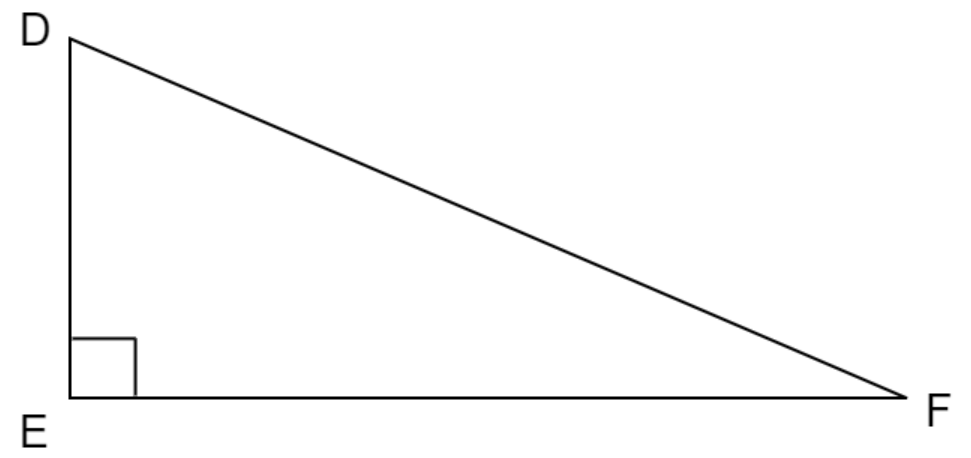
Triangle $DEF$ in the figure is the right triangle with $\angle E = {90^ \circ }$ .
What type of angles are $\angle D$ and $\angle F$ ?
A). They are equal angles
B). They form a pair of adjacent angles
C). They are complementary angles
D). They are supplementary angles
Answer
 Verified
522.9k+ views
Hint: We will use the angle sum property to the relationship between the angles of the triangle given in the figure. The angle sum property of a triangle states that the angles of a triangle always add up to ${180^ \circ }$. Every triangle has three angles and whether it is an acute, obtuse, or right triangle, the angles sum to ${180^ \circ }$.
Complete step-by-step solution:
The sum of interior angles of a triangle is ${180^ \circ }$ .
The angles of the triangle are $\angle D,\angle E{\text{ and }}\angle F$.
Now we will add the angles,
$\angle D + \angle E + \angle F = {180^ \circ }$
Substituting the value of $\angle E$ which is given in the question as ${90^ \circ }$ .
We get,
$\angle D + {90^ \circ } + \angle F = {180^ \circ }$
$\angle D + \angle F = {180^ \circ } - {90^ \circ }$
$\angle D + \angle F = {90^ \circ }$
From the above equation it is clear that the angles are complementary.
Therefore, the correct answer is option C. They are complementary angles.
Note: The sum of two interior angles of any triangle is always complementary. Two angles are said to be complementary if they add up to 90 degrees. Two complementary angles can be either adjacent or nonadjacent. Three or more angles cannot be complementary even if their sum is 90 degrees. When talking about complementary angles, always remember that the angles appear in pairs. One angle is the complement of the other angle.
Complete step-by-step solution:
The sum of interior angles of a triangle is ${180^ \circ }$ .
The angles of the triangle are $\angle D,\angle E{\text{ and }}\angle F$.
Now we will add the angles,
$\angle D + \angle E + \angle F = {180^ \circ }$
Substituting the value of $\angle E$ which is given in the question as ${90^ \circ }$ .
We get,
$\angle D + {90^ \circ } + \angle F = {180^ \circ }$
$\angle D + \angle F = {180^ \circ } - {90^ \circ }$
$\angle D + \angle F = {90^ \circ }$
From the above equation it is clear that the angles are complementary.
Therefore, the correct answer is option C. They are complementary angles.
Note: The sum of two interior angles of any triangle is always complementary. Two angles are said to be complementary if they add up to 90 degrees. Two complementary angles can be either adjacent or nonadjacent. Three or more angles cannot be complementary even if their sum is 90 degrees. When talking about complementary angles, always remember that the angles appear in pairs. One angle is the complement of the other angle.

Recently Updated Pages
Three beakers labelled as A B and C each containing 25 mL of water were taken A small amount of NaOH anhydrous CuSO4 and NaCl were added to the beakers A B and C respectively It was observed that there was an increase in the temperature of the solutions contained in beakers A and B whereas in case of beaker C the temperature of the solution falls Which one of the following statements isarecorrect i In beakers A and B exothermic process has occurred ii In beakers A and B endothermic process has occurred iii In beaker C exothermic process has occurred iv In beaker C endothermic process has occurred

Master Class 7 Social Science: Engaging Questions & Answers for Success
Master Class 7 Science: Engaging Questions & Answers for Success
Master Class 7 Maths: Engaging Questions & Answers for Success
Class 7 Question and Answer - Your Ultimate Solutions Guide
Master Class 9 Social Science: Engaging Questions & Answers for Success
Three beakers labelled as A B and C each containing 25 mL of water were taken A small amount of NaOH anhydrous CuSO4 and NaCl were added to the beakers A B and C respectively It was observed that there was an increase in the temperature of the solutions contained in beakers A and B whereas in case of beaker C the temperature of the solution falls Which one of the following statements isarecorrect i In beakers A and B exothermic process has occurred ii In beakers A and B endothermic process has occurred iii In beaker C exothermic process has occurred iv In beaker C endothermic process has occurred
Master Class 7 Social Science: Engaging Questions & Answers for Success
Master Class 7 Science: Engaging Questions & Answers for Success
Trending doubts
Full Form of IASDMIPSIFSIRSPOLICE class 7 social science CBSE
What are the factors of 100 class 7 maths CBSE
What is a subcontinent class 7 social science CBSE
When phenolphthalein is added toNaOH the colour of class 7 chemistry CBSE
Find HCF and LCM of 510 and 92 by applying the prime class 7 maths CBSE
AIM To prepare stained temporary mount of onion peel class 7 biology CBSE