




Triangle ABC is inscribed in the parabola described by the equation ${{y}^{2}}-6x-4y+10=0$, so that A is the vertex of the parabola and B and C are the endpoints of the Latus rectum of the parabola. The area of the triangle ABC is?
(a) 18
(b) 9
(c) 4.5
(d) 2.25
Answer
 Verified
608.4k+ views
Hint: We start solving the problem by rewriting the given equation of parabola in the form of ${{\left( y-p \right)}^{2}}=4a\left( x-q \right)$. We then find the vertex and end latus rectum using the fact that the vertex of the parabola ${{\left( y-p \right)}^{2}}=4a\left( x-q \right)$ is $\left( q,p \right)$, ends of the latus rectum is $\left( q+a,p\pm 2a \right)$. We then find the Area of the triangle formed by these points using the fact that the area of the triangle with vertices $\left( {{x}_{1}},{{y}_{1}} \right)$, $\left( {{x}_{2}},{{y}_{2}} \right)$ and $\left( {{x}_{3}},{{y}_{3}} \right)$ is $\dfrac{1}{2}\times \left| \begin{matrix}
{{x}_{1}}-{{x}_{2}} & {{x}_{1}}-{{x}_{3}} \\
{{y}_{1}}-{{y}_{2}} & {{y}_{1}}-{{y}_{3}} \\
\end{matrix} \right|$.
Complete step-by-step answer:
According to the problem, we are given that the triangle ABC is inscribed in the parabola described by the equation ${{y}^{2}}-6x-4y+10=0$ such that A is the vertex of the parabola and B and C are the end points of the Latus rectum of the parabola. We need to find the area of the triangle ABC.
Let us write the equation of the parabola in the form ${{\left( y-p \right)}^{2}}=4a\left( x-q \right)$.
So, we get ${{y}^{2}}-4y+4-6x+6=0$.
$\Rightarrow {{\left( y-2 \right)}^{2}}=6x-6$.
$\Rightarrow {{\left( y-2 \right)}^{2}}=6\left( x-1 \right)$ ---(1).
We know that the vertex of the parabola ${{\left( y-p \right)}^{2}}=4a\left( x-q \right)$ is $\left( q,p \right)$, ends of the latus rectum is $\left( q+a,p\pm 2a \right)$.
Comparing this with equation (1), we get $4a=6\Leftrightarrow a=1.5$.
We get vertex as $A\left( 1,2 \right)$ and ends of the latus rectum as $B\left( 2.5,5 \right)$ and $C\left( 2.5,-1 \right)$.
Let us draw all this information.
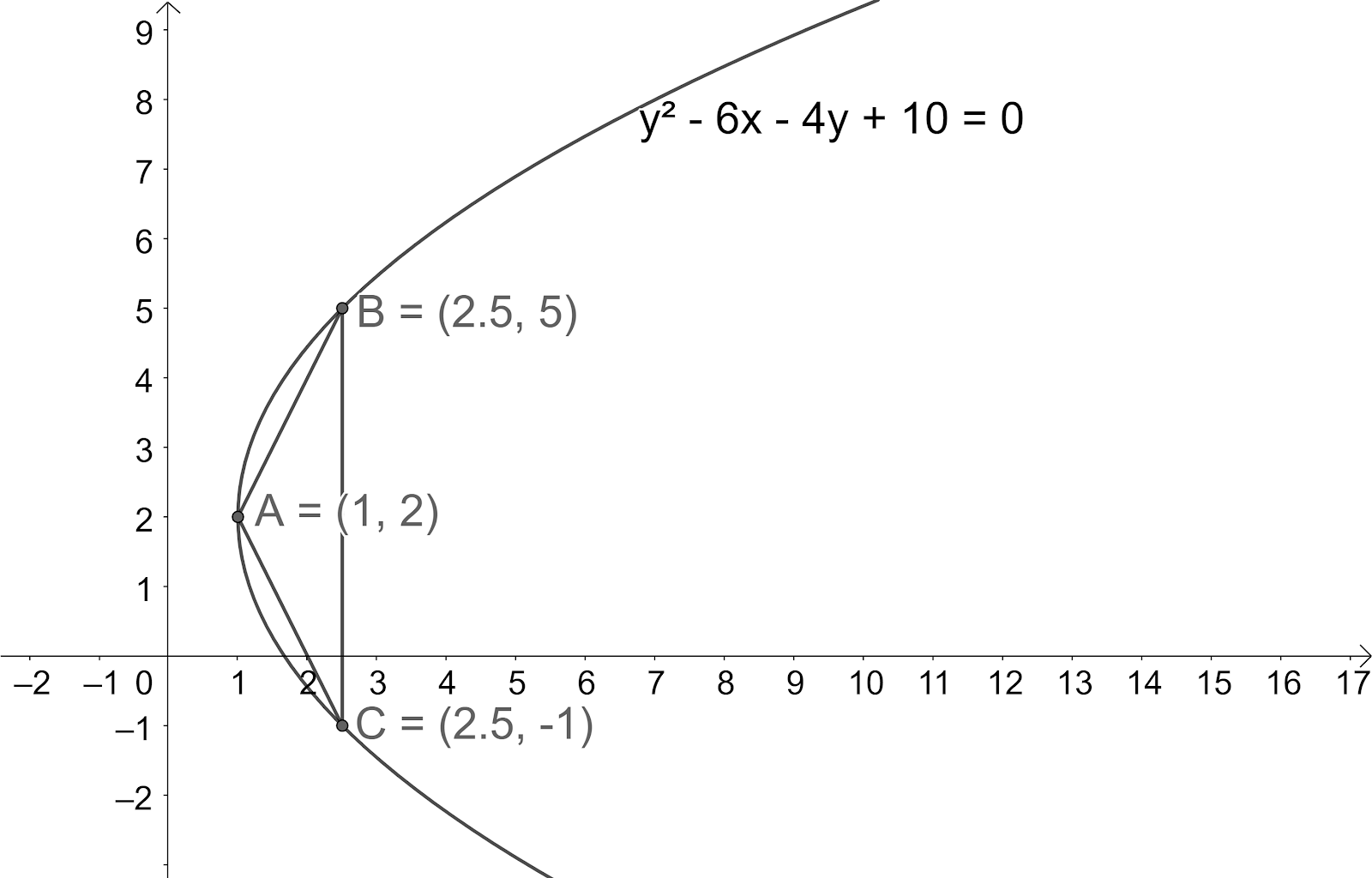
Now, we need to find the area of the triangle formed by the points A, B and C as vertices.
We know that the area of the triangle with vertices $\left( {{x}_{1}},{{y}_{1}} \right)$, $\left( {{x}_{2}},{{y}_{2}} \right)$ and $\left( {{x}_{3}},{{y}_{3}} \right)$ is $\dfrac{1}{2}\times \left| \begin{matrix}
{{x}_{1}}-{{x}_{2}} & {{x}_{1}}-{{x}_{3}} \\
{{y}_{1}}-{{y}_{2}} & {{y}_{1}}-{{y}_{3}} \\
\end{matrix} \right|$.
So, we get the area of the triangle ABC as ${{\Delta }_{ABC}}=\dfrac{1}{2}\times \left| \begin{matrix}
1-2.5 & 1-2.5 \\
2-5 & 2+1 \\
\end{matrix} \right|$.
$\Rightarrow {{\Delta }_{ABC}}=\dfrac{1}{2}\times \left| \begin{matrix}
-1.5 & -1.5 \\
-3 & 3 \\
\end{matrix} \right|$.
$\Rightarrow {{\Delta }_{ABC}}=\dfrac{1}{2}\times \left| \left( -1.5\times 3 \right)-\left( -1.5\times -3 \right) \right|$.
$\Rightarrow {{\Delta }_{ABC}}=\dfrac{1}{2}\times \left| \left( -4.5 \right)-\left( 4.5 \right) \right|$.
$\Rightarrow {{\Delta }_{ABC}}=\dfrac{1}{2}\times \left| -9 \right|$.
$\Rightarrow {{\Delta }_{ABC}}=4.5$.
So, we have found the area of the triangle ABC as 4.5.
The correct option for the given problem is (c).
So, the correct answer is “Option (c)”.
Note: We can also use the Heron’s formula for calculating the area of the triangle. Whenever we get this type of problems, we first need to convert the equation of conic similar to its standard form as it will be easier to find the vertex, focus and other points. Here we have taken the modulus after performing the determinant as we know that the area of any figure is a positive quantity. Similarly, we can expect the problems to find the area of the triangle with A as the focus of the parabola.
{{x}_{1}}-{{x}_{2}} & {{x}_{1}}-{{x}_{3}} \\
{{y}_{1}}-{{y}_{2}} & {{y}_{1}}-{{y}_{3}} \\
\end{matrix} \right|$.
Complete step-by-step answer:
According to the problem, we are given that the triangle ABC is inscribed in the parabola described by the equation ${{y}^{2}}-6x-4y+10=0$ such that A is the vertex of the parabola and B and C are the end points of the Latus rectum of the parabola. We need to find the area of the triangle ABC.
Let us write the equation of the parabola in the form ${{\left( y-p \right)}^{2}}=4a\left( x-q \right)$.
So, we get ${{y}^{2}}-4y+4-6x+6=0$.
$\Rightarrow {{\left( y-2 \right)}^{2}}=6x-6$.
$\Rightarrow {{\left( y-2 \right)}^{2}}=6\left( x-1 \right)$ ---(1).
We know that the vertex of the parabola ${{\left( y-p \right)}^{2}}=4a\left( x-q \right)$ is $\left( q,p \right)$, ends of the latus rectum is $\left( q+a,p\pm 2a \right)$.
Comparing this with equation (1), we get $4a=6\Leftrightarrow a=1.5$.
We get vertex as $A\left( 1,2 \right)$ and ends of the latus rectum as $B\left( 2.5,5 \right)$ and $C\left( 2.5,-1 \right)$.
Let us draw all this information.
Now, we need to find the area of the triangle formed by the points A, B and C as vertices.
We know that the area of the triangle with vertices $\left( {{x}_{1}},{{y}_{1}} \right)$, $\left( {{x}_{2}},{{y}_{2}} \right)$ and $\left( {{x}_{3}},{{y}_{3}} \right)$ is $\dfrac{1}{2}\times \left| \begin{matrix}
{{x}_{1}}-{{x}_{2}} & {{x}_{1}}-{{x}_{3}} \\
{{y}_{1}}-{{y}_{2}} & {{y}_{1}}-{{y}_{3}} \\
\end{matrix} \right|$.
So, we get the area of the triangle ABC as ${{\Delta }_{ABC}}=\dfrac{1}{2}\times \left| \begin{matrix}
1-2.5 & 1-2.5 \\
2-5 & 2+1 \\
\end{matrix} \right|$.
$\Rightarrow {{\Delta }_{ABC}}=\dfrac{1}{2}\times \left| \begin{matrix}
-1.5 & -1.5 \\
-3 & 3 \\
\end{matrix} \right|$.
$\Rightarrow {{\Delta }_{ABC}}=\dfrac{1}{2}\times \left| \left( -1.5\times 3 \right)-\left( -1.5\times -3 \right) \right|$.
$\Rightarrow {{\Delta }_{ABC}}=\dfrac{1}{2}\times \left| \left( -4.5 \right)-\left( 4.5 \right) \right|$.
$\Rightarrow {{\Delta }_{ABC}}=\dfrac{1}{2}\times \left| -9 \right|$.
$\Rightarrow {{\Delta }_{ABC}}=4.5$.
So, we have found the area of the triangle ABC as 4.5.
The correct option for the given problem is (c).
So, the correct answer is “Option (c)”.
Note: We can also use the Heron’s formula for calculating the area of the triangle. Whenever we get this type of problems, we first need to convert the equation of conic similar to its standard form as it will be easier to find the vertex, focus and other points. Here we have taken the modulus after performing the determinant as we know that the area of any figure is a positive quantity. Similarly, we can expect the problems to find the area of the triangle with A as the focus of the parabola.
Recently Updated Pages
Master Class 12 Economics: Engaging Questions & Answers for Success

Master Class 12 English: Engaging Questions & Answers for Success
Master Class 12 Social Science: Engaging Questions & Answers for Success
Master Class 12 Maths: Engaging Questions & Answers for Success
Master Class 12 Physics: Engaging Questions & Answers for Success
Master Class 9 General Knowledge: Engaging Questions & Answers for Success
Trending doubts
One Metric ton is equal to kg A 10000 B 1000 C 100 class 11 physics CBSE
Difference Between Prokaryotic Cells and Eukaryotic Cells
Two of the body parts which do not appear in MRI are class 11 biology CBSE
1 ton equals to A 100 kg B 1000 kg C 10 kg D 10000 class 11 physics CBSE
Draw a diagram of nephron and explain its structur class 11 biology CBSE
10 examples of friction in our daily life