



How do you translate the graph of $y = \sin \left( {x - \dfrac{\pi }{3}} \right)$?
Answer
 Verified
568.2k+ views
Hint: We will write the given equation in the general format of the equation, and find the various parameters such as baseline, amplitude, and shift to plot the graph of the given equation.
Formula used: $y = a\sin (bx + c) + d$
Where $a$ is the amplitude of the equation which tells us the maximum and the minimum value the graph would go from the baseline value,
$b$ is the period of the graph,
$c$ depicts the shift of the equation, positive shift represents that the graph is shifted towards the left and negative shift represents the graph shifting to right.
And $d$ is the baseline of the equation which tells us whether the graph is going upwards or downwards.
Complete step-by-step solution:
We have the given equation as:
$y = \sin \left( {x - \dfrac{\pi }{3}} \right)$ which is a regular $y = \sin x$ graph but which is shifted to the right by $\dfrac{\pi }{3}$ units.
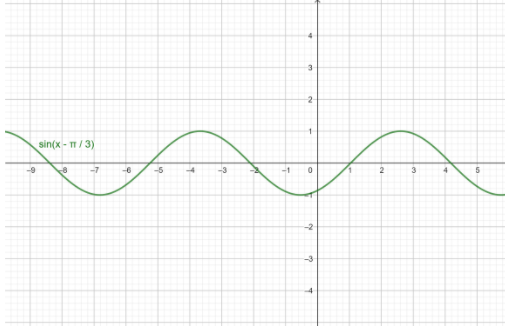
Now the amplitude of the above equation is $1$ and the baseline is $0$, therefore the graph has maximum and minimum values in the $y$ coordinate as $ - 1$ and $1$.
Now the starting point in a general $y = \sin x$ graph is $0$, but since this is a shifted graph, we find the starting point as:
$ \Rightarrow x - \dfrac{\pi }{3} = 0$, therefore $x = \dfrac{\pi }{3}$is the starting point.
Now the period is found out as: $\dfrac{{2\pi }}{a}$
On substituting we get:
$period = \dfrac{{2\pi }}{1} = 2\pi $
Therefore, now we can write the final graph of $y = \sin \left( {x - \dfrac{\pi }{3}} \right)$ is the same graph of $y = \sin x$, but it just starts from the point $\dfrac{\pi }{3}$ from the $x$ axis instead of $0$.
Note: The definition of translation is changing of position in a two-dimensional space.
The sign of the shift $c$ represents in which direction the shift is taking place, it could be negative or positive for right and left respectively.
Formula used: $y = a\sin (bx + c) + d$
Where $a$ is the amplitude of the equation which tells us the maximum and the minimum value the graph would go from the baseline value,
$b$ is the period of the graph,
$c$ depicts the shift of the equation, positive shift represents that the graph is shifted towards the left and negative shift represents the graph shifting to right.
And $d$ is the baseline of the equation which tells us whether the graph is going upwards or downwards.
Complete step-by-step solution:
We have the given equation as:
$y = \sin \left( {x - \dfrac{\pi }{3}} \right)$ which is a regular $y = \sin x$ graph but which is shifted to the right by $\dfrac{\pi }{3}$ units.
Now the amplitude of the above equation is $1$ and the baseline is $0$, therefore the graph has maximum and minimum values in the $y$ coordinate as $ - 1$ and $1$.
Now the starting point in a general $y = \sin x$ graph is $0$, but since this is a shifted graph, we find the starting point as:
$ \Rightarrow x - \dfrac{\pi }{3} = 0$, therefore $x = \dfrac{\pi }{3}$is the starting point.
Now the period is found out as: $\dfrac{{2\pi }}{a}$
On substituting we get:
$period = \dfrac{{2\pi }}{1} = 2\pi $
Therefore, now we can write the final graph of $y = \sin \left( {x - \dfrac{\pi }{3}} \right)$ is the same graph of $y = \sin x$, but it just starts from the point $\dfrac{\pi }{3}$ from the $x$ axis instead of $0$.
Note: The definition of translation is changing of position in a two-dimensional space.
The sign of the shift $c$ represents in which direction the shift is taking place, it could be negative or positive for right and left respectively.
Recently Updated Pages
Basicity of sulphurous acid and sulphuric acid are

Master Class 12 English: Engaging Questions & Answers for Success
Master Class 12 Social Science: Engaging Questions & Answers for Success
Master Class 12 Maths: Engaging Questions & Answers for Success
Master Class 12 Economics: Engaging Questions & Answers for Success
Master Class 12 Physics: Engaging Questions & Answers for Success
Trending doubts
Draw a labelled sketch of the human eye class 12 physics CBSE
Which are the Top 10 Largest Countries of the World?
Draw ray diagrams each showing i myopic eye and ii class 12 physics CBSE
Giving reasons state the signs positive or negative class 12 physics CBSE
Explain esterification reaction with the help of a class 12 chemistry CBSE
What is defined as a solenoid Depict a diagram with class 12 physics CBSE