




How do you translate a graph up or down ?
Answer
 Verified
556.2k+ views
Hint: When we draw the graph of f(x) , if we shift the graph of f(x) k units upward, then the new graph would be of f(x) +k similarly if we shift the graph k units downward, the new graph would be of f(x)-k .
Complete step by step answer:
We translate a graph up by shifting every point on the graph upwards by some units and we translate a graph down by shifting every point on the graph downward by some units.
If we shift the curve f k units upward the new curve will be of f(x)+k, let’s take an example lets draw the graph of $f\left( x \right)={{x}^{2}}$ and shift the graph upward by 4 units
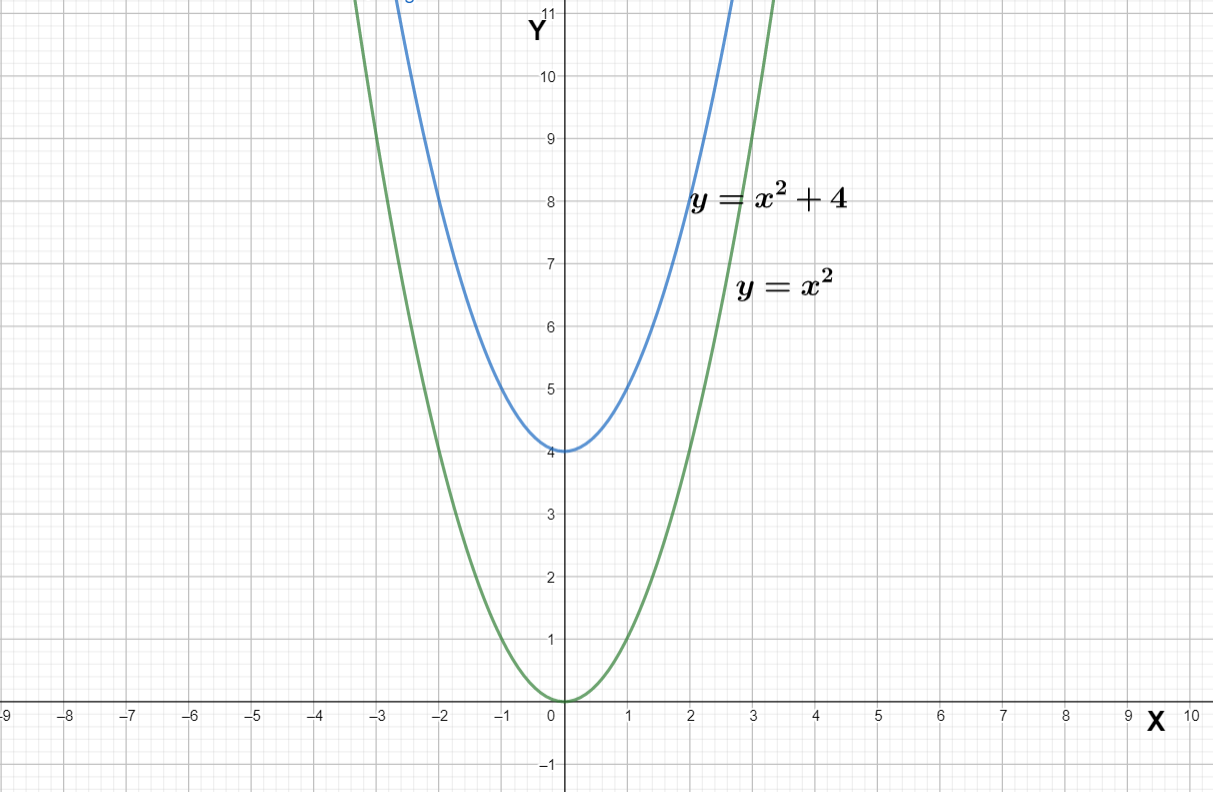
We can see that the green curve is of $f\left( x \right)={{x}^{2}}$ and if we shift the curve 4 units upward we will get the blue curve which is $f\left( x \right)={{x}^{2}}+4$ , if we shift the green curve 4 units downward we will get the curve for $f\left( x \right)={{x}^{2}}-4$.
Note:
If we translate any curve right or left that means if we have a curve f(x) and we shift the curve k units towards right then we will get the curve for f(x-k) and if we shift the curve k units towards left we will get the curve for f(k+x) . Do not get confused between f(x)+k and f(x+k) . If $f\left( x \right)={{x}^{2}}$ , then $f\left( x \right)+k$ is equal to ${{x}^{2}}+k$ and $f\left( x+k \right)$ is equal to ${{\left( x+k \right)}^{2}}$
Complete step by step answer:
We translate a graph up by shifting every point on the graph upwards by some units and we translate a graph down by shifting every point on the graph downward by some units.
If we shift the curve f k units upward the new curve will be of f(x)+k, let’s take an example lets draw the graph of $f\left( x \right)={{x}^{2}}$ and shift the graph upward by 4 units
We can see that the green curve is of $f\left( x \right)={{x}^{2}}$ and if we shift the curve 4 units upward we will get the blue curve which is $f\left( x \right)={{x}^{2}}+4$ , if we shift the green curve 4 units downward we will get the curve for $f\left( x \right)={{x}^{2}}-4$.
Note:
If we translate any curve right or left that means if we have a curve f(x) and we shift the curve k units towards right then we will get the curve for f(x-k) and if we shift the curve k units towards left we will get the curve for f(k+x) . Do not get confused between f(x)+k and f(x+k) . If $f\left( x \right)={{x}^{2}}$ , then $f\left( x \right)+k$ is equal to ${{x}^{2}}+k$ and $f\left( x+k \right)$ is equal to ${{\left( x+k \right)}^{2}}$
Recently Updated Pages
Master Class 10 Computer Science: Engaging Questions & Answers for Success

Master Class 10 General Knowledge: Engaging Questions & Answers for Success
Master Class 10 English: Engaging Questions & Answers for Success
Master Class 10 Social Science: Engaging Questions & Answers for Success
Master Class 10 Maths: Engaging Questions & Answers for Success
Master Class 10 Science: Engaging Questions & Answers for Success
Trending doubts
What is the median of the first 10 natural numbers class 10 maths CBSE
Which women's tennis player has 24 Grand Slam singles titles?
Who is the Brand Ambassador of Incredible India?
Why is there a time difference of about 5 hours between class 10 social science CBSE
Write a letter to the principal requesting him to grant class 10 english CBSE
State and prove converse of BPT Basic Proportionality class 10 maths CBSE