




TP and TQ are tangents to parabola \[{{y}^{2}}=4ax\] and normals at P and Q intersect at a point R on the curve. The locus of the center of the circle circumscribing \[\Delta TPQ\] is a parabola whose
(a) vertex is (1, 0)
(b) foot of directrix is \[\left( \dfrac{7}{8},0 \right)\]
(c) length of latus – rectum is \[\dfrac{1}{4}\]
(d) focus is \[\left( \dfrac{9}{8},0 \right)\]
Answer
 Verified
536.9k+ views
Hint: Prove that the center of the circle circumscribing is simplified to \[{{y}^{2}}=\dfrac{x-1}{2}\], where (x, y) are the coordinates of the center.
Complete step-by-step answer:
We know that the equation of parabola is
\[{{y}^{2}}=4ax\]
From the question, \[{{y}^{2}}=4x\], where a = 1.
Let us consider the two points as \[P\left( at_{1}^{2},2a{{t}_{1}} \right)\] and \[Q\left( at_{2}^{2},2a{{t}_{2}} \right)\].
Now, we need to find the intersection of tangents at P and Q.
Differentiate the equation of parabola,
\[\Rightarrow {{y}^{2}}=4ax\]
Therefore, \[2y.\dfrac{dy}{dx}=4a\]
\[\Rightarrow \dfrac{dy}{dx}=\dfrac{2a}{y}\]
Therefore, slope of a tangent at a given point \[\left( {{x}_{1}},{{y}_{1}} \right)\] having slope m, by point – slope form
\[y-{{y}_{1}}=m\left( x-{{x}_{1}} \right)\]
Therefore, equation of tangent
\[\Rightarrow y-{{y}_{1}}=\dfrac{2a}{{{y}_{1}}}\left( x-{{x}_{1}} \right)\]
\[{{y}_{1}}\left( y-{{y}_{1}} \right)=2ax-2a{{x}_{1}}\text{ }\left[ \because y_{1}^{2}=4a{{x}_{1}}
\right]\]
\[{{y}_{1}}y-y_{1}^{2}=2ax-2a{{x}_{1}}\]
\[\Rightarrow {{y}_{1}}y-4a{{x}_{1}}=2ax-2a{{x}_{1}}\]
\[\Rightarrow {{y}_{1}}y=2ax+2a{{x}_{1}}\]
\[\therefore y{{y}_{1}}=2a\left( x+{{x}_{1}} \right)\]
For point \[P\left( at_{1}^{2},2a{{t}_{1}} \right)\],
Equation of tangent at \[{{t}_{1}}\],
\[\Rightarrow y\left( 2a{{t}_{1}} \right)=2a\left( x+at_{1}^{2} \right)\]
\[y{{t}_{1}}=x+at_{1}^{2}....\left( i \right)\]
Similarly at \[Q\left( at_{2}^{2},2a{{t}_{2}} \right)\]
Equation of tangent at \[{{t}_{2}}\],
\[\Rightarrow y\left( 2a{{t}_{2}} \right)=2a\left( x+at_{2}^{2} \right)\]
\[y{{t}_{2}}=x+at_{2}^{2}....\left( ii \right)\]
Now, equation (i) – equation (ii)
\[\Rightarrow y\left( {{t}_{1}}-{{t}_{2}} \right)=a\left( t_{1}^{2}-t_{2}^{2} \right)\text{ }\left[ \because {{a}^{2}}-{{b}^{2}}=\left( a+b \right)\left( a-b \right) \right]\]
\[y\left( {{t}_{1}}-{{t}_{2}} \right)=a\left( {{t}_{1}}-{{t}_{2}} \right)\left( {{t}_{1}}+{{t}_{2}}
\right)\]
\[\Rightarrow y=a\left( {{t}_{1}}+{{t}_{2}} \right)\]
Substitute value of y in equation (i).
\[a\left( {{t}_{1}}+{{t}_{2}} \right){{t}_{1}}=x+at_{1}^{2}\]
\[at_{1}^{2}+a{{t}_{1}}{{t}_{2}}=x+at_{1}^{2}\]
\[\Rightarrow x=a{{t}_{1}}{{t}_{2}}\]
Therefore, point of intersection of tangents P and Q is \[T\left[ a{{t}_{1}}{{t}_{2}},a\left( {{t}_{1}}+{{t}_{2}} \right) \right]\].
Similarly, the point of intersection of normals drawn at \[P\left( at_{1}^{2},2a{{t}_{1}} \right)\] and \[Q\left( at_{2}^{2},2a{{t}_{2}} \right)\] is given by point R, where the coordinates of R is \[\left[ a\left( t_{1}^{2}+t_{2}^{2}+{{t}_{1}}{{t}_{2}}+2 \right),-a{{t}_{1}}{{t}_{2}}\left( {{t}_{1}}+{{t}_{2}} \right) \right]\]
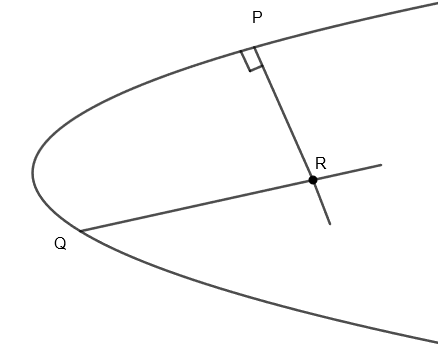
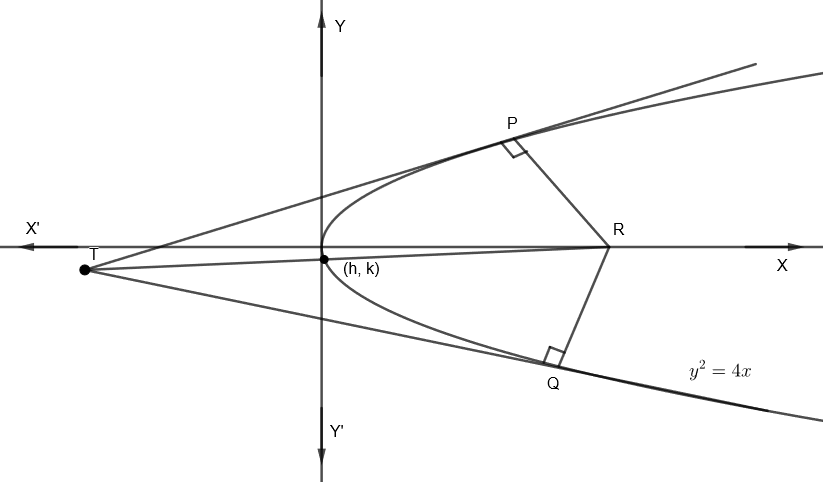
From the figure we can understand that TP and TQ are the tangents to the parabola \[{{y}^{2}}=4x\]. And the normals of P and Q meet at R where \[\angle TPR={{90}^{o}}\] and \[\angle TQR={{90}^{o}}\].
Now by joining the points T and R. Then TPR becomes a right angled triangle. So, we need to find the locus of the center of the circle circumscribing \[\Delta TPQ\].
Here in \[\Delta TPR\], the circumcenter is the midpoint of TR (i.e. hypotenuse of \[\Delta TPR\])
Let us take the coordinates of the midpoint of TR as (h, k). See the figure to find the exact place of the circumcenter.
(h, k) is the midpoint of T and R.
\[T\left( a{{t}_{1}}{{t}_{2}},a\left( {{t}_{1}}+{{t}_{2}} \right) \right)\] and \[R\left[ a\left( t_{1}^{2}+t_{2}^{2}+{{t}_{1}}{{t}_{2}}+2 \right),-a{{t}_{1}}{{t}_{2}}\left( {{t}_{1}}+{{t}_{2}} \right) \right]\]
The formula to midpoint \[\Rightarrow \left(
\dfrac{{{x}_{2}}+{{x}_{1}}}{2},\dfrac{{{y}_{2}}+{{y}_{1}}}{2} \right)\]
\[\therefore h=\dfrac{{{x}_{2}}+{{x}_{1}}}{2}\] and \[k=\dfrac{{{y}_{2}}+{{y}_{1}}}{2}\]
\[\therefore h=\dfrac{a\left( t_{1}^{2}+t_{2}^{2}+{{t}_{1}}{{t}_{2}}+2
\right)+a{{t}_{1}}{{t}_{2}}}{2}\]
\[=\dfrac{at_{1}^{2}+at_{2}^{2}+a{{t}_{1}}{{t}_{2}}+2a+a{{t}_{1}}{{t}_{2}}}{2}\]
\[=\dfrac{a\left( t_{1}^{2}+t_{2}^{2}+2{{t}_{1}}{{t}_{2}}+2 \right)}{2}\]
\[k=\dfrac{-a{{t}_{1}}{{t}_{2}}\left( {{t}_{1}}+{{t}_{2}} \right)+a\left( {{t}_{1}}+{{t}_{2}}
\right)}{2}\]
\[=\dfrac{a\left( {{t}_{1}}+{{t}_{2}} \right)\left( 1-{{t}_{1}}{{t}_{2}} \right)}{2}\]
\[\therefore \left( h,k \right)=\left[ \dfrac{a\left( t_{1}^{2}+t_{2}^{2}+2{{t}_{1}}{{t}_{2}}+2
\right)}{2},\dfrac{a\left( {{t}_{1}}+{{t}_{2}} \right)\left( 1-{{t}_{1}}{{t}_{2}} \right)}{2}
\right]....\left( iii \right)\]
Here, the given equation of parabola is \[{{y}^{2}}=4x\], where a = 1.
When the value of a = 1, by simplifying equation (iii), we get it equal to
\[{{k}^{2}}=\dfrac{h-1}{2}\].
\[k=\dfrac{a\left( {{t}_{1}}+{{t}_{2}} \right)\left( 1-{{t}_{1}}{{t}_{2}} \right)}{2}\]
The chord joining \[\left( at_{1}^{2},2a{{t}_{1}} \right)\] and \[\left( at_{2}^{2},2a{{t}_{2}} \right)\] passes through the focus, if \[{{t}_{1}}{{t}_{2}}=-1\] [i.e. the tangents are perpendicular]
Put a = 1 and \[{{t}_{1}}{{t}_{2}}=-1\]
\[k=\dfrac{\left( {{t}_{1}}+{{t}_{2}} \right)\left[ 1-\left( -1 \right) \right]}{2}=\left( {{t}_{1}}+{{t}_{2}} \right)\times \dfrac{2}{2}={{t}_{1}}+{{t}_{2}}\]
\[\therefore k={{t}_{1}}+{{t}_{2}}\]
Now, squaring both the sides, we get
\[{{k}^{2}}={{\left( {{t}_{1}}+{{t}_{2}} \right)}^{2}}={{t}_{1}}+{{t}_{2}}+2{{t}_{1}}{{t}_{2}}\]
Substitute \[{{t}_{1}}{{t}_{2}}=-1\]
\[\Rightarrow {{k}^{2}}={{t}_{1}}+{{t}_{2}}+2\left( -1 \right)\]
\[\therefore {{k}^{2}}={{t}_{1}}+{{t}_{2}}-2.....\left( iv \right)\]
Now, \[h=\dfrac{a\left( t_{1}^{2}+t_{2}^{2}+2{{t}_{1}}{{t}_{2}}+2 \right)}{2}\]
Put a = 1 and \[{{t}_{1}}{{t}_{2}}=-1\]
\[\therefore h=\dfrac{t_{1}^{2}+t_{2}^{2}+2\left( -1
\right)+2}{2}=\dfrac{t_{1}^{2}+t_{2}^{2}}{2}\]
\[h-1\Rightarrow \dfrac{t_{1}^{2}+t_{2}^{2}}{2}-1\]
\[h-1\Rightarrow \dfrac{t_{1}^{2}+t_{2}^{2}-2}{2}\]
\[\therefore \dfrac{h-1}{2}\Rightarrow t_{1}^{2}+t_{2}^{2}-2....\left( v \right)\]
By comparing equations (iv) and (v), we can come to the conclusion that
\[{{k}^{2}}=\dfrac{h-1}{2}\]
Putting (x, y) in place of (h, k), we get
\[{{y}^{2}}=\dfrac{x-1}{2}....\left( vi \right)\]
Now, considering equation (vi), it’s the equation of a parabola,
\[{{y}^{2}}=\dfrac{1}{2}\left( x-1 \right)\]
where the vertex is (1, 0)
It’s obtained by putting y = 0.
\[0=\dfrac{1}{2}\left( x-1 \right)\]
\[\Rightarrow x=1\]
Therefore, vertex is (1, 0) and the value of \[4a=\dfrac{1}{2}\].
\[\Rightarrow a=\dfrac{1}{2\times 4}=\dfrac{1}{8}\]
Therefore, the focus is obtained by (1+a, 0).
\[F\left( 1+\dfrac{1}{8},0 \right)=F\left( \dfrac{9}{8},0 \right)\]
To find the foot of the directrix \[{{F}_{D}}\], the directrix will come behind the parabola, which is at a distance of (1 – a) from the parabola.
Here, the y – coordinate is zero, as the components lie in the x – axis.
Therefore, foot of directrix = (1 – a, 0)
\[{{F}_{D}}=\left( 1-\dfrac{1}{8},0 \right)=\left( \dfrac{7}{8},0 \right)\]
We know that the length of latus rectum = 4a
\[=4\times \dfrac{1}{8}=\dfrac{1}{2}\]
Therefore, we got the values of the parabola, where the locus of the center of the circle circumscribes the triangle \[\Delta TPQ\].
\[\begin{align}
& \text{Vertex}=\left( 1,0 \right) \\
& \text{Focus}=\left( \dfrac{9}{8},0 \right) \\
& \text{Foot of Directrix}=\left( \dfrac{7}{8},0 \right) \\
& \text{Length of latus rectum}=\dfrac{1}{2} \\
\end{align}\]
Hence the correct options are (a), (b) and (d).
Note: By taking the value of a = 1, as per the equation of parabola \[{{y}^{2}}=4x\], we obtain the simplified form of (h, k) as \[{{k}^{2}}=h-\dfrac{1}{2}\]. From this, we get the values of vertex, focus, foot of directrix and length of latus rectum.
Complete step-by-step answer:
We know that the equation of parabola is
\[{{y}^{2}}=4ax\]
From the question, \[{{y}^{2}}=4x\], where a = 1.
Let us consider the two points as \[P\left( at_{1}^{2},2a{{t}_{1}} \right)\] and \[Q\left( at_{2}^{2},2a{{t}_{2}} \right)\].
Now, we need to find the intersection of tangents at P and Q.
Differentiate the equation of parabola,
\[\Rightarrow {{y}^{2}}=4ax\]
Therefore, \[2y.\dfrac{dy}{dx}=4a\]
\[\Rightarrow \dfrac{dy}{dx}=\dfrac{2a}{y}\]
Therefore, slope of a tangent at a given point \[\left( {{x}_{1}},{{y}_{1}} \right)\] having slope m, by point – slope form
\[y-{{y}_{1}}=m\left( x-{{x}_{1}} \right)\]
Therefore, equation of tangent
\[\Rightarrow y-{{y}_{1}}=\dfrac{2a}{{{y}_{1}}}\left( x-{{x}_{1}} \right)\]
\[{{y}_{1}}\left( y-{{y}_{1}} \right)=2ax-2a{{x}_{1}}\text{ }\left[ \because y_{1}^{2}=4a{{x}_{1}}
\right]\]
\[{{y}_{1}}y-y_{1}^{2}=2ax-2a{{x}_{1}}\]
\[\Rightarrow {{y}_{1}}y-4a{{x}_{1}}=2ax-2a{{x}_{1}}\]
\[\Rightarrow {{y}_{1}}y=2ax+2a{{x}_{1}}\]
\[\therefore y{{y}_{1}}=2a\left( x+{{x}_{1}} \right)\]
For point \[P\left( at_{1}^{2},2a{{t}_{1}} \right)\],
Equation of tangent at \[{{t}_{1}}\],
\[\Rightarrow y\left( 2a{{t}_{1}} \right)=2a\left( x+at_{1}^{2} \right)\]
\[y{{t}_{1}}=x+at_{1}^{2}....\left( i \right)\]
Similarly at \[Q\left( at_{2}^{2},2a{{t}_{2}} \right)\]
Equation of tangent at \[{{t}_{2}}\],
\[\Rightarrow y\left( 2a{{t}_{2}} \right)=2a\left( x+at_{2}^{2} \right)\]
\[y{{t}_{2}}=x+at_{2}^{2}....\left( ii \right)\]
Now, equation (i) – equation (ii)
\[\Rightarrow y\left( {{t}_{1}}-{{t}_{2}} \right)=a\left( t_{1}^{2}-t_{2}^{2} \right)\text{ }\left[ \because {{a}^{2}}-{{b}^{2}}=\left( a+b \right)\left( a-b \right) \right]\]
\[y\left( {{t}_{1}}-{{t}_{2}} \right)=a\left( {{t}_{1}}-{{t}_{2}} \right)\left( {{t}_{1}}+{{t}_{2}}
\right)\]
\[\Rightarrow y=a\left( {{t}_{1}}+{{t}_{2}} \right)\]
Substitute value of y in equation (i).
\[a\left( {{t}_{1}}+{{t}_{2}} \right){{t}_{1}}=x+at_{1}^{2}\]
\[at_{1}^{2}+a{{t}_{1}}{{t}_{2}}=x+at_{1}^{2}\]
\[\Rightarrow x=a{{t}_{1}}{{t}_{2}}\]
Therefore, point of intersection of tangents P and Q is \[T\left[ a{{t}_{1}}{{t}_{2}},a\left( {{t}_{1}}+{{t}_{2}} \right) \right]\].
Similarly, the point of intersection of normals drawn at \[P\left( at_{1}^{2},2a{{t}_{1}} \right)\] and \[Q\left( at_{2}^{2},2a{{t}_{2}} \right)\] is given by point R, where the coordinates of R is \[\left[ a\left( t_{1}^{2}+t_{2}^{2}+{{t}_{1}}{{t}_{2}}+2 \right),-a{{t}_{1}}{{t}_{2}}\left( {{t}_{1}}+{{t}_{2}} \right) \right]\]
From the figure we can understand that TP and TQ are the tangents to the parabola \[{{y}^{2}}=4x\]. And the normals of P and Q meet at R where \[\angle TPR={{90}^{o}}\] and \[\angle TQR={{90}^{o}}\].
Now by joining the points T and R. Then TPR becomes a right angled triangle. So, we need to find the locus of the center of the circle circumscribing \[\Delta TPQ\].
Here in \[\Delta TPR\], the circumcenter is the midpoint of TR (i.e. hypotenuse of \[\Delta TPR\])
Let us take the coordinates of the midpoint of TR as (h, k). See the figure to find the exact place of the circumcenter.
(h, k) is the midpoint of T and R.
\[T\left( a{{t}_{1}}{{t}_{2}},a\left( {{t}_{1}}+{{t}_{2}} \right) \right)\] and \[R\left[ a\left( t_{1}^{2}+t_{2}^{2}+{{t}_{1}}{{t}_{2}}+2 \right),-a{{t}_{1}}{{t}_{2}}\left( {{t}_{1}}+{{t}_{2}} \right) \right]\]
The formula to midpoint \[\Rightarrow \left(
\dfrac{{{x}_{2}}+{{x}_{1}}}{2},\dfrac{{{y}_{2}}+{{y}_{1}}}{2} \right)\]
\[\therefore h=\dfrac{{{x}_{2}}+{{x}_{1}}}{2}\] and \[k=\dfrac{{{y}_{2}}+{{y}_{1}}}{2}\]
\[\therefore h=\dfrac{a\left( t_{1}^{2}+t_{2}^{2}+{{t}_{1}}{{t}_{2}}+2
\right)+a{{t}_{1}}{{t}_{2}}}{2}\]
\[=\dfrac{at_{1}^{2}+at_{2}^{2}+a{{t}_{1}}{{t}_{2}}+2a+a{{t}_{1}}{{t}_{2}}}{2}\]
\[=\dfrac{a\left( t_{1}^{2}+t_{2}^{2}+2{{t}_{1}}{{t}_{2}}+2 \right)}{2}\]
\[k=\dfrac{-a{{t}_{1}}{{t}_{2}}\left( {{t}_{1}}+{{t}_{2}} \right)+a\left( {{t}_{1}}+{{t}_{2}}
\right)}{2}\]
\[=\dfrac{a\left( {{t}_{1}}+{{t}_{2}} \right)\left( 1-{{t}_{1}}{{t}_{2}} \right)}{2}\]
\[\therefore \left( h,k \right)=\left[ \dfrac{a\left( t_{1}^{2}+t_{2}^{2}+2{{t}_{1}}{{t}_{2}}+2
\right)}{2},\dfrac{a\left( {{t}_{1}}+{{t}_{2}} \right)\left( 1-{{t}_{1}}{{t}_{2}} \right)}{2}
\right]....\left( iii \right)\]
Here, the given equation of parabola is \[{{y}^{2}}=4x\], where a = 1.
When the value of a = 1, by simplifying equation (iii), we get it equal to
\[{{k}^{2}}=\dfrac{h-1}{2}\].
\[k=\dfrac{a\left( {{t}_{1}}+{{t}_{2}} \right)\left( 1-{{t}_{1}}{{t}_{2}} \right)}{2}\]
The chord joining \[\left( at_{1}^{2},2a{{t}_{1}} \right)\] and \[\left( at_{2}^{2},2a{{t}_{2}} \right)\] passes through the focus, if \[{{t}_{1}}{{t}_{2}}=-1\] [i.e. the tangents are perpendicular]
Put a = 1 and \[{{t}_{1}}{{t}_{2}}=-1\]
\[k=\dfrac{\left( {{t}_{1}}+{{t}_{2}} \right)\left[ 1-\left( -1 \right) \right]}{2}=\left( {{t}_{1}}+{{t}_{2}} \right)\times \dfrac{2}{2}={{t}_{1}}+{{t}_{2}}\]
\[\therefore k={{t}_{1}}+{{t}_{2}}\]
Now, squaring both the sides, we get
\[{{k}^{2}}={{\left( {{t}_{1}}+{{t}_{2}} \right)}^{2}}={{t}_{1}}+{{t}_{2}}+2{{t}_{1}}{{t}_{2}}\]
Substitute \[{{t}_{1}}{{t}_{2}}=-1\]
\[\Rightarrow {{k}^{2}}={{t}_{1}}+{{t}_{2}}+2\left( -1 \right)\]
\[\therefore {{k}^{2}}={{t}_{1}}+{{t}_{2}}-2.....\left( iv \right)\]
Now, \[h=\dfrac{a\left( t_{1}^{2}+t_{2}^{2}+2{{t}_{1}}{{t}_{2}}+2 \right)}{2}\]
Put a = 1 and \[{{t}_{1}}{{t}_{2}}=-1\]
\[\therefore h=\dfrac{t_{1}^{2}+t_{2}^{2}+2\left( -1
\right)+2}{2}=\dfrac{t_{1}^{2}+t_{2}^{2}}{2}\]
\[h-1\Rightarrow \dfrac{t_{1}^{2}+t_{2}^{2}}{2}-1\]
\[h-1\Rightarrow \dfrac{t_{1}^{2}+t_{2}^{2}-2}{2}\]
\[\therefore \dfrac{h-1}{2}\Rightarrow t_{1}^{2}+t_{2}^{2}-2....\left( v \right)\]
By comparing equations (iv) and (v), we can come to the conclusion that
\[{{k}^{2}}=\dfrac{h-1}{2}\]
Putting (x, y) in place of (h, k), we get
\[{{y}^{2}}=\dfrac{x-1}{2}....\left( vi \right)\]
Now, considering equation (vi), it’s the equation of a parabola,
\[{{y}^{2}}=\dfrac{1}{2}\left( x-1 \right)\]
where the vertex is (1, 0)
It’s obtained by putting y = 0.
\[0=\dfrac{1}{2}\left( x-1 \right)\]
\[\Rightarrow x=1\]
Therefore, vertex is (1, 0) and the value of \[4a=\dfrac{1}{2}\].
\[\Rightarrow a=\dfrac{1}{2\times 4}=\dfrac{1}{8}\]
Therefore, the focus is obtained by (1+a, 0).
\[F\left( 1+\dfrac{1}{8},0 \right)=F\left( \dfrac{9}{8},0 \right)\]
To find the foot of the directrix \[{{F}_{D}}\], the directrix will come behind the parabola, which is at a distance of (1 – a) from the parabola.
Here, the y – coordinate is zero, as the components lie in the x – axis.
Therefore, foot of directrix = (1 – a, 0)
\[{{F}_{D}}=\left( 1-\dfrac{1}{8},0 \right)=\left( \dfrac{7}{8},0 \right)\]
We know that the length of latus rectum = 4a
\[=4\times \dfrac{1}{8}=\dfrac{1}{2}\]
Therefore, we got the values of the parabola, where the locus of the center of the circle circumscribes the triangle \[\Delta TPQ\].
\[\begin{align}
& \text{Vertex}=\left( 1,0 \right) \\
& \text{Focus}=\left( \dfrac{9}{8},0 \right) \\
& \text{Foot of Directrix}=\left( \dfrac{7}{8},0 \right) \\
& \text{Length of latus rectum}=\dfrac{1}{2} \\
\end{align}\]
Hence the correct options are (a), (b) and (d).
Note: By taking the value of a = 1, as per the equation of parabola \[{{y}^{2}}=4x\], we obtain the simplified form of (h, k) as \[{{k}^{2}}=h-\dfrac{1}{2}\]. From this, we get the values of vertex, focus, foot of directrix and length of latus rectum.
Recently Updated Pages
Basicity of sulphurous acid and sulphuric acid are

Master Class 10 English: Engaging Questions & Answers for Success
Master Class 10 Social Science: Engaging Questions & Answers for Success
Master Class 10 Computer Science: Engaging Questions & Answers for Success
Class 10 Question and Answer - Your Ultimate Solutions Guide
Master Class 10 General Knowledge: Engaging Questions & Answers for Success
Trending doubts
Which country won the ICC Men's ODI World Cup in 2023?
In cricket, how many legal balls are there in a standard over?
Explain the Treaty of Vienna of 1815 class 10 social science CBSE
A boat goes 24 km upstream and 28 km downstream in class 10 maths CBSE
What does "powerplay" mean in limited-overs cricket?
What is the "Powerplay" in T20 cricket?