




Total number of $\sigma $bonds in ${{N}_ {3}}H$is _______
Answer
 Verified
653.4k+ views
Hint: Hydrazoic acid, also known as hydrogen azide or azoimide, is a compound with the chemical formula ${{N}_ {3}}H$. It is a colourless, volatile, and explosive liquid at room temperature and pressure. It is a compound of nitrogen and hydrogen, and is therefore a pnictogen hydride.
Complete step by step solution:
We have been provided with a compound ${{N}_ {3}}H$,
Its IUPAC name Hydrogen azide is a nitrogen hydride. It is a conjugate acid of an azide anion,
The hybridisation of the central N atom is only $sp$. And, remaining two N atoms is $s{{p}^ {2}} $
Its structure is:
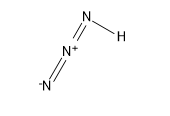
Sigma bonds are the strongest type of covalent chemical bond. They are formed by head-on overlapping between atomic orbitals. Sigma bonding is most simply defined for diatomic molecules using the language and tools of symmetry groups.
Pi bonds are covalent chemical bonds where two lobes of an orbital on one atom overlap two lobes of an orbital on another atom and this overlap occurs laterally. Each of these atomic orbitals has zero electron density at a shared nodal plane, passing through the two bonded nuclei.
From this we came to know that Hydrazoic acid has 3 sigma bonds with 3 hydrogens and zero pi bonds and has a lone pair of electrons.
Note: ${{N}_ {3}}H$ is called the covalent azide and it does not dissociate easily. This makes sodium azide more stable than hydrazoic acid. Hence, $N{{a}^ {+}} {{N}^ {3-}} $decomposes at a much higher temperature than ${{N}_ {3}}H$and hence, the higher thermal stability of $N{{H}_ {3}} Na$.
Complete step by step solution:
We have been provided with a compound ${{N}_ {3}}H$,
Its IUPAC name Hydrogen azide is a nitrogen hydride. It is a conjugate acid of an azide anion,
The hybridisation of the central N atom is only $sp$. And, remaining two N atoms is $s{{p}^ {2}} $
Its structure is:
Sigma bonds are the strongest type of covalent chemical bond. They are formed by head-on overlapping between atomic orbitals. Sigma bonding is most simply defined for diatomic molecules using the language and tools of symmetry groups.
Pi bonds are covalent chemical bonds where two lobes of an orbital on one atom overlap two lobes of an orbital on another atom and this overlap occurs laterally. Each of these atomic orbitals has zero electron density at a shared nodal plane, passing through the two bonded nuclei.
From this we came to know that Hydrazoic acid has 3 sigma bonds with 3 hydrogens and zero pi bonds and has a lone pair of electrons.
Note: ${{N}_ {3}}H$ is called the covalent azide and it does not dissociate easily. This makes sodium azide more stable than hydrazoic acid. Hence, $N{{a}^ {+}} {{N}^ {3-}} $decomposes at a much higher temperature than ${{N}_ {3}}H$and hence, the higher thermal stability of $N{{H}_ {3}} Na$.
Recently Updated Pages
If x a + bt + ct2 where x is in meters and t is in class 11 physics CBSE

A car covers the first half distance between two places class 11 physics CBSE
The resultant of two vectors overrightarrow P and overrightarrow class 11 physics CBSE
Find the value of cos 135 class 11 maths CBSE
A mass M is held in place by an applied force F and class 11 physics CBSE
A solution of glucose in water is labelled as 10 dfracwv class 11 chemistry CBSE
Trending doubts
Find the value of the expression given below sin 30circ class 11 maths CBSE
One Metric ton is equal to kg A 10000 B 1000 C 100 class 11 physics CBSE
Draw a diagram of nephron and explain its structur class 11 biology CBSE
10 examples of friction in our daily life
Proton was discovered by A Thomson B Rutherford C Chadwick class 11 chemistry CBSE
Bond order ofO2 O2+ O2 and O22 is in order A O2 langle class 11 chemistry CBSE