



To increase the range of an ammeter, we need to connect a suitable
A. Low resistance in parallel
B. Low resistance in series
C. High resistance in parallel
D. High resistance in series.
Answer
 Verified
609.3k+ views
Hint: Electric currents in circuit are measured in amperes denoted by (A) Hence name of measuring instrument suggested as ammeter. Value of resistor as well as combination of resistor with circuit must be in a way such that all current goes through the device and the device will measure a more exact and accurate value of (I).
Complete answer:
Ammeter is a measuring instrument which is used to measure the value of current in a circuit. Unit of current is ammeter, denoted by A. in order to measure current from electrical components by ammeter, the ammeter must be connected in series to that device or circuit because objects in series experience the same current shown in figure (1).
So to increase the range of ammeters we need to connect a suitable low resistance in parallel combination. We will understand this concept with the help of diagrams.
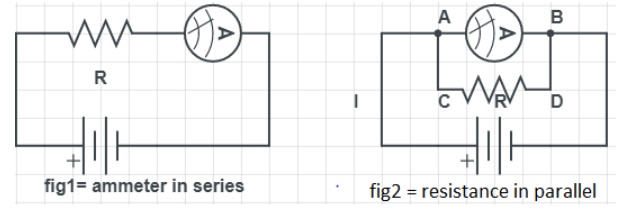
Now if we consider the ammeter as an ideal ammeter then the internal resistance of the ideal ammeter is zero. i.e. r = 0 in figure (2) if I is the current flowing through then it will split part of current flow through ammeter and part of will flow through resistor. If I is $100 \%$ current flows and if current flows in the resistor is $90 \%$ and $10 \%$ current in ammeter then resistance must have high resistance.
To increase current flow in ammeter form $10 \%$ we need to decrease the value of resistance so that the amount of current will flow through resistance and more current will flow through the ammeter. Hence ammeter will measure more current and will show deflection. Actually when the value of resistance is high, it drags more current from the voltage source so that current will pass through point C to D. If we decrease value resistance let's current will drag and hence more current will go through ammeter. So to increase the range of ammeters we should have to connect low resistance in parallel so that equivalent resistance is lower hence to increase range of an ammeter we need to connect a suitable low resistance in parallel.
Therefore option (A) is correct option .
Additional information:
Resistance in parallel when a number of resistors are connected in parallel then we know that potential difference across each component will be the same. If a resistor ${{R}_{1}},{{R}_{2}}......{{R}_{n}}$ is connected in parallel the equivalent resistance of the circuit is given by
$\dfrac{1}{{{R}_{p}}}=\dfrac{1}{{{R}_{1}}}+\dfrac{1}{{{R}_{2}}}+......+\dfrac{1}{{{R}_{n}}}$
Hence when several numbers of resistor are connected in parallel combination then the equivalent resistance is equal to sum of reciprocal of each individual component which is resistance.
Note:
Students should know that ammeter must not be connected to a voltage source because it is designed to work under a minimal burden. The main principle of ammeter is that it must have low inductive resistance and also low or very low resistance. If ammeters measure smaller current then they are designed as millimeters or micro ammeters.
Complete answer:
Ammeter is a measuring instrument which is used to measure the value of current in a circuit. Unit of current is ammeter, denoted by A. in order to measure current from electrical components by ammeter, the ammeter must be connected in series to that device or circuit because objects in series experience the same current shown in figure (1).
So to increase the range of ammeters we need to connect a suitable low resistance in parallel combination. We will understand this concept with the help of diagrams.
Now if we consider the ammeter as an ideal ammeter then the internal resistance of the ideal ammeter is zero. i.e. r = 0 in figure (2) if I is the current flowing through then it will split part of current flow through ammeter and part of will flow through resistor. If I is $100 \%$ current flows and if current flows in the resistor is $90 \%$ and $10 \%$ current in ammeter then resistance must have high resistance.
To increase current flow in ammeter form $10 \%$ we need to decrease the value of resistance so that the amount of current will flow through resistance and more current will flow through the ammeter. Hence ammeter will measure more current and will show deflection. Actually when the value of resistance is high, it drags more current from the voltage source so that current will pass through point C to D. If we decrease value resistance let's current will drag and hence more current will go through ammeter. So to increase the range of ammeters we should have to connect low resistance in parallel so that equivalent resistance is lower hence to increase range of an ammeter we need to connect a suitable low resistance in parallel.
Therefore option (A) is correct option .
Additional information:
Resistance in parallel when a number of resistors are connected in parallel then we know that potential difference across each component will be the same. If a resistor ${{R}_{1}},{{R}_{2}}......{{R}_{n}}$ is connected in parallel the equivalent resistance of the circuit is given by
$\dfrac{1}{{{R}_{p}}}=\dfrac{1}{{{R}_{1}}}+\dfrac{1}{{{R}_{2}}}+......+\dfrac{1}{{{R}_{n}}}$
Hence when several numbers of resistor are connected in parallel combination then the equivalent resistance is equal to sum of reciprocal of each individual component which is resistance.
Note:
Students should know that ammeter must not be connected to a voltage source because it is designed to work under a minimal burden. The main principle of ammeter is that it must have low inductive resistance and also low or very low resistance. If ammeters measure smaller current then they are designed as millimeters or micro ammeters.
Recently Updated Pages
Master Class 11 Social Science: Engaging Questions & Answers for Success

Master Class 11 English: Engaging Questions & Answers for Success
Master Class 11 Maths: Engaging Questions & Answers for Success
Master Class 11 Chemistry: Engaging Questions & Answers for Success
Master Class 11 Biology: Engaging Questions & Answers for Success
Master Class 11 Physics: Engaging Questions & Answers for Success
Trending doubts
One Metric ton is equal to kg A 10000 B 1000 C 100 class 11 physics CBSE
Difference Between Prokaryotic Cells and Eukaryotic Cells
How many of the following diseases can be studied with class 11 biology CBSE
Which of the following enzymes is used for carboxylation class 11 biology CBSE
Draw a diagram of a plant cell and label at least eight class 11 biology CBSE
Two of the body parts which do not appear in MRI are class 11 biology CBSE