




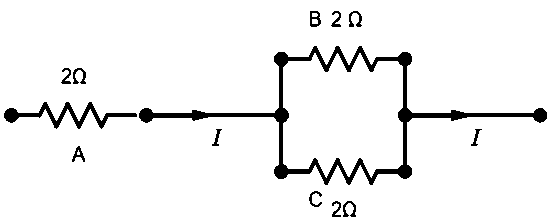
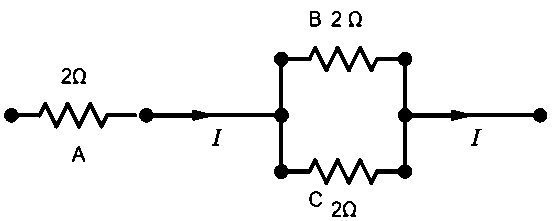
Three resistors A, B, and C of 2\[\Omega \] resistance is as shown in figure. Each of them dissipates energy and can withstand a maximum power of 18W without melting. Find the maximum current that can flow through the three resistors.
Answer
 Verified
627.6k+ views
Hint: We are given the power ratings of three resistors each with the same resistance. We have to find the maximum current that can be flow through each element using this circuit which is forming a network of series-parallel combinations.
Complete answer:
We have to find the maximum current that can flow through this circuit. It is already given that the maximum power is dissipated by the resistors. We can find the maximum current that can flow through the resistors without melting them using this power rating.
We know from the Ohm’s law that –
\[\begin{align}
& V=IR \\
& \Rightarrow \text{ }I=\dfrac{V}{R} \\
\end{align}\]
We also know that the power dissipated can be expressed in terms of the voltage drop and the current flow. The power dissipation is given as –
\[P=VI\]
We can substitute the voltage term in the above equation with that we know from Ohm's law. We will get a equation that relates power and the current as –
\[\begin{align}
& P=(IR)I \\
& \Rightarrow P={{I}^{2}}R \\
\end{align}\]
Now, we can find the current that a resistance can allow to pass without melting for a given wattage rating –
It is already given –
\[\begin{align}
& R=2\Omega \\
& \text{and,} \\
& P=18W \\
& P={{I}^{2}}R \\
\end{align}\]
\[\begin{align}
& \Rightarrow \text{ }I=\sqrt{\dfrac{P}{R}} \\
& \Rightarrow \text{ }I=\sqrt{\dfrac{18}{2}}=3A \\
\end{align}\]
So, we understand that the maximum current that can pass through any of the resistors A, B and C is 3A.
Now, we have to consider the given circuit, we know that the resistors B and C are in parallel connection. So, the current that will pass through them will be half the half current through A.
The maximum current is 3A. Therefore, the current I that can pass through the circuit is 3A.
The current through the resistors B and C in this circuit will be 1.5A.
Note:
In household connections, we use a parallel network to tackle this issue. The voltage from the source will remain a constant and the current can be adjusted according to the device for its own safety. The current is distributed in the circuit according to the load.
Complete answer:
We have to find the maximum current that can flow through this circuit. It is already given that the maximum power is dissipated by the resistors. We can find the maximum current that can flow through the resistors without melting them using this power rating.
We know from the Ohm’s law that –
\[\begin{align}
& V=IR \\
& \Rightarrow \text{ }I=\dfrac{V}{R} \\
\end{align}\]
We also know that the power dissipated can be expressed in terms of the voltage drop and the current flow. The power dissipation is given as –
\[P=VI\]
We can substitute the voltage term in the above equation with that we know from Ohm's law. We will get a equation that relates power and the current as –
\[\begin{align}
& P=(IR)I \\
& \Rightarrow P={{I}^{2}}R \\
\end{align}\]
Now, we can find the current that a resistance can allow to pass without melting for a given wattage rating –
It is already given –
\[\begin{align}
& R=2\Omega \\
& \text{and,} \\
& P=18W \\
& P={{I}^{2}}R \\
\end{align}\]
\[\begin{align}
& \Rightarrow \text{ }I=\sqrt{\dfrac{P}{R}} \\
& \Rightarrow \text{ }I=\sqrt{\dfrac{18}{2}}=3A \\
\end{align}\]
So, we understand that the maximum current that can pass through any of the resistors A, B and C is 3A.
Now, we have to consider the given circuit, we know that the resistors B and C are in parallel connection. So, the current that will pass through them will be half the half current through A.
The maximum current is 3A. Therefore, the current I that can pass through the circuit is 3A.
The current through the resistors B and C in this circuit will be 1.5A.
Note:
In household connections, we use a parallel network to tackle this issue. The voltage from the source will remain a constant and the current can be adjusted according to the device for its own safety. The current is distributed in the circuit according to the load.
Recently Updated Pages
Which will be the least stable resonating structure class 11 chemistry CBSE

How many 5 digit telephone numbers can be construc-class-11-maths-CBSE
How do you find the angle of the resultant vector class 11 physics CBSE
Draw labelled diagram of the following i Gram seed class 11 biology CBSE
1 Quintal is equal to a 110 kg b 10 kg c 100kg d 1000 class 11 physics CBSE
What is the need and importance of classification class 11 biology CBSE
Trending doubts
One Metric ton is equal to kg A 10000 B 1000 C 100 class 11 physics CBSE
Find the value of the expression given below sin 30circ class 11 maths CBSE
Draw a diagram of nephron and explain its structur class 11 biology CBSE
10 examples of friction in our daily life
Proton was discovered by A Thomson B Rutherford C Chadwick class 11 chemistry CBSE
The teeth used for biting and cutting food are called class 11 biology CBSE