




Three men, A,B and C of mass $40kg$, $50kg$ and $60kg$ are standing on a plank of mass $90kg$, which is kept on a smooth horizontal plane. If A and C exchange their positions, then B will shift:
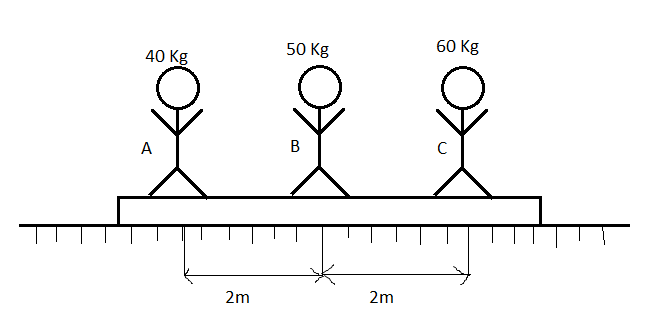
A. $1/3m$ towards left w.r.t ground
B. $1/3m$ towards right w.r.t ground
C. Will not move w.r.t ground
D. $5/3m$ towards left w.r.t to ground
Answer
 Verified
613.8k+ views
Hint: When no external force acts on a system, the center of mass of the system remains constant. This problem can be solved using the concept that since there are no external forces on the system, the center of mass of the system will remain the same. By equating the centers of mass for the initial and final conditions we can find the shift in the position of B.
Formula used:
The center of mass of a system relative to a point $\left( x,y \right)$ is given by $\left( {{C}_{x}},{{C}_{y}} \right)$where
$\left( {{C}_{x}},{{C}_{y}} \right)=\left( \dfrac{\sum{m{{r}_{x}}}}{\sum{m}},\dfrac{\sum{m{{r}_{y}}}}{\sum{m}} \right)$
where ${{r}_{x}}$ and ${{r}_{y}}$ are the positions in the horizontal and vertical plane of the mass m with respect to $\left( x,y \right)$.
Complete Step-by-Step solution:
In this problem, since all the men are assumed to be equal in height and movement of the plank is only allowed in the horizontal plane, the center of mass in the vertical direction is not of required importance in solving the question.
We will consider the three men along with the plank to be the system.
Hence, we will solve this problem only in one dimension (the horizontal) to make it easier.
Hence, let B be the origin (0) and the direction towards C (right) be considered the positive axis.
The plank can be considered to be a point mass with all its mass concentrated at its center of mass (which will be the origin as it is the midpoint and the center of mass of a uniform rectangle (cuboid in 2 dimensions is its center)
Now, position of C with respect to B =$2m$ ---------------(1)
Mass of C is given to be ${{M}_{C}}=60Kg$ -----------------(2)
Now, position of A with respect to B =$-2m$------------- --(3)
Mass of A is given to be ${{M}_{A}}=40Kg$ ------------------(4)
Now, position of B with respect to B =$0m$ ------------------(5)
Mass of B is given to be ${{M}_{B}}=50Kg$ ---------------------(6)
Position of point mass of plank with respect to B =$0m$--------------------(7)
Mass of plank is given to be ${{M}_{Plank}}=90Kg$ ------------------(8)
Now, we will find the center of mass w.r.t point B.
The center of mass of a system relative to a point $\left( x,y \right)$ is given by $\left( {{C}_{x}},{{C}_{y}} \right)$ where
$\left( {{C}_{x}},{{C}_{y}} \right)=\left( \dfrac{\sum{m{{r}_{x}}}}{\sum{m}},\dfrac{\sum{m{{r}_{y}}}}{\sum{m}} \right)$ -------------(9)
where ${{r}_{x}} $ and $ {{r}_{y}}$ are the positions in the horizontal and vertical plane of the mass m with respect to $\left( x,y \right)$.
Hence, using (1),(2),(3),(4),(5),(6), (7), (8) and (9) , we get center of mass in the horizontal direction $\left( {{P}_{1}} \right)$ as
${{P}_{1}}=\dfrac{\left( {{M}_{A}}\times \left( -2 \right) \right)+\left( {{M}_{B}}\times \left( 0 \right) \right)+\left( {{M}_{C}}\times \left( 2 \right) \right)+\left( {{M}_{Plank}}\times \left( ) \right) \right)}{{{M}_{A}}+{{M}_{B}}+{{M}_{C}}+{{M}_{Plank}}}$
$\therefore {{P}_{1}}=\dfrac{\left( 40\times \left( -2 \right) \right)+\left( 50\times \left( 0 \right) \right)+\left( 60\times \left( 2 \right) \right)+\left( 90\times \left( 0 \right) \right)}{40+50+60+90}=\dfrac{-80+0+120+0}{240}=\dfrac{40}{240}=\dfrac{1}{6}m$ ------------(10)
Hence, the center of mass of the system is at a distance of $\dfrac{1}{6}m$ from B towards C.
Now, it is given in the question that A and C exchange positions. Hence, the center of mass relative to point B will also change. Hence, due to this plank shifts horizontally to the right by x. Hence,
Now, position of C with respect to earlier position of B, i.e. origin =$\left( -2+x \right)m$ - ---------------------(11)
Mass of C is given to be ${{M}_{C}}=60Kg$ -------------(12)
Now, position of A with respect to earlier position of B, i.e. origin = $\left( 2+x \right)m$ ---------------------(13)
Mass of A is given to be ${{M}_{A}}=40Kg$ ----------------(14)
Now, position of B with respect to earlier position of B, i.e. origin =$\left( x \right)m$ ---------------(15)
Mass of B is given to be ${{M}_{B}}=50Kg$ --------------------(16)
Position of point mass of plank with respect to earlier position of B = $\left( x \right)m$--------------------------(17)
Mass of plank is given to be ${{M}_{Plank}}=90Kg$ -------------(18)
Again using (9),(10),(11),(12),(13),(14), (15),(16),(17) and(18) we will get the new center of mass of the system $\left( {{P}_{2}} \right)$ as:
${{P}_{2}}=\dfrac{\left( {{M}_{A}}\times \left( 2+x \right) \right)+\left( {{M}_{B}}\times \left( x \right) \right)+\left( {{M}_{C}}\times \left( -2+x \right) \right)+\left( {{M}_{Plank}}\times \left( x \right) \right)}{{{M}_{A}}+{{M}_{B}}+{{M}_{C}}+{{M}_{Plank}}}$
\[\therefore {{P}_{2}}=\dfrac{\left( 40\times \left( 2+x \right) \right)+\left( 50\times \left( x \right) \right)+\left( 60\times \left( -2+x \right) \right)+\left( 90\times \left( x \right) \right)}{40+50+60+90}\]
\[\therefore {{P}_{2}}=\dfrac{\left( 80+40x \right)+\left( 50x \right)+\left( -120+60x \right)+90x}{40+50+60+90}=\dfrac{-40+240x}{240}=\dfrac{24x-4}{24}=\dfrac{6x-1}{6}m\] ---------------------(19)
Now, since there are no external forces on the system but the change has occurred due to internal actions (exchange of positions between two masses of the system), the center of mass in the initial and final state must remain the same with respect to the origin.
Hence, from (10) and (19)
$\dfrac{1}{6}=\dfrac{6x-1}{6}$
$\therefore 1=6x-1$
$\therefore 2=6x$
$\therefore x=\dfrac{1}{3}m$
Hence, the plank shifts by $\dfrac{1}{3}m$ towards the right with respect to the ground.
Hence, the correct option is B) $1/3m$ towards right w.r.t ground.
Note: Students can make a very common silly mistake of not considering the mass of the plank in the problem since it does not hit the mind at the first sight of the question intuitively. Upon seeing the figure also, (which only contains the numerical values of the masses of the three men), students may quite easily forget about the mass of the plank and proceed only using the masses of the three men for finding out the center of mass.
However, this leads to a completely wrong result and a lot of wastage of time. Students should be careful of such intricacies in such problems specially.
Formula used:
The center of mass of a system relative to a point $\left( x,y \right)$ is given by $\left( {{C}_{x}},{{C}_{y}} \right)$where
$\left( {{C}_{x}},{{C}_{y}} \right)=\left( \dfrac{\sum{m{{r}_{x}}}}{\sum{m}},\dfrac{\sum{m{{r}_{y}}}}{\sum{m}} \right)$
where ${{r}_{x}}$ and ${{r}_{y}}$ are the positions in the horizontal and vertical plane of the mass m with respect to $\left( x,y \right)$.
Complete Step-by-Step solution:
In this problem, since all the men are assumed to be equal in height and movement of the plank is only allowed in the horizontal plane, the center of mass in the vertical direction is not of required importance in solving the question.
We will consider the three men along with the plank to be the system.
Hence, we will solve this problem only in one dimension (the horizontal) to make it easier.
Hence, let B be the origin (0) and the direction towards C (right) be considered the positive axis.
The plank can be considered to be a point mass with all its mass concentrated at its center of mass (which will be the origin as it is the midpoint and the center of mass of a uniform rectangle (cuboid in 2 dimensions is its center)
Now, position of C with respect to B =$2m$ ---------------(1)
Mass of C is given to be ${{M}_{C}}=60Kg$ -----------------(2)
Now, position of A with respect to B =$-2m$------------- --(3)
Mass of A is given to be ${{M}_{A}}=40Kg$ ------------------(4)
Now, position of B with respect to B =$0m$ ------------------(5)
Mass of B is given to be ${{M}_{B}}=50Kg$ ---------------------(6)
Position of point mass of plank with respect to B =$0m$--------------------(7)
Mass of plank is given to be ${{M}_{Plank}}=90Kg$ ------------------(8)
Now, we will find the center of mass w.r.t point B.
The center of mass of a system relative to a point $\left( x,y \right)$ is given by $\left( {{C}_{x}},{{C}_{y}} \right)$ where
$\left( {{C}_{x}},{{C}_{y}} \right)=\left( \dfrac{\sum{m{{r}_{x}}}}{\sum{m}},\dfrac{\sum{m{{r}_{y}}}}{\sum{m}} \right)$ -------------(9)
where ${{r}_{x}} $ and $ {{r}_{y}}$ are the positions in the horizontal and vertical plane of the mass m with respect to $\left( x,y \right)$.
Hence, using (1),(2),(3),(4),(5),(6), (7), (8) and (9) , we get center of mass in the horizontal direction $\left( {{P}_{1}} \right)$ as
${{P}_{1}}=\dfrac{\left( {{M}_{A}}\times \left( -2 \right) \right)+\left( {{M}_{B}}\times \left( 0 \right) \right)+\left( {{M}_{C}}\times \left( 2 \right) \right)+\left( {{M}_{Plank}}\times \left( ) \right) \right)}{{{M}_{A}}+{{M}_{B}}+{{M}_{C}}+{{M}_{Plank}}}$
$\therefore {{P}_{1}}=\dfrac{\left( 40\times \left( -2 \right) \right)+\left( 50\times \left( 0 \right) \right)+\left( 60\times \left( 2 \right) \right)+\left( 90\times \left( 0 \right) \right)}{40+50+60+90}=\dfrac{-80+0+120+0}{240}=\dfrac{40}{240}=\dfrac{1}{6}m$ ------------(10)
Hence, the center of mass of the system is at a distance of $\dfrac{1}{6}m$ from B towards C.
Now, it is given in the question that A and C exchange positions. Hence, the center of mass relative to point B will also change. Hence, due to this plank shifts horizontally to the right by x. Hence,
Now, position of C with respect to earlier position of B, i.e. origin =$\left( -2+x \right)m$ - ---------------------(11)
Mass of C is given to be ${{M}_{C}}=60Kg$ -------------(12)
Now, position of A with respect to earlier position of B, i.e. origin = $\left( 2+x \right)m$ ---------------------(13)
Mass of A is given to be ${{M}_{A}}=40Kg$ ----------------(14)
Now, position of B with respect to earlier position of B, i.e. origin =$\left( x \right)m$ ---------------(15)
Mass of B is given to be ${{M}_{B}}=50Kg$ --------------------(16)
Position of point mass of plank with respect to earlier position of B = $\left( x \right)m$--------------------------(17)
Mass of plank is given to be ${{M}_{Plank}}=90Kg$ -------------(18)
Again using (9),(10),(11),(12),(13),(14), (15),(16),(17) and(18) we will get the new center of mass of the system $\left( {{P}_{2}} \right)$ as:
${{P}_{2}}=\dfrac{\left( {{M}_{A}}\times \left( 2+x \right) \right)+\left( {{M}_{B}}\times \left( x \right) \right)+\left( {{M}_{C}}\times \left( -2+x \right) \right)+\left( {{M}_{Plank}}\times \left( x \right) \right)}{{{M}_{A}}+{{M}_{B}}+{{M}_{C}}+{{M}_{Plank}}}$
\[\therefore {{P}_{2}}=\dfrac{\left( 40\times \left( 2+x \right) \right)+\left( 50\times \left( x \right) \right)+\left( 60\times \left( -2+x \right) \right)+\left( 90\times \left( x \right) \right)}{40+50+60+90}\]
\[\therefore {{P}_{2}}=\dfrac{\left( 80+40x \right)+\left( 50x \right)+\left( -120+60x \right)+90x}{40+50+60+90}=\dfrac{-40+240x}{240}=\dfrac{24x-4}{24}=\dfrac{6x-1}{6}m\] ---------------------(19)
Now, since there are no external forces on the system but the change has occurred due to internal actions (exchange of positions between two masses of the system), the center of mass in the initial and final state must remain the same with respect to the origin.
Hence, from (10) and (19)
$\dfrac{1}{6}=\dfrac{6x-1}{6}$
$\therefore 1=6x-1$
$\therefore 2=6x$
$\therefore x=\dfrac{1}{3}m$
Hence, the plank shifts by $\dfrac{1}{3}m$ towards the right with respect to the ground.
Hence, the correct option is B) $1/3m$ towards right w.r.t ground.
Note: Students can make a very common silly mistake of not considering the mass of the plank in the problem since it does not hit the mind at the first sight of the question intuitively. Upon seeing the figure also, (which only contains the numerical values of the masses of the three men), students may quite easily forget about the mass of the plank and proceed only using the masses of the three men for finding out the center of mass.
However, this leads to a completely wrong result and a lot of wastage of time. Students should be careful of such intricacies in such problems specially.
Recently Updated Pages
Basicity of sulphurous acid and sulphuric acid are

Master Class 10 English: Engaging Questions & Answers for Success
Master Class 10 Social Science: Engaging Questions & Answers for Success
Master Class 10 Computer Science: Engaging Questions & Answers for Success
Class 10 Question and Answer - Your Ultimate Solutions Guide
Master Class 10 General Knowledge: Engaging Questions & Answers for Success
Trending doubts
Who is known as the "Little Master" in Indian cricket history?
Explain the Treaty of Vienna of 1815 class 10 social science CBSE
A boat goes 24 km upstream and 28 km downstream in class 10 maths CBSE
Which are the three major ports of Tamil Nadu A Chennai class 10 social science CBSE
The highest dam in India is A Bhakra dam B Tehri dam class 10 social science CBSE
Describe the process of Unification of Italy class 10 social science CBSE