




Three charges - q, Q and - q are placed at equal distances on a straight line. If the total potential energy of the system of three charges is zero, then the ratio Q: q is
(A) 1:2
(B) 2:1
(C) 1:1
(D) 1:4
Answer
 Verified
589.2k+ views
Hint: In this question, we need to determine the ratio of the two charges Q and q such that - q, Q and - q are placed at equal distances on a straight line. For this, we will use a potential energy formula for the electrostatic system and put it equal to zero, and solve for Q:q.
Complete step by step answer:
The potential energy between the charged particles is given as,
$U = K\dfrac{{{Q_1}{Q_2}}}{d}$ where, $K = \dfrac{1}{{4\pi {\varepsilon _0}}}$.
The following figure depicts the pictorial representation of the placement of the charged particles.
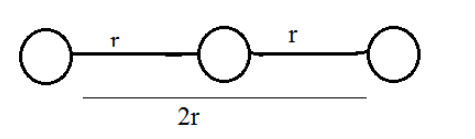
Net U= potential energy due to -q and Q + potential energy due to Q and - q + potential energy due to -q and -q
${U_{net}} = K\left( {\dfrac{{ - qQ}}{r}} \right) + K\left( {\dfrac{{ - qQ}}{r}} \right) + K\left( {\dfrac{{ - {q^2}}}{{2r}}} \right)$
According to the question, the net potential energy of the combination is zero. So,
$
{U_{net}} = 0 \\
\Rightarrow K\left( {\dfrac{{ - qQ}}{r}} \right) + K\left( {\dfrac{{ - qQ}}{r}} \right) + K\left( {\dfrac{{ - {q^2}}}{{2r}}} \right) = 0 \\
\Rightarrow\dfrac{{Kq}}{r}\left( { - Q - Q + \dfrac{q}{2}} \right) = 0 \\
\Rightarrow - 2Q + \dfrac{q}{2} = 0 \\
\Rightarrow - 2Q = - \dfrac{q}{2} \\
\therefore\dfrac{Q}{q} = \dfrac{1}{4} \\
$
Hence, the ratio of the charge Q and q is 1:4.
Hence,option D is correct.
Note:Don’t forget to write the sign of the charge with its magnitude. The electric potential energy of a system of point charges is defined as the work required assembling the system of charges by bringing them close together, as in the system from an infinite distance.
Complete step by step answer:
The potential energy between the charged particles is given as,
$U = K\dfrac{{{Q_1}{Q_2}}}{d}$ where, $K = \dfrac{1}{{4\pi {\varepsilon _0}}}$.
The following figure depicts the pictorial representation of the placement of the charged particles.
Net U= potential energy due to -q and Q + potential energy due to Q and - q + potential energy due to -q and -q
${U_{net}} = K\left( {\dfrac{{ - qQ}}{r}} \right) + K\left( {\dfrac{{ - qQ}}{r}} \right) + K\left( {\dfrac{{ - {q^2}}}{{2r}}} \right)$
According to the question, the net potential energy of the combination is zero. So,
$
{U_{net}} = 0 \\
\Rightarrow K\left( {\dfrac{{ - qQ}}{r}} \right) + K\left( {\dfrac{{ - qQ}}{r}} \right) + K\left( {\dfrac{{ - {q^2}}}{{2r}}} \right) = 0 \\
\Rightarrow\dfrac{{Kq}}{r}\left( { - Q - Q + \dfrac{q}{2}} \right) = 0 \\
\Rightarrow - 2Q + \dfrac{q}{2} = 0 \\
\Rightarrow - 2Q = - \dfrac{q}{2} \\
\therefore\dfrac{Q}{q} = \dfrac{1}{4} \\
$
Hence, the ratio of the charge Q and q is 1:4.
Hence,option D is correct.
Note:Don’t forget to write the sign of the charge with its magnitude. The electric potential energy of a system of point charges is defined as the work required assembling the system of charges by bringing them close together, as in the system from an infinite distance.
Recently Updated Pages
Basicity of sulphurous acid and sulphuric acid are

Master Class 12 English: Engaging Questions & Answers for Success
Master Class 12 Social Science: Engaging Questions & Answers for Success
Master Class 12 Maths: Engaging Questions & Answers for Success
Master Class 12 Economics: Engaging Questions & Answers for Success
Master Class 12 Physics: Engaging Questions & Answers for Success
Trending doubts
Which are the Top 10 Largest Countries of the World?
Draw a labelled sketch of the human eye class 12 physics CBSE
Draw ray diagrams each showing i myopic eye and ii class 12 physics CBSE
Giving reasons state the signs positive or negative class 12 physics CBSE
Explain esterification reaction with the help of a class 12 chemistry CBSE
What is defined as a solenoid Depict a diagram with class 12 physics CBSE