




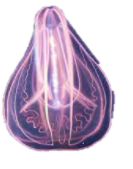
This is an image of comb jelly. What is the common name of it?
A) Sea walnut
B) Sea gooseberries
C) Venus’s girdle
D) Thimble comb jelly
Answer
 Verified
559.2k+ views
Hint: Comb jelly belong to the phylum Ctenophore which is derived from the Greek word which means to carry comb. The combs are the group of cilia that is used for locomotion. The comb jellies are invertebrates and live in marine habitats. They are the largest animal to swim in using cilia. These organisms show bioluminescence.
Complete answer:
Comb jelly is the marine predator which prey on microscopic larvae, rotifers, crustaceans. The size ranges from few millimetres to around 5 feet. The comb jelly shown in the figure is called thimble comb jelly. These organisms have an egg-shaped body and have a pair of retractable tentacles which have tentilla and are covered with colloblasts. The colloblasts are the sticky cells that these organisms use to capture prey. The body of these organisms is a mass of jelly and has a bilayer outside and another in the internal cavity. The organisms which prey on ctenophores are large-mouthed beroids and combless platyctenids. These organisms have a nervous system, muscles and other sensory organs. They are commonly known as Thimble comb jelly.
- Sea walnut: They are spherical, oval and small but lack tentacles. The body is made up of folds that resemble a walnut.
- Sea gooseberries: It is a spherical or oval-shaped organism that has long tentacles to catch prey that can be retracted.
- Venus’s girdle: It is the comb jelly that looks like a ribbon. They can be a metre long as well.
Thus, the correct answer is option ‘D’.
Note: This organism is colourless and transparent that live near the surface of the water. The ones that live deeper in the water have pigments and also show characteristic bioluminescence emitting blue and green colour which is only visible in dark. Some reflect the light through their comb and create the rainbow effect.
Complete answer:
Comb jelly is the marine predator which prey on microscopic larvae, rotifers, crustaceans. The size ranges from few millimetres to around 5 feet. The comb jelly shown in the figure is called thimble comb jelly. These organisms have an egg-shaped body and have a pair of retractable tentacles which have tentilla and are covered with colloblasts. The colloblasts are the sticky cells that these organisms use to capture prey. The body of these organisms is a mass of jelly and has a bilayer outside and another in the internal cavity. The organisms which prey on ctenophores are large-mouthed beroids and combless platyctenids. These organisms have a nervous system, muscles and other sensory organs. They are commonly known as Thimble comb jelly.
- Sea walnut: They are spherical, oval and small but lack tentacles. The body is made up of folds that resemble a walnut.
- Sea gooseberries: It is a spherical or oval-shaped organism that has long tentacles to catch prey that can be retracted.
- Venus’s girdle: It is the comb jelly that looks like a ribbon. They can be a metre long as well.
Thus, the correct answer is option ‘D’.
Note: This organism is colourless and transparent that live near the surface of the water. The ones that live deeper in the water have pigments and also show characteristic bioluminescence emitting blue and green colour which is only visible in dark. Some reflect the light through their comb and create the rainbow effect.
Recently Updated Pages
Master Class 11 Social Science: Engaging Questions & Answers for Success

Master Class 11 English: Engaging Questions & Answers for Success
Master Class 11 Accountancy: Engaging Questions & Answers for Success
Master Class 11 Physics: Engaging Questions & Answers for Success
Master Class 11 Computer Science: Engaging Questions & Answers for Success
Master Class 11 Business Studies: Engaging Questions & Answers for Success
Trending doubts
One Metric ton is equal to kg A 10000 B 1000 C 100 class 11 physics CBSE
Find the value of the expression given below sin 30circ class 11 maths CBSE
Draw a diagram of nephron and explain its structur class 11 biology CBSE
10 examples of friction in our daily life
Proton was discovered by A Thomson B Rutherford C Chadwick class 11 chemistry CBSE
The teeth used for biting and cutting food are called class 11 biology CBSE